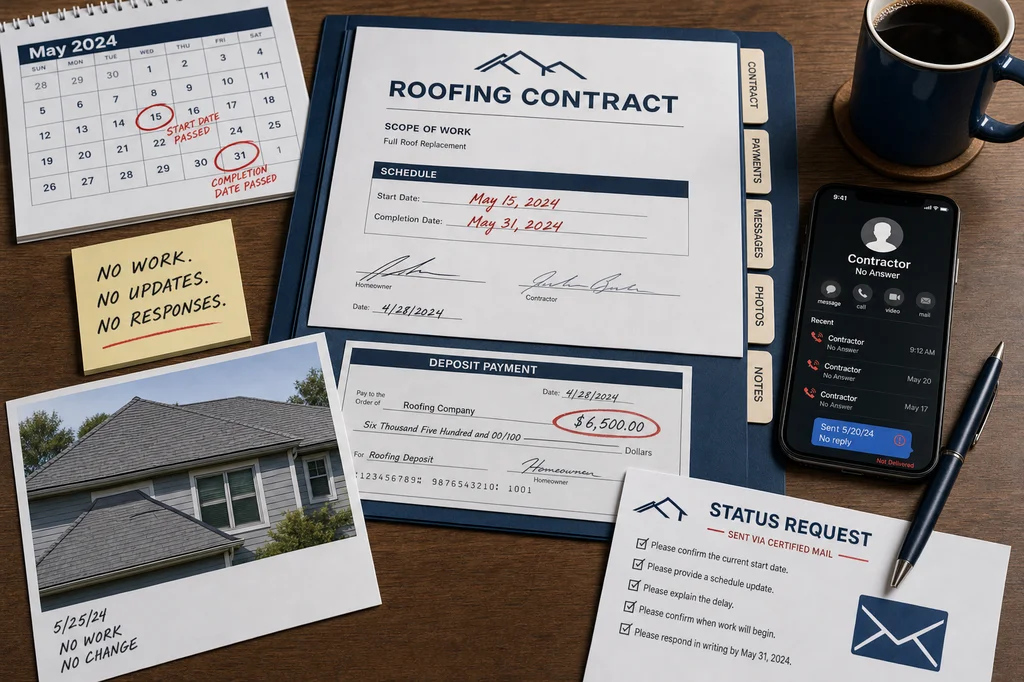
The Zeno Construction case in Fort Worth is a warning against waiting indefinitely after paying a roofing or renovation deposit. Missing contract dates, shifting explanations, unanswered calls, and no visible progress can signal a project that needs prompt, documented escalation rather than more patience.
What the Fort Worth Zeno Construction case involved
Jeremy Gerard Zeno pleaded guilty in Tarrant County to theft of property totaling more than $300,000 and received a 30-year prison sentence. Prosecutors focused on five victims in that sentencing, while saying other cases remained under investigation.
The reported pattern was not simply a late project. Victims described excuses, different aliases, and ghosting after checks were collected. One homeowner reportedly paid $40,000 for a barndominium renovation that barely began before communication stopped. Another reported losing $35,000 on an unfinished build, and a foundation company said it was not paid for work it completed.
That distinction matters. A contractor can fall behind because of weather, materials, labor, or an overloaded schedule. But a homeowner should not treat a prolonged lack of work and lack of communication as ordinary delay. The practical issue is whether the contractor is giving you a clear, supportable path to completion and following it.
Why missing dates make a deposit harder to track
A contract without a usable project schedule leaves you with no shared checkpoint for measuring delay. A written start date, completion target, and any conditions that may move those dates turn vague assurances into something you can compare against actual events.
Minnesota requirements may apply to certain contracts involving start and finish dates, but contract rules differ by state and contract type. Do not assume that missing dates automatically cancel your agreement or guarantee a refund. Instead, treat the omission as a reason to slow down before paying and have an attorney review a contract if the stakes are high.
For a roof project, the schedule should make room for real constraints. A major storm can overload local crews, and some materials or multi-trade projects can take longer than a straightforward roof replacement. What should not be unclear is whether the contractor disclosed the expected wait before taking your money and whether you have a written update when that plan changes.
- Start trigger: State whether work begins on a calendar date, after permit approval, after materials arrive, or after an insurance decision.
- Completion target: Give a realistic target and identify what can reasonably delay it.
- Payment stages: Tie each payment to a defined milestone rather than an open-ended promise to start later.
- Change process: Require schedule changes and added work to be documented in writing.
Spot the Zeno Construction-style deposit warning pattern
The most concerning pattern is not one rescheduled appointment. It is a growing gap between what you paid, what the contractor promised, and what can be verified at your property.
Repeated explanations can be legitimate when they come with a specific revised plan, a reachable contact, and visible progress. They become more serious when each contact produces a new excuse but no dates, materials, crews, permits, or completed work. Ghosting after payment is especially important because it prevents you from confirming whether the project is delayed, abandoned, or being handled by someone else.
Keep a dated file from the first payment forward. Save the signed contract, payment receipts, canceled checks or card records, texts, emails, voicemails, photos of site conditions, and every promised date. This does not decide whether a dispute is civil or criminal; that determination belongs to the appropriate authorities. It does give you a clean record if you need to seek help.
What to say when the roof project is not moving
Ask for a written status update that requires a concrete answer, not another verbal assurance. Give the contractor one organized request covering the project status, funds, materials, and next scheduled action.
- “Please confirm the date work will begin and the expected completion date.”
- “Please identify which materials have been ordered, where they are stored, and when they will be delivered.”
- “Please provide an itemized accounting of the deposit and the work completed to date.”
- “If the schedule has changed, please send the revised scope and schedule in writing.”
Send the request through the communication methods listed in your contract and retain proof that it was sent. If there is an active leak or other condition that could worsen, focus separately on protecting the home through a qualified roofing professional. A delayed contractor should not leave you guessing while damage continues.
Escalate a stalled deposit before more money changes hands
Escalation is appropriate when deadlines pass without a documented update, the contractor stops responding, or the project shows little or no progress despite substantial payment. Do not send additional money just to obtain another promise of a start date.
First, review the contract’s notice, cancellation, dispute, and payment terms. Then consider contacting the contractor in writing, your payment provider or bank where applicable, your state consumer-protection office, and local law enforcement if you believe theft may have occurred. Insurance coverage, payment disputes, and potential legal remedies depend on your policy, contract, and state, so confirm options with counsel or your state insurance department rather than relying on a roofer’s opinion.
Choosing a contractor with a clear scope and accountable communication reduces the chance that a deposit becomes an open-ended problem. Directorii lists verified contractors.
Use a smaller deposit risk before the project begins
One contractor’s personal approach was to limit the initial payment to no more than one-third, with another portion due at the start of work. That is a business-owner opinion, not a universal rule or a legal payment standard.
For your project, the useful takeaway is to understand exactly what each payment buys. If a contractor requests a large upfront amount, ask what materials, permits, labor scheduling, or other defined obligations it covers. Compare that answer with the written scope and schedule before signing or paying.
Source: Roofing Insights on the Zeno Construction case
FAQ
What happened in the Zeno Construction case in Fort Worth?
Jeremy Gerard Zeno pleaded guilty in Tarrant County to theft of property totaling more than $300,000 and was sentenced to 30 years in prison. Prosecutors focused on five victims for that sentencing and said additional cases were still under investigation. Reported complaints included collected checks, unfinished work, excuses, aliases, and ghosting.
When should I worry that a roofing deposit is not being used for my project?
You should worry when promised dates pass, there is no written revised schedule, and you cannot verify materials, crews, permits, or completed work. A delay can happen for legitimate reasons, especially after storms, but a contractor should still provide a reachable contact and a specific plan. Keep records before making any additional payment.
Should my roofing contract include a start and completion date?
Yes, your contract should identify how and when the project is expected to start and finish, plus conditions that can change those dates. Dates give you a way to measure a delay instead of relying on vague promises. Whether missing dates affect enforceability depends on your contract and state, so confirm that question with local counsel.
What should I ask a contractor who keeps delaying my roof work?
Ask for a written start date, expected completion date, material status, and an accounting of your deposit and completed work. Request a revised scope and schedule if circumstances have changed. Save the request and the response with your contract, receipts, messages, and photos so you have a dated record of what was promised.
Can I report a contractor who takes a deposit and stops responding?
You can consider reporting the situation to the appropriate consumer-protection office or local law enforcement, particularly if you believe theft may have occurred. Whether a matter is treated as a contract dispute or a criminal case depends on the facts and local law. Review your contract and seek legal guidance for advice specific to your situation.