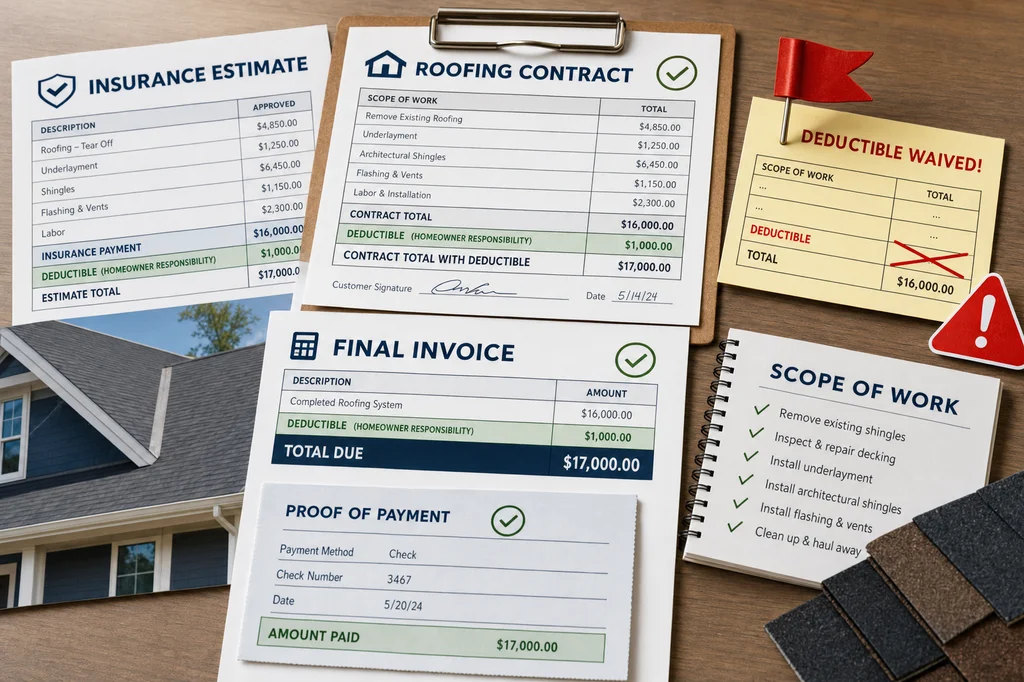
When a roofer says they can waive, cover, or “eat” your insurance deductible—or promises a free roof—treat it as a major warning sign. Your deductible is part of your insurance policy, and the contract, invoice, scope of work, and proof of payment should reflect the real transaction.
In many states, rebating or hiding a deductible in the numbers can be illegal and may cross into insurance fraud. Rules and policy terms vary, so contact your insurer, state insurance department, or qualified legal counsel if an arrangement is unclear.
1. The contractor starts by hiding numbers or bending rules
A deductible offer can signal trouble before work begins when it depends on concealing the deductible or sending inaccurate information to the insurer. If a contractor is willing to play games with claim paperwork at the start, homeowners have reason to question whether the company will handle the rest of the job honestly.
A trustworthy arrangement does not require a side agreement that conflicts with the paperwork. The deductible, payments, and work performed should be documented accurately.
2. The deductible pitch replaces an explanation of value
Not paying a deductible can sound appealing, especially when a homeowner is focused on out-of-pocket cost. But the offer is not a substitute for a contractor explaining how the roof will be done.
A contractor should be able to explain its process, workmanship, materials, warranty, reputation, and why the work should be done correctly. A company that relies mainly on “you do not have to pay your deductible” is selling a shortcut rather than helping you evaluate the roof work.
3. The missing money has to come from somewhere
A deductible does not simply disappear. If a contractor absorbs it to win the job, the cost may show up elsewhere: cheaper materials, rushed or unpaid labor, reduced overhead, or parts of the work not being done correctly.
The more serious risk is inaccurate claim billing. A contractor may inflate an estimate, add questionable supplements, or bill for work that was not performed. Require a clear written scope and a written explanation for any difference between the contractor’s scope and the insurer-approved scope. Do not agree to billing for work you do not understand or do not expect to receive.
4. Inaccurate paperwork can pull the homeowner into the problem
It is not always only the contractor’s problem when false information reaches an insurer. Trouble can arise if the final invoice does not reflect the real payment or if the contractor says a deductible was paid when it was not.
An insurer may request proof that the deductible was paid. When payment records and invoices do not add up, the result can be delays, disputes, or larger problems than the deductible itself. Keep the paperwork clean, transparent, and consistent from the contract through the final invoice.
- Review the written contract before signing.
- Keep proof of every payment.
- Compare the final invoice with the work actually completed.
- Request written documentation for scope changes and supplements.
5. A company giving away profit may not be available later
Roofing companies have material, labor, insurance, licensing, vehicle, supervision, office, and warranty-service costs. A company that constantly absorbs deductibles to win jobs may be operating with thin margins, poor cash flow, or an unsustainable business model.
That matters after installation. If you later have a leak, workmanship problem, or warranty issue, a contractor that has closed or cannot meet its obligations may be difficult to reach. A manufacturer may treat an installation problem as the contractor’s responsibility rather than a product issue.
What to request instead of a deductible workaround
If you cannot pay the deductible at once, ask whether the contractor offers legitimate financing or a payment plan. Do not accept a hidden-deductible arrangement in place of clear terms.
Before choosing a roofer, get a clear contract, a properly documented scope of work, and records that accurately show the deductible and every payment. The deductible offer is not a favor when the numbers must be hidden to make it work.
Source: 5 Red Flags When Roofers “Waive” Your Deductible
FAQ
Why is a roofer offering to waive my deductible a red flag?
A deductible is part of your insurance policy. When an offer depends on hiding the deductible, altering numbers, or claiming it was paid when it was not, the paperwork may no longer reflect the real transaction. In many states, rebating or concealing a deductible can be illegal.
What records should show my deductible and payments?
The written contract, final invoice, and proof of payment should tell a consistent story about the price, work performed, deductible, and payments. Keep records of payments and written documentation for changes to the scope.
What should a roofer explain besides the deductible?
A contractor should explain its process, workmanship, materials, warranty, reputation, and why the roof work should be done correctly. A deductible promise is not a substitute for a clear explanation of the job.
How should supplements or differences in scope be handled?
Require a clear written scope and a written explanation for any difference between the contractor’s scope and the insurer-approved scope. The contractor should document added work rather than rely on vague verbal assurances.
What if I cannot pay my deductible all at once?
Ask whether the contractor offers legitimate financing or a payment plan. Avoid arrangements that hide the deductible or create paperwork that does not match what you actually paid.