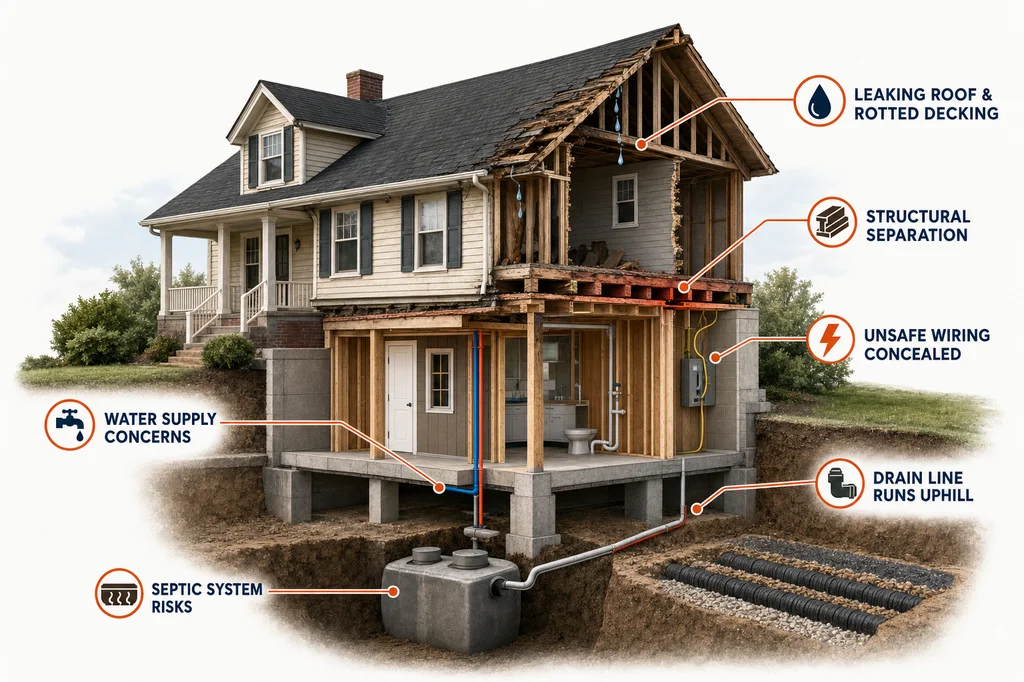
Buying a house with unpermitted additions can mean buying risks that a quick walkthrough cannot reveal. One moved-house sale near Lake Cavanaugh, Washington, shows why an as-is agreement does not replace careful buyer due diligence.
A 1930s house placed over an owner-built lower level
Larry Thompson bought land near Lake Cavanaugh, Washington, moved a 1930s home onto it, and placed the house over a new first floor he built himself without permits. In 1994, Greg and Ela Sloan bought the property after a quick walkthrough with no inspection. The sale was as-is, and they did not know Thompson had done the construction.
The property was not simply an older home. It combined a relocated structure with a newer lower level, along with plumbing, wiring, water, and septic systems that had to function together. That construction history was the central issue buyers needed to understand before purchase.
The defects that did not show up in a quick walkthrough
After moving in, the Sloans encountered a leaking roof, rotted decking, toilets that did not flush, and water that made them sick. Following an earthquake in 2000, the house began pulling apart.
When walls were opened, structural engineers identified major foundation and framing problems. Other reported issues included pipes running uphill, unsafe wiring concealed behind walls, a nonfunctioning septic system, and rot throughout the framing.
Those facts illustrate the limits of a visual visit. Roof leaks, rotted decking, plumbing failures, unclear water conditions, and separation in the structure are not cosmetic details when they appear alongside an unusual building history.
Due diligence triggered by a moved house or added level
The following are general buyer due-diligence steps, not facts established for every property with altered or unpermitted work. Their purpose is to identify questions that a basic walkthrough may leave unanswered.
- Document the alteration. Ask what was moved, added, rebuilt, or converted, and when the work occurred.
- Request available permit and construction records. For a relocated home or added level, records may help clarify the history of foundation, structural, utility, water, and septic work.
- Match inspections to visible conditions. A leaking roof or rotted deck calls for a closer review of roofing, decking, and water entry. Plumbing that does not drain or flush normally calls for a plumbing evaluation.
- Investigate water and septic questions before closing. Where the water source is unclear or the septic system does not function, obtain appropriate local review and testing rather than treating the issue as a minor repair.
- Consider structural review when the home has moved or separated. A structural professional can evaluate accessible signs of movement, framing concerns, and the connection between an older house and its supporting structure.
How an as-is term fits into the decision
An as-is sale describes the condition in which the buyer agrees to purchase the property; it is not a substitute for learning what has been built, altered, or concealed behind finished surfaces. Whether contract language affects a dispute depends on the facts and local law.
The account of the later litigation contains conflicting descriptions of appellate rulings. For that reason, this sale should not be treated as a definitive fraud or as-is precedent. If significant defects or missing construction records emerge, a real-estate attorney can explain the contract and local legal considerations.
When roofing and exterior decay change the scope
In this property, the roof leaked and the decking was rotted before the broader construction problems came to light. Water entry and decayed exterior materials can point to work beyond a surface repair, particularly when a house has been relocated or substantially altered.
For roof leaks, rotted decking, or exterior water-entry concerns, arrange an evaluation that addresses the affected roofing and exterior assembly. Directorii lists verified contractors.
Source: Engineer SHOCKED: “This Is the Worst Home I’ve Ever Inspected”
FAQ
Should I skip an inspection on an as-is house?
An as-is term does not replace buyer due diligence. In the Lake Cavanaugh sale, the buyers had a quick walkthrough and no inspection before later finding roof, plumbing, water, wiring, septic, framing, and foundation problems.
What makes a moved house different from a typical older home?
A moved house may combine an older structure with a newer foundation or lower level, plus altered utilities and site systems. That history can justify focused questions about how the house, framing, plumbing, water, and septic components were installed and connected.
Can a walkthrough reveal framing problems behind finished walls?
Not always. In this sale, the reported framing and foundation concerns became apparent after walls were opened. Visible separation, leaks, rot, or an unusual construction history are reasons to consider whether further evaluation is needed.
What should I investigate if the roof leaks and decking is rotted?
Treat leaks and rot as conditions that need a fuller review of the roofing, decking, and water-entry areas. In the reported property, those problems appeared along with failures in other building systems.
What should I do if a home's water source or septic system is unclear?
Resolve the question before closing through appropriate local review and testing. The reported property had water that made the buyers sick and a septic system that did not work, making both systems central to the purchase risk.