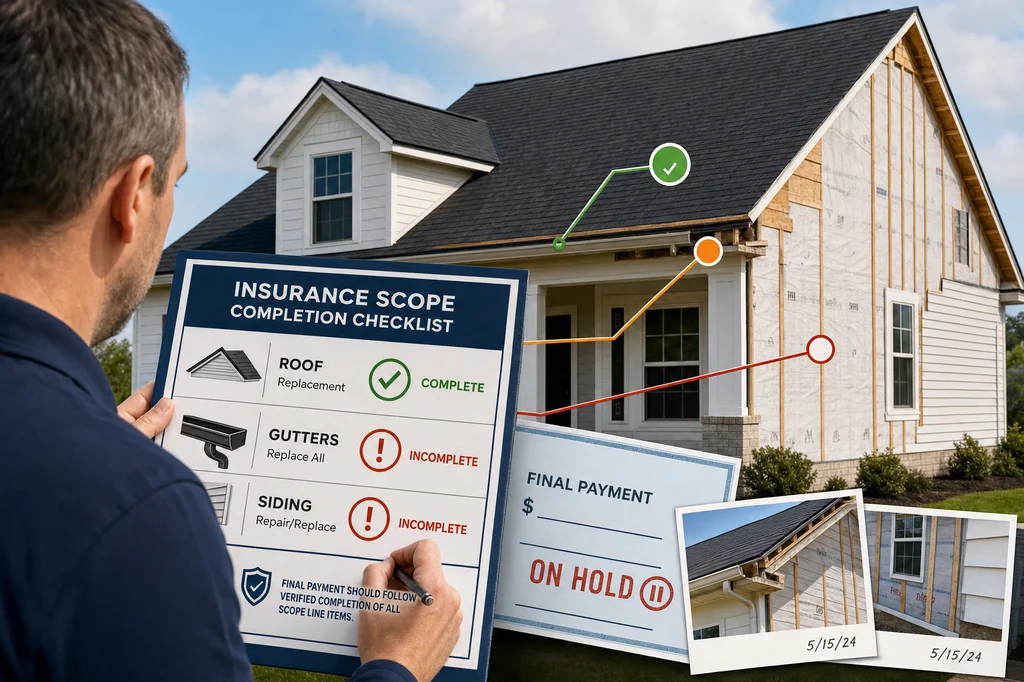
An unfinished claim involving Evolve Construction and Bulldog Adjusting shows why you should match every paid line item to completed work before final insurance funds are released. A roof may be installed while insured siding, gutters, or other repairs remain undone, leaving you to sort out the remaining money and scope.
Start with the insurer’s complete scope, not the roof invoice
Your insurance estimate is the working map for the entire repair, not just the most visible project. Compare it line by line with what has actually been installed, repaired, removed, or replaced.
In the reported Indiana claim, the homeowner said the insurance scope included roof work, gutters, siding on one side of the home, and other items. The homeowner reported that only the roof and a dump trailer were completed, while other listed work was not. A contractor receipt reportedly separated items that were done from items that were not done, creating confusion about the amount still owed or available for remaining repairs.
Do not treat a contractor’s internal invoice as proof that the whole claim is complete. It may describe only that contractor’s portion of the work. Your decision should be based on the insurer’s scope, your signed contract, change orders, payment records, and the condition of the property.
- Insurance scope: Mark each item as complete, incomplete, replaced by another repair, or not yet addressed.
- Contractor agreement: Identify exactly which scope items that company agreed to perform and which work it said would be assigned elsewhere.
- Receipts and invoices: Check that descriptions, quantities, and totals match completed work.
- Photos and messages: Keep dated records of unfinished siding, gutters, debris, damaged areas, and communications about scheduling or payment.
- Payment trail: Record each insurance payment, who received it, and whether it was an initial or final payment.
Do not sign a whole-claim completion form for partial work
A completion form can affect how remaining claim money is handled, so its wording matters. If only the roof is finished, a form stating that all work on the claim is complete may not reflect the condition of your home.
The homeowner reported being asked to sign a document stating that all work had been completed, even though the gutters and siding were still unfinished. The homeowner declined and requested a roof-only confirmation instead. That is the key distinction: confirm only work you can verify was completed, and do not rely on a verbal assurance that the form applies to a smaller portion of the project.
Before signing any completion statement, read whether it refers to a specific trade, a particular invoice, or the entire insurance claim. If the language is unclear, pause. Ask the insurer what the form will authorize and consult a qualified attorney or public adjuster if you need advice about a contract, release, or disputed funds.
How a public adjuster can change your communication path
A public adjuster may assist with a claim, but the agreement can change who communicates with the insurer. Understand that arrangement before you sign and keep a copy of every authorization and fee term.
The homeowner reported that a contractor representative said a public adjuster was required in Indiana. The homeowner later reported being told by the insurer to communicate through Bulldog Adjusting after that arrangement was in place. The homeowner also said the public-adjuster contract stated that the public-adjuster cost would be absorbed by Evolve Construction, while Bulldog Adjusting later retained a portion of claim funds.
That does not establish what every public-adjuster agreement requires. It does show why you should read the authorization closely before allowing anyone to represent you. Know whether you can still speak directly with your insurer, who may receive claim checks, how fees are calculated, and how to end the relationship if communication breaks down. These terms can depend on the contract and state rules.
What to document when the work stalls
Missed appointments and material sitting at the property are not proof of the final outcome, but they are events worth documenting. A detailed record makes it easier to explain the problem clearly to the insurer, an insurance regulator, counsel, or a replacement contractor.
The homeowner reported three scheduled roof appointments that did not occur, followed by a roof installation after complaints were filed with the Indiana Department of Insurance and the Indiana Attorney General. The homeowner also reported collecting a substantial amount of nails from the driveway and front lawn after installation. If debris, exposed damage, or incomplete work remains, record it promptly from the ground and arrange for a professional to assess the roof rather than attempting to inspect it yourself.
- Save the original insurance estimate and every revised estimate.
- Download app messages, emails, texts, call logs, and notices about claim payments.
- Photograph incomplete exterior work and cleanup concerns from safe ground-level locations.
- Write down missed dates, arrivals, work performed, and names or companies involved.
- Send factual written notice identifying the unfinished scope item, rather than relying only on phone calls.
Keep payment decisions tied to completed work
Claim money should not become detached from the work it was intended to fund. Before releasing final funds or approving a final draw, compare the scope, invoices, and completion status one more time.
In this reported claim, the homeowner said an initial insurance check of roughly $19,000 was collected before the roof, gutters, and siding work was complete. The homeowner later reported that a further payment was sent in connection with closing the claim, then that Bulldog Adjusting sent the homeowner $11,600 after the homeowner repeatedly objected to further funds going to Evolve Construction. The homeowner estimated that work valued at roughly $13,000 had been completed from a claim described as about $38,000.
The practical lesson is not to assume a claim closure notice means all repairs are physically complete. Notify the insurer in writing if the scope remains unfinished. State the specific line items that remain, attach your supporting records, and ask what documentation it needs to review the status. Coverage and payment handling depend on your policy and claim file.
Questions to resolve before hiring a replacement roofer or exterior contractor
A replacement company needs a clean, written starting point. It should know what is complete, what remains damaged, what materials are already on site, and whether any claim funds remain available.
- Which insurer scope items remain incomplete, and are any items disputed?
- Has the original contractor been released from the remaining work in writing?
- What funds have been paid, returned, held, or sent to another party?
- Does the replacement estimate separate roof, siding, gutter, and cleanup work?
- What existing work needs evaluation before new siding or gutters are installed?
Get a written scope from the replacement contractor that identifies only the work it will perform. Directorii lists verified contractors.
For allegations of incomplete work, payment disputes, or a disputed release, keep your communications factual and preserve the documents. A lawyer can advise on contract and payment disputes; your state insurance department can explain its complaint process and public-adjuster oversight.
Source: Homeowner claim account involving Evolve Construction and Bulldog Adjusting
FAQ
What should I compare when roof claim work is unfinished?
Compare the insurer’s full scope with your signed contract, invoices, payment records, photos, and the work actually completed. Mark every line item as complete or incomplete. A roof installation alone does not show that siding, gutters, cleanup, or other insured repairs have been completed.
Should I sign a completion form if only my roof is done?
You should sign only a form whose wording accurately describes completed work. If the form says the entire claim is complete while gutters, siding, or other repairs remain, pause and seek clarification. Ask the insurer how the form affects remaining claim funds and consult counsel if needed.
Can a public adjuster prevent me from talking to my insurer?
Your ability to communicate with the insurer can depend on the authorization and public-adjuster agreement you signed. Review those documents to see who is authorized to act for you and how communication is handled. If the arrangement is unclear, ask the insurer and obtain qualified advice before signing additional forms.
What records should I keep if Evolve Construction work is incomplete?
Keep the insurance estimate, contract, receipts, claim-payment notices, app messages, emails, texts, dated photos, and a timeline of scheduled and missed work. Preserve factual records of unfinished items and cleanup concerns. These documents help show what was included in the claim and what remains unresolved.
What if Bulldog Adjusting or another representative asks for final claim funds?
First determine whether the requested payment matches work that has been completed and documented. Review your public-adjuster agreement and notify the insurer in writing if material scope items remain unfinished. Payment handling depends on the policy and contracts, so seek legal or licensed professional advice for a dispute.
When should I hire another contractor for unfinished siding or gutters?
Hire a replacement contractor after you have documented the remaining scope and clarified whether the original contractor has been released from that work. Request a written estimate that separates the remaining repairs by trade and identifies any existing work that needs evaluation.