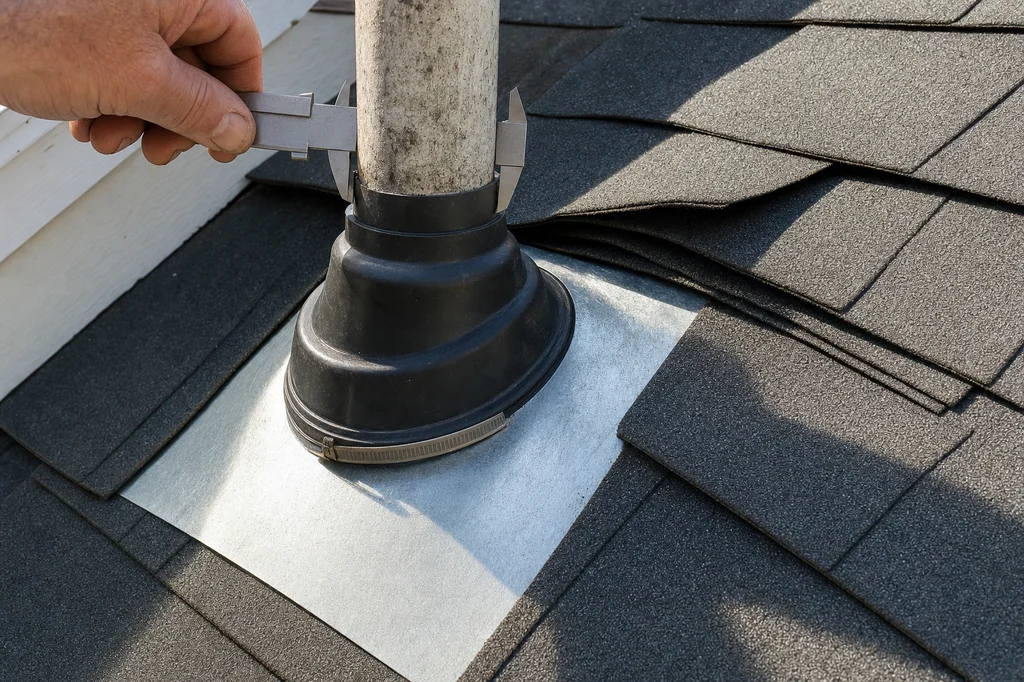
Lifetime Tool’s Ultimate Pipe Flashing is designed around a locking silicone boot and broad metal flashing, but it is not a one-size-fits-all reroof approval. Before work begins, verify the vent-stack material, outside diameter, roof pitch, and whether an accessory sleeve or pipe-elimination product is part of the proposed scope.
What the Ultimate Pipe Flashing is designed to do
The key feature is a silicone boot held in place by a PVC locking collar. Lifetime Tool describes that collar as preventing the boot from relaxing away from the pipe, including at the crimp where the boot meets the metal base.
The manufacturer describes the base as 24-gauge galvanized steel. It also states that the flashing extends four inches on each side of the pipe and six inches above it. Those dimensions matter because a pipe flashing is not merely a rubber collar: the surrounding metal has to integrate with the roof covering so water sheds around the penetration.
Lifetime Tool markets the product for use from dead level through a 20/12 pitch on smaller sizes, with markings to 18/12. Treat that as a product-fit claim, not a substitute for a roofer’s assessment of your roof details. A steep roof, unusual shingle layout, or crowded area around the vent can affect how the flashing is installed.
Check the vent stack before selecting a boot size
Confirm what is actually coming through your roof before approving a precision-fit pipe flashing. Newer-looking vent pipes and older plumbing can have very different outside diameters even when their nominal pipe size sounds similar.
Lifetime Tool says its Ultimate Pipe Flashing is designed to fit Schedule 40 PVC, ABS, and some galvanized iron pipe with the same outside diameter. That does not mean every older pipe will fit directly. Copper and cast-iron stacks may need a separate accessory rather than the base flashing alone.
- PVC or ABS: Confirm the pipe’s actual size and whether it is Schedule 40, since the flashing is described as a precision fit.
- Galvanized iron: Confirm its outside diameter rather than assuming all older iron is equivalent.
- Copper: Lifetime Tool shows an Easy Sleeve that fits over a two-inch copper pipe so a two-inch Ultimate flashing can be installed over the sleeve.
- Cast iron: The company shows a two-inch cast-iron pipe using a three-inch Easy Sleeve and then a three-inch Ultimate flashing. The larger sleeve accounts for the cast iron.
When an Easy Sleeve or Easy Fit should be in the written scope
Older vent stacks may need an adapter or a different solution, and that choice should be made before shingles are removed. Lifetime Tool presents Easy Sleeve accessories for copper and cast-iron situations where the standard flashing would not directly match the pipe.
The company also presents an Easy Fit product for certain old cast-iron plumbing conditions. Its stated approach is to cut the old pipe at deck level and drive the Easy Fit into the pipe; it offers three-inch and four-inch models. This is not a homeowner roof task.
Easy Fit is intended to eliminate the exposed iron section so rust does not continue running down the roof. Whether that approach is appropriate for your house depends on the vent arrangement. Have a qualified professional evaluate the plan before approving a pipe alteration.
How to read the wind-driven-rain claim
Lifetime Tool demonstrated its product in wind-driven rain at 110 miles per hour without a reported leak at the pipe or the boot-to-metal crimp. The company also reported testing five leading sellers and said the first three failed at 30 miles per hour, while other products reached 50 and 70 miles per hour.
That demonstration is useful because it focuses attention on common leak paths: the pipe-to-boot seal and the crimp between the boot and metal. It is not proof that every installed roof will perform identically in every storm. Installation, roof geometry, the condition of the vent pipe, and how the flashing is woven into the roof covering still matter.
Do not confuse a product demonstration with a blanket roof-system warranty. Lifetime Tool says it stands alongside the warranty system for the roof covering installed. Review the applicable flashing and roof-covering warranty information for your project.
Items to approve before the reroof starts
A clear estimate turns this specialty flashing from a sales feature into a verifiable part of the job. Get the product and the special conditions written down while the roof is still intact.
- Name the product: The proposal should state Ultimate Pipe Flashing, not only “new pipe boots.”
- List each vent stack: Note which ones are PVC, ABS, galvanized iron, copper, or cast iron.
- Identify accessories: If an Easy Sleeve or Easy Fit is needed, include its size and location in the scope.
- Confirm the flashing layout: The installer should account for the stated four-inch side coverage and six-inch top coverage as the flashing is integrated with the new roof.
- Separate plumbing changes from roofing work: If old pipe is being cut, covered, or otherwise altered, clarify who is responsible and whether another qualified pro is needed.
Choosing the wrong size or skipping the required accessory can leave a good flashing product mismatched to the pipe it is supposed to seal. Directorii lists verified contractors.
For the product demonstration and the accessories shown for copper and cast-iron stacks, see the Source: Lifetime Tool Ultimate Pipe Flashing demonstration.
FAQ
What should I verify before approving Lifetime Tool Ultimate Pipe Flashing?
Verify the material and actual outside diameter of every vent stack, the flashing size, roof pitch, and any needed accessory. The product is described as a precision fit for Schedule 40 PVC, ABS, and some galvanized iron, while older copper and cast iron may require a different setup.
Can Ultimate Pipe Flashing fit an older copper vent stack?
It may fit with an Easy Sleeve accessory rather than directly on the copper pipe. Lifetime Tool showed a two-inch Easy Sleeve installed over a two-inch copper pipe, followed by a two-inch Ultimate flashing. Have the installer confirm the actual pipe dimensions before ordering materials.
Why would a cast-iron vent stack need a larger sleeve?
Cast iron can require a larger accessory because its outside diameter differs from the pipe size used for the standard flashing. Lifetime Tool showed a two-inch cast-iron pipe paired with a three-inch Easy Sleeve and then a three-inch Ultimate flashing. Your stack should be measured before the reroof.
What does the locking silicone boot do?
Lifetime Tool describes its PVC locking collar as holding the silicone boot against the vent pipe so the boot does not relax away from it. The design also addresses the crimp where the boot meets the metal base, which is another area the company identified in its water testing.
Should the estimate list pipe flashing separately from new shingles?
Yes, the estimate should identify the specific flashing product and any sleeves or pipe-elimination accessories needed at individual vent stacks. A general line for pipe boots can hide an important compatibility issue, especially if your home has copper or cast-iron plumbing that needs a nonstandard solution.