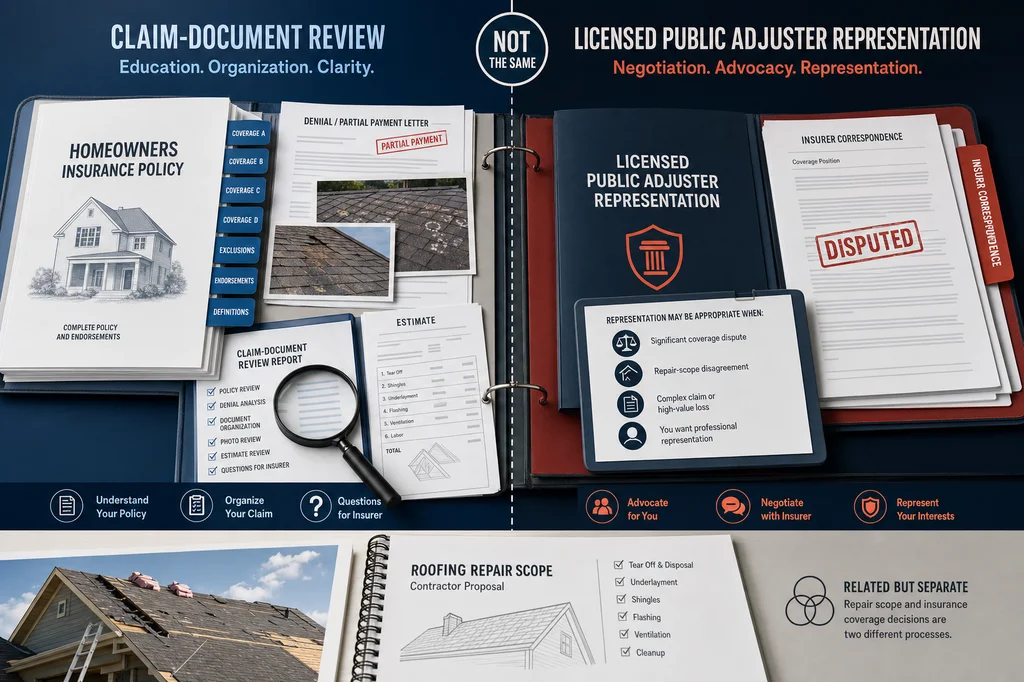
Tugboat's insurance-claim review is designed to help homeowners examine insurance claim documents and policy language without negotiating with the insurer. That can be useful after a denial or confusing estimate, but it is not the same service as representation by a licensed public adjuster or legal counsel.
Start with the entire insurance policy, not the denial page
A denial letter may cite only the provisions the insurer relied on. Your full policy can contain definitions, endorsements, exclusions, and other language that affects how the cited provision applies to your loss.
The practical point is simple: do not treat a short denial explanation as a complete map of your coverage. Gather the complete policy in force on the date of loss, including declarations, forms, endorsements, renewal documents, correspondence, photos, repair estimates, and the insurer's scope of loss if one was issued.
Reading the full policy does not guarantee that damage is covered. It gives you a better record to evaluate whether the insurer addressed the relevant provisions and facts. If policy wording is unclear or a coverage dispute is significant, confirm your options with a licensed insurance professional, public adjuster, or attorney as appropriate for your state.
What Tugboat says its claim-document review does
Tugboat says it reviews homeowners' claim documents and issues a report that the homeowner can use when communicating with an insurance company. Cameron Mooney, Tugboat's CEO, said the company educates homeowners and answers questions about their claims and options.
That type of review can be a useful organizing step when you need help understanding a denial letter, estimate, policy provision, or missing document. It may help you identify the questions that still need answers before you respond to an insurer.
However, document education has a clear boundary. Tugboat said it does not negotiate with insurance companies or give homeowners legal advice. A report may help you prepare for a conversation, but it does not replace someone authorized to represent you in a claim dispute.
When a small claim may be a fit for a review service
A claim-document review may make sense when the issue is limited and you mainly need help making sense of the paperwork. Tugboat said it is intended for homeowners whose claims may be too small to be handled by an adjuster.
- You received a denial or partial-payment explanation. A review can help you compare the insurer's stated reasoning with the full policy and your claim file.
- Your documents are scattered. A report may give you a clearer list of policy forms, estimates, correspondence, and photos to organize.
- You want to communicate more precisely. Understanding the terms and documents involved can help you ask focused questions rather than arguing from a contractor estimate alone.
- You are deciding whether the dispute needs escalation. A review can help reveal whether you need a different kind of licensed help.
Keep the goal narrow. This is a document-and-options service, not a promise that an insurer will change its decision, increase payment, or approve a claim.
When to move from review to a licensed public adjuster
If a claim needs negotiation or formal representation, a licensed public adjuster may be the more appropriate professional. Tugboat said it refers homeowners out when it believes an adjuster is necessary.
Consider whether your situation has moved beyond document explanation. A larger disagreement over the scope of repairs, a disputed cause of damage, competing interpretations of policy language, or ongoing communication that requires representation can call for licensed assistance. Public-adjuster licensing and permitted activities vary by state, so verify the person's current license and the terms of any agreement before hiring.
A roofing contractor can document visible damage and provide a repair scope, but should not be treated as the authority on insurance coverage or legal rights. Likewise, a claim reviewer should be clear about whether it is educating you, preparing documents, negotiating, or referring you elsewhere.
Questions to settle before paying for claim help
You should know exactly what service you are buying and who will handle the next step. Get the answer in writing before you share documents or sign an agreement.
- Will the service review my complete policy, including endorsements and definitions?
- What documents do you need from me, and what report or work product will I receive?
- Will anyone contact or negotiate with my insurer on my behalf?
- Are you providing education only, or are you acting under a state license?
- If my claim needs a licensed public adjuster, how will you tell me and what happens next?
- Does the agreement describe fees, cancellation terms, privacy practices, and any referral arrangement?
The wrong claim-help provider can cost you time when your roof repair still needs a clear, supportable scope. For the repair side of the decision, Directorii lists verified contractors.
Keep the claim file separate from the repair decision
Your insurance claim and your roofing contract are connected, but they are not the same decision. An insurer's estimate may not match a contractor's proposed scope, and a contractor's scope does not itself establish coverage.
Choose a roofer based on a written description of the work, materials, repairs, and payment terms. Then keep copies of that scope with your claim file so you can compare it with the insurer's documents. If the differences are substantial, get clarity on the claim path before committing to work that depends on a disputed payment.
Source: Roofing Report: Badger VS Tugboat
FAQ
What does a Tugboat claim review do?
Tugboat says it reviews claim documents and provides a report homeowners can use when communicating with their insurance company. It also says it educates homeowners and answers questions about claims and options. The service is presented as document review and education, not insurer negotiation or legal advice.
Should I read my whole insurance policy after a claim denial?
Yes, reviewing the complete policy can help you understand a denial beyond the provisions quoted in the denial letter. Definitions, endorsements, and other sections may be relevant to the issue. Reading the policy does not establish coverage, so seek licensed or legal guidance if the wording remains unclear.
Can Tugboat negotiate my insurance claim for me?
Tugboat said it does not negotiate with insurance companies for homeowners. Its stated role is to review documents, educate homeowners, and answer questions about claims and options. If you need negotiation or representation, ask whether a licensed public adjuster is appropriate in your state.
When should I consider a licensed public adjuster instead?
Consider a licensed public adjuster when the claim needs negotiation or representation rather than document explanation alone. Tugboat said it refers homeowners when it believes an adjuster is needed. Verify the adjuster's current license, allowed activities, and agreement terms because requirements vary by state.
Can my roofer tell me what my insurance policy covers?
A roofer can provide a repair estimate and document roof conditions, but should not be treated as the authority on policy coverage. Compare the contractor's written scope with the insurer's documents, then use a licensed insurance professional, public adjuster, or attorney for coverage questions when needed.