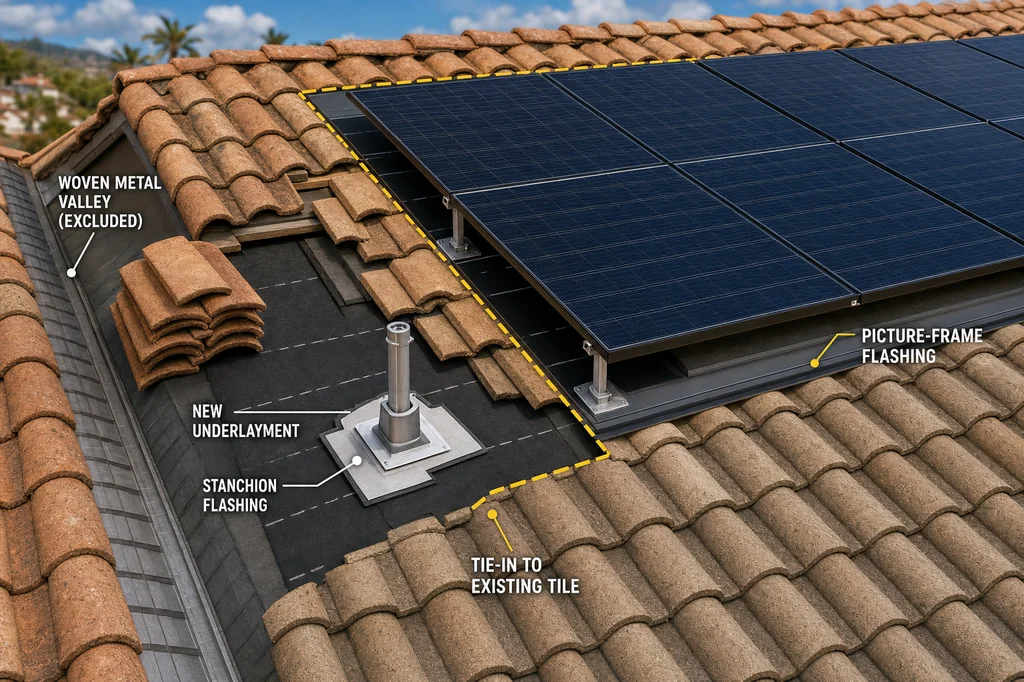
Before solar goes on a concrete tile roof, ask whether the scope includes lifting and reinstalling tile, installing new underlayment in the solar area, and flashing around panel stanchions. On the Zenith Roofing Services project shown, tiles were removed so new underlayment could be installed before the tiles were put back for solar.
Tile sheds water; the underlayment does the waterproofing
Concrete tile is a water-shedding product, not a waterproofing product. The tile protects the underlayment from UV rays and rain. When water gets behind tile, it can reach the flatter roof sections, wear the underlayment paper, and lead to a leak.
Brian Ramirez, owner of Zenith Roofing Services in San Diego, says underlayment commonly starts failing at about 20 to 30 years, even when the tile still looks good from the outside. He identifies two common causes when a tile roof leaks: flashing that was not installed to keep water on top of the tiles, or an older roof.
This makes the solar-area scope important. A proposal can identify the tiles to be removed and reset, the underlayment to be installed, and the detail planned around the solar supports rather than simply saying the roof is ready for panels.
Picture-frame flashing is one named solar option
Zenith Roofing Services describes an array picture frame as a common local practice around solar panels in San Diego. In that approach, shingles are used below the framed solar area.
Brian also names double flashing and a tile-adhesive approach with full composition shingles on the bottom as options around solar-panel legs. He notes that the methods have pros and cons, while picture framing with shingles below is common in the area.
For a bid, the useful detail is the named method and its location around the array. Ask the company to show whether it proposes a picture frame, double flashing, or another stated assembly around the panel stanchions.
A valley can be outside the solar scope
Solar work does not necessarily mean every nearby roof detail will be rebuilt. On the project shown, Zenith Roofing Services planned to tie into the existing roof rather than replace a woven metal valley. Brian said lifting that valley could “open up a can of worms,” while the solar company wanted work only in specified sections.
The planned tie-in included peel-and-stick material underneath and mastic. Zenith also planned maintenance in the remaining roof area, including replacing broken tiles and sealing vent pipes, because the homeowner said the rest of the roof had previously been lifted.
If an array is near a valley, the written scope can state whether the valley is included, where the new work ties into the existing roof, and which sections are limited to the solar installation.
Saved tile can be placed where it will be seen
Zenith planned to save usable tile from the back roof and use it in a more visible area near the front. New tile was planned for a less-visible area because it could differ in color or have a newer appearance without the algae seen on existing tile.
That is a practical scope detail for a tile-lift project: identify which existing tile will be saved and reset, where new tile will go, and how broken tile will be handled.
Age guidance from Zenith Roofing Services
Zenith Roofing Services gives company-specific guidance for a leaking tile roof: if the roof is about 15 years old, the company says it may receive a repair; if it is more than 30 years old, the company recommends replacement. This is Zenith’s guidance, not a universal rule for every tile roof.
Before approving solar-related roofing work, ask whether the proposal is limited to the solar sections or whether it recommends broader underlayment replacement. The answer should be clear in the scope, along with the tile-lift area, planned tie-in, saved-versus-new tile placement, and named flashing method.
Source: Zenith Roofing Services tile-roof and solar discussion
FAQ
Why does underlayment matter beneath a concrete tile roof?
Concrete tile sheds water and helps protect the underlayment from UV rays and rain, but it is not the waterproofing layer. Zenith Roofing Services says water that gets behind tile can wear the underlayment paper on flatter roof sections and lead to leaks.
What is picture-frame flashing for a solar array?
Zenith Roofing Services describes a picture frame as a flashed area around the solar array, with shingles used below it. The company also names double flashing and a tile-adhesive approach with full composition shingles on the bottom as other options around solar-panel legs.
What should a tile-roof solar scope identify?
It should identify the sections where tile will be lifted and reinstalled, whether new underlayment is included in the solar area, the flashing method around panel stanchions, and the planned tie-in to the existing roof. It can also state how broken, saved, and new tiles will be handled.
Should a nearby roof valley be included with solar work?
Not necessarily. On one Zenith Roofing Services project, the company limited work to sections requested for solar and did not lift a woven valley because doing so could expand the work. If solar is near a valley, ask whether it is included and where the new work will tie in.
Can new replacement tiles look different from existing tiles?
Yes. Zenith Roofing Services planned to reuse saved tiles in a more visible area and place new tiles in a less-visible area because newer tiles could differ in color and lack the algae appearance of the existing tiles.