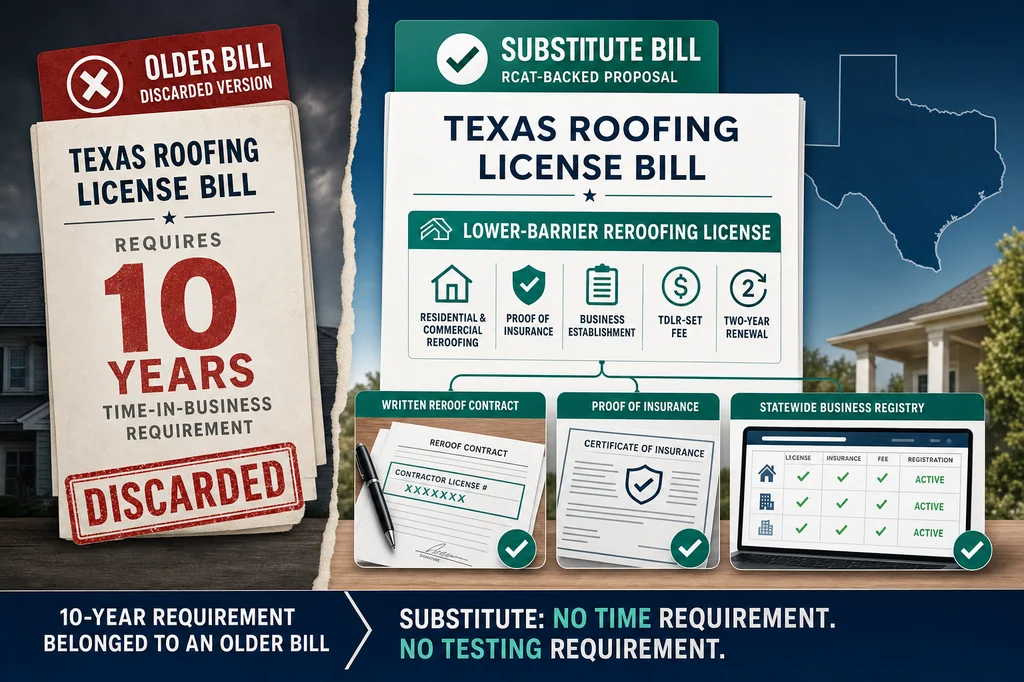
The Texas roofing license debate turned on a detail that was easy to miss: the 10-year time-in-business requirement belonged to an older bill version, not the substitute version backed by RCAT representatives. The substitute described a lower-barrier state license for residential and commercial reroofing, with consumer-facing contract and registry features.
The 10-year version was not the substitute bill
An earlier bill version required 10 years in business. RCAT representatives said that version was older, too restrictive, and discarded in favor of the substitute presented during the House committee hearing.
The substitute version described no years-in-business requirement. A new business could apply immediately if it met the stated minimum requirements. It also did not include a testing requirement.
That distinction matters when evaluating claims about Texas roofer license requirements. The proposal discussed in the video was not designed to keep new roofing businesses from entering the market through a 10-year experience rule.
What the substitute license would have required
Under the substitute version described, an applicant would need to establish a business with the county or state, provide proof of insurance, pay a fee set by the Texas Department of Licensing and Regulation (TDLR), register, and renew the license every two years.
The bill did not specify the fee or the required insurance amount. Those details were described as items TDLR would set rather than figures written into the bill.
The proposal focused on residential and commercial reroofing. RCAT representatives said the narrower scope was intended to address consumer risk in reroofing while avoiding barriers that had complicated earlier licensing efforts.
The homeowner-facing features: contract, insurance, and reporting
The substitute bill was described as requiring contractors to provide a written contract that included the contractor's license number and information on where to report an issue if something went wrong.
For a homeowner, the useful records would be:
- The contracting business name: Match a claimed credential to the business named in the written contract.
- The license number: If the proposed system or a contractor's claim supplies a number, keep it with the contract and make sure it identifies the same business.
- Proof of insurance: The proposed license process required insurance proof. Obtain the documentation rather than relying on a verbal assurance.
- Reporting information: The proposed contract would identify where to report an issue.
Keep the written contract and payment records. Those documents connect the business, the agreement, and the money paid if a problem later needs to be reported or addressed.
What the statewide database was meant to show
The substitute bill was also described as creating a statewide database to track reported issues. Consumers would be able to see whether a business was licensed, had supplied proof of insurance, paid its fee, and was registered with the Secretary of State.
This was presented as a way to give homeowners a single place to check basic business and licensing information. It was not described as a guarantee of workmanship or as a substitute for preserving the contract and insurance documents connected to a reroof job.
Why the proposal emphasized a reporting path
One concern raised in the debate was a contractor taking a roofing deposit and then ceasing communication. RCAT representatives said there was no tracking of how often such situations, or similar circumstances, occurred. They argued that a license number in the contract, insurance proof, and a reporting pathway would create more accountability than an arrangement with no statewide tracking.
The proposal discussed in the video should not be mistaken for a statement of current Texas licensing requirements. For questions about insurance coverage or legal options in a dispute, confirm the details with your insurer, counsel, or the appropriate state agency.
Directorii lists verified contractors.
Source: Texas Roofing License Debate: RCAT Answers the Critics
FAQ
Did the substitute Texas roofing license bill require 10 years in business?
No. RCAT representatives said the 10-year requirement appeared in an older bill version that was discarded. The substitute version described no time-in-business requirement.
Would the substitute proposal have required a roofing test?
No. The substitute version described no testing requirement. It called for an established business, proof of insurance, a fee set by TDLR, registration, and renewal every two years.
What information would the proposed reroof contract include?
The substitute bill was described as requiring a written contract with the contractor's license number and information about where to report an issue if something went wrong.
What would homeowners have been able to check in the proposed statewide database?
The database was described as a place where consumers could see whether a business was licensed, had supplied proof of insurance, paid its fee, and was registered with the Secretary of State. It was also intended to track reported issues.
Why did the proposal focus on reroofing instead of all roofing work?
RCAT representatives said the proposal focused on residential and commercial reroofing because they viewed it as a higher consumer-risk area. They also said broader coverage had created complications in earlier licensing efforts.