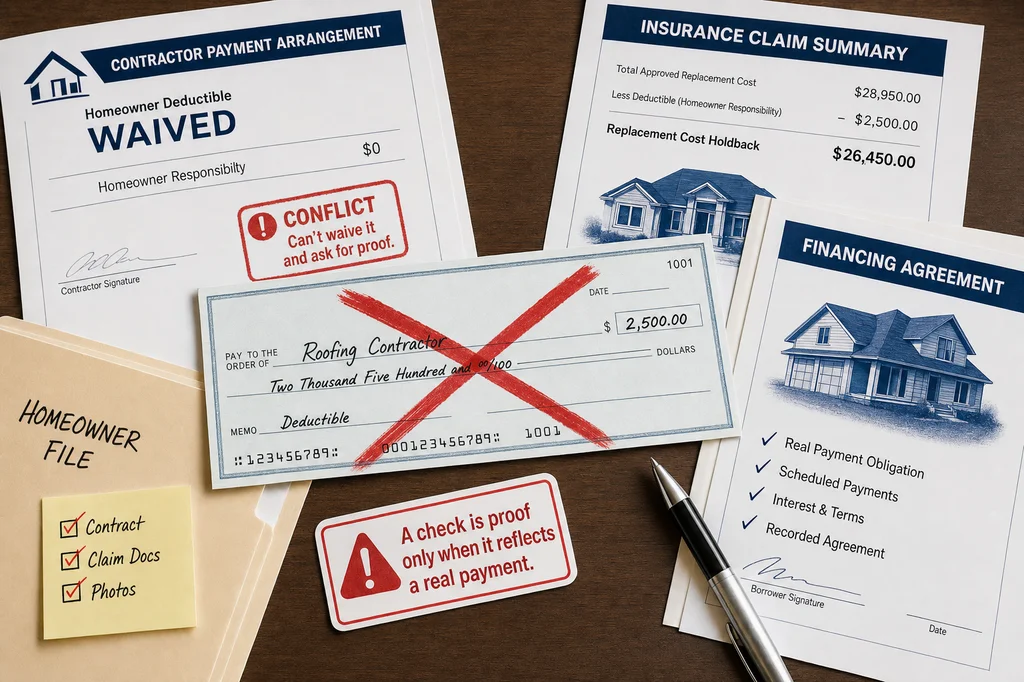
A Texas roof deductible check should represent a real payment. Do not write a check merely to create proof for withheld replacement-cost funds when the payment did not actually occur.
Insurance-industry attorney Steven Badger described a specific scenario: a homeowner is told the deductible will be waived, then later asked to write a check so it can be shown to the insurer. The homeowner is allegedly promised that the check will be torn up afterward.
Why a deductible check can affect withheld claim funds
Badger said that, under the Texas deductible statute he discussed, an insurance company does not have to pay replacement-cost-value holdback until reasonable proof shows that the deductible has been paid. He described a homeowner’s check as an example of that proof.
That creates a problem when a contractor has promised to absorb the deductible. If no deductible payment occurred, a check written only for submission to the insurer can make the paperwork appear different from the real transaction.
The check-and-tear-up allegation
Badger said he has received homeowner affidavits alleging that some contractors instructed homeowners to write a deductible check for submission to the insurer and promised to tear it up afterward.
Whether or not a check is ever deposited, do not create payment evidence for a payment that did not happen. A document submitted in connection with your claim should accurately reflect the arrangement you made.
- “Write the check and I’ll tear it up afterward.” Do not write a check simply to make it appear that you paid your deductible.
- A deductible waiver followed by a request for payment proof. Ask for the written arrangement to match the actual transaction.
- Pressure to submit documents you have not reviewed. Keep copies of documents connected to your claim and payment arrangement.
Financing is different from creating a fake payment record
Badger said a legitimate financing agreement is one way to provide reasonable proof of deductible payment under the Texas statute he discussed. He also mentioned Fund My Deductible as a company that partners with contractors.
A financing agreement is a real payment obligation, not a substitute for a check written only for appearance. Read the financing agreement before signing so you understand the obligation it creates.
Keep the payment story accurate
If you are paying the deductible by check, write the check only when it is an actual payment you intend to make. If financing is offered, obtain and review the complete financing agreement. Make sure the documents you provide in connection with the claim reflect what actually occurred.
Badger’s central warning is straightforward: homeowners should not be brought into an insurance-fraud scheme through a deductible arrangement that requires false proof of payment. Directorii lists verified contractors.
If you already wrote a check that was not a real payment
Keep the check, contract, messages, and any documents connected to the arrangement. Contact your insurer directly to ask what documentation it has received and what it needs for the claim. If you are unsure about a document or arrangement, consider speaking with a Texas attorney or another licensed professional.
Source: Who commits more Insurance fraud? Contractors or carriers? Steven Badger
FAQ
Should I write a deductible check if a roofer says it will be torn up?
No. Do not write a check merely to create proof of a deductible payment that did not occur. Badger said he has received homeowner affidavits alleging that contractors asked for checks to show insurers and promised to tear them up afterward.
Why would an insurer ask for Texas roof deductible proof of payment?
Badger said an insurer may withhold replacement-cost-value holdback until reasonable proof is provided that the deductible has been paid. He identified a homeowner check as an example of proof.
Can a financing agreement be used for a roof deductible?
Badger said a legitimate financing agreement can serve as reasonable proof of deductible payment under the Texas statute he discussed. Financing creates a real obligation, so review the complete agreement before signing.
What should I do if I already wrote a check that was not a real payment?
Keep the check and related documents, including messages and the contract. Contact your insurer directly to ask what it received and what it needs for the claim. If you do not understand the arrangement, consider consulting a Texas attorney or another licensed professional.