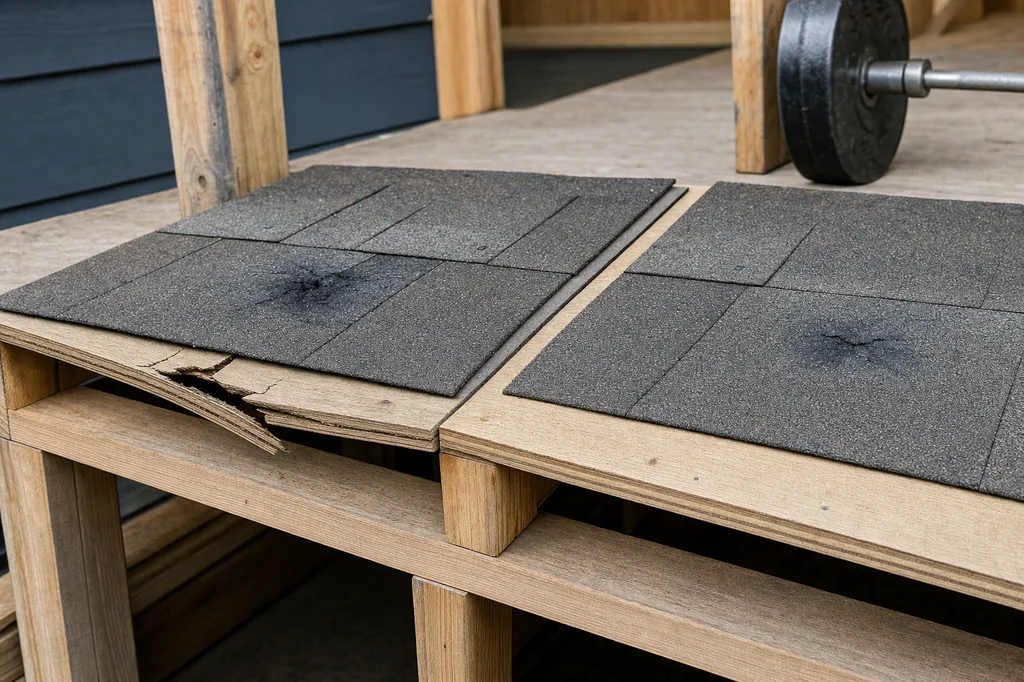
A 225-pound barbell drop makes for a dramatic shingle demonstration. But when plywood beneath a sample cracks, the result may show a failure of the backing as well as the shingle. That is the central limitation to consider when looking at Tamko HailGuard’s barbell-drop claim.
What a broken plywood deck can change
In the Tamko demonstration, HailGuard was shown taking repeated 225-pound drops with minimal visible damage while other samples appeared to crack after fewer impacts. The visible difference was striking: some of the samples that appeared to lose had deep dips, and broken plywood or exposed framing was visible beneath them.
That observation raises a reasonable question about the support conditions. If a board is loose, cracks, or bends sharply under a concentrated hit, a shingle attached to it can crack with the board. A broken backing board does not automatically prove that the shingle itself was the weak component.
It also does not establish that Tamko rigged the setup, used inconsistent decks, or makes a poor shingle. It means the condition and support of the plywood are important variables when interpreting the demonstration.
The repeat drops used one plywood deck
A repeat setup placed each sample on the same plywood deck and changed only the shingle. The demonstrated drops increased from 315 pounds to 405 pounds and then 455 pounds.
Several shingles were shown on that shared deck, including Tamko Titan and Malarkey Vista. After the demonstrated drops, the samples were described as having no visible holes or cracks, despite visible dents and flattened areas. The repeat setup was intended to show that a dramatic difference can disappear when the backing remains consistent.
That result is not proof that all shingles perform the same way, that every roof deck reacts alike, or that a barbell predicts hail performance. It does show why a shingle-only conclusion is difficult when the backing changes or fails.
A barbell drop is not a hailstorm
A concentrated barbell impact is a specific demonstration, not a complete measure of roof performance in weather. The useful questions are narrower: Was the plywood the same beneath every sample? Was the board similarly supported? Did the shingle itself show a crack, hole, or other visible damage apart from damage to the wood below it?
When comparing impact claims, look past the headline result and separate these observations:
- Shingle condition: Look for visible cracks, holes, tears, or crushed granules on the shingle itself.
- Backing condition: Note whether the plywood cracked, flexed, or opened beneath the sample.
- Consistent support: A meaningful side-by-side demonstration keeps the deck and its support the same while changing the shingle.
- Drop conditions: Weight, impact location, and the number of drops affect what the sample can show.
How to use the Tamko HailGuard claim
The Tamko HailGuard barbell test can be one piece of product information, but it should not settle a shingle choice on its own. The footage supports a concern that broken plywood may influence the apparent result; it does not prove poor HailGuard performance or manipulation by Tamko.
For a roofing purchase, identify the exact shingle being offered and review the available product and warranty information for that product. If decking condition is a concern, discuss it with a licensed roofing professional. Directorii lists verified contractors.
The takeaway from the broken-board images
The most important distinction is simple: a shingle may be damaged because it failed under impact, because the plywood beneath it failed, or because both failed together. A demonstration that does not keep the backing consistent cannot cleanly answer which material caused the result.
Source: YouTube
FAQ
What weight was used in the Tamko HailGuard barbell demonstration?
The Tamko demonstration used 225-pound barbell drops. A separate repeat setup increased the demonstrated drop weights to 315, 405, and 455 pounds.
Why does broken plywood matter in a shingle drop test?
If plywood cracks or bends beneath a shingle, the shingle can deform or crack with the backing. That makes it difficult to tell whether the shingle failed on its own or whether failure of the wood contributed to the visible result.
Did the repeat setup use the same backing for each sample?
Yes. The repeat setup placed each shingle sample on the same plywood deck and changed only the shingle. Tamko Titan and Malarkey Vista were among the shingles shown in that setup.
Does the barbell test prove Tamko HailGuard is poor or that Tamko rigged a test?
No. Visible broken plywood raises a question about whether backing conditions influenced the result, but it does not prove that Tamko rigged the setup or that HailGuard is a poor shingle.
Can a barbell-drop test predict hail performance on every roof?
No. A concentrated barbell drop is a specific demonstration. It does not by itself establish how every shingle and roof deck will respond to hail or other weather conditions.