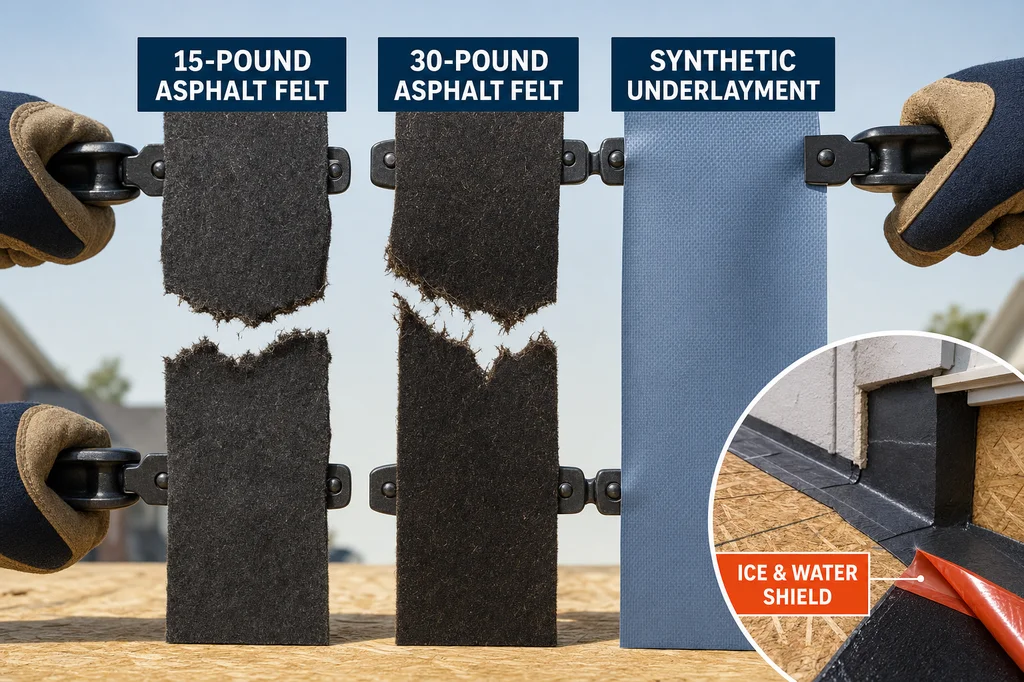
Choosing between synthetic and felt underlayment is not just a question of which roll looks thicker. In a tear demonstration, 15-pound and 30-pound felt tore easily, while a thinner synthetic sample took much more force to tear. Separately, self-adhered ice-and-water shield is used at roof areas such as valleys, chimneys, end walls, and roof-to-wall intersections.
The layer between shingles and the roof deck
Shingle underlayment goes between the shingles and the roof deck, whether the deck is plywood or one-by decking. It acts as a second protective layer beneath the finished roof covering.
Asphalt felt, often called tar paper, is one of the oldest underlayment types still in use. It is made from wood pulp and other organic materials formed into paper, then coated with asphalt to help water shed from its surface. Synthetic felt, or synthetic underlayment, is a polypropylene membrane.
What the synthetic-versus-felt tear test showed
The clearest difference shown between these materials was tear resistance. Samples of 30-pound felt and 15-pound felt tore readily. A single layer of thinner synthetic felt required substantially more force to tear.
That is a demonstration of the samples shown, not a performance rating for every underlayment product. Still, it gives homeowners a practical reason to distinguish the field underlayment by material instead of treating every roll as the same.
- Asphalt felt: asphalt-coated paper made with wood pulp and other organic materials.
- Synthetic underlayment: a polypropylene membrane that resisted tearing more strongly in the demonstration.
- Field underlayment: the broad layer used beneath shingles across the roof deck.
Ice-and-water shield is the sticky detail membrane
Ice-and-water shield has a plastic release film on its back because the membrane is extremely sticky. It is intended for roof areas that are more prone to leaking: valleys, around chimneys, end walls, and places where the roof meets a wall.
When it heats up, the membrane adheres tightly to the deck. Nails driven through it were described as sealing around the fastener when the material gets hot. This makes ice-and-water shield distinct from the field underlayment used beneath shingles.
High-temperature membrane and rolled-roofing base sheet
High-temperature ice-and-water shield is another sticky membrane. It is intended for areas that get extremely hot, including beneath metal, copper, and standing-seam roofs. The product label discussed also listed certain synthetic tile, clay tile, and concrete tile applications. Its top surface was described as non-slip, like synthetic felt.
For very low-pitched areas with granulated rolled roofing, a base sheet is part of a different base-and-cap system. The base sheet is installed directly on the deck before the granulated cap sheet. Like ice-and-water shield, it has a sticky backing, but it is thicker. Markings on some base-sheet products help show lap locations and cap-sheet spacing.
A focused way to compare underlayment choices
For a shingle roof, separate the broad field layer from the sticky membrane used at specific details. Synthetic and asphalt felt are field-underlayment choices; ice-and-water shield is the membrane identified for valleys, chimneys, end walls, and roof-to-wall intersections.
If the roof covering is metal, copper, standing seam, or one of the listed tile types, high-temperature ice-and-water shield is the specialty product discussed for high-heat applications. If a low-pitched area uses rolled roofing, base sheet and cap sheet are part of that system rather than ordinary shingle underlayment.
Directorii lists verified contractors.
Source: Roofing Underlayments EXPLAINED by a roofer: Tar Paper, Synthetic, Ice and Water Shield
FAQ
What did the synthetic vs felt tear test show?
The 15-pound and 30-pound felt samples tore easily in the demonstration. A thinner single layer of synthetic felt took much more force to tear. The demonstration showed the samples' relative tear resistance rather than a rating for every product.
What is asphalt felt made of?
Asphalt felt, also called tar paper, is made from wood pulp and other organic materials formed into paper and coated with asphalt. The asphalt coating helps water shed from the material.
Where is ice-and-water shield used?
Ice-and-water shield is used in valleys, around chimneys, at end walls, and where a roof meets a wall. It has a sticky backing protected by a plastic release film and adheres tightly to the roof deck when warmed.
What is high-temperature ice-and-water shield for?
High-temperature ice-and-water shield is intended for areas exposed to extreme heat, including beneath metal, copper, and standing-seam roofs. The product label described also listed certain synthetic tile, clay tile, and concrete tile uses.
What is a rolled-roofing base sheet?
A base sheet is a thicker, self-adhered layer used in a rolled-roofing base-and-cap system on very low-pitched areas. It is installed on the deck before the granulated cap sheet and is different from ordinary shingle underlayment.