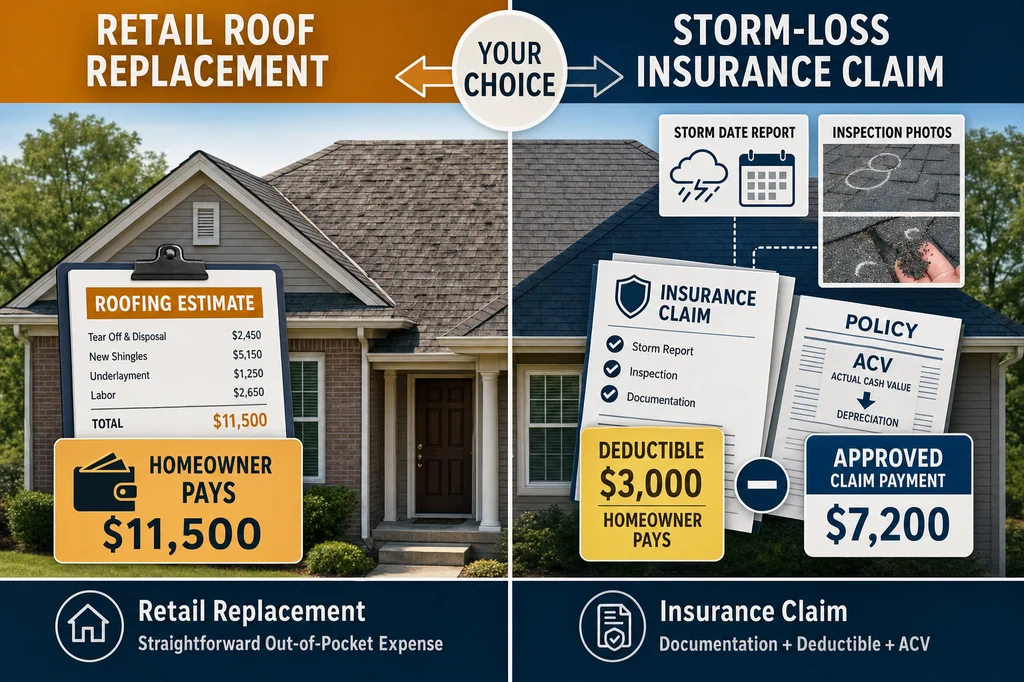
A State Farm roof claim denial—or the possibility of one—does not answer the first homeowner question: is this a retail roof replacement, or is there a storm-loss claim worth pursuing? Tom Williams of T Williams Roofing drew that distinction from the start of his conversations with homeowners.
Williams described meeting a homeowner whose roof needed replacement but who did not want to involve insurance. The homeowner had lived in the house for years, did not believe recent hail had affected the property, and chose to pay out of pocket. Two other roofing companies recommended an insurance route and lost the job after pushing it.
That example makes the central decision plain: needing a new roof and having a storm claim are not the same thing.
Williams’s experience with State Farm and Allstate
Williams said State Farm and Allstate were his most difficult insurers for roof-claim approvals. He estimated that roughly 8% to 10% of the State Farm claims he pursued were approved and about 15% of Allstate claims were approved, compared with about 70% for other insurers.
Those are Williams’s own reported results, not published approval rates or a prediction for any individual policy, property, or storm. He described advising homeowners with those carriers that a claim could involve a difficult fight rather than a quick replacement.
He also recalled a family claim in which wind had blown shingles from a townhouse roof and exposed plywood, but the claim was written as a repair that did not meet the deductible. In another example, he described an older homeowner receiving a six-shingle repair after a hail event while nearby homes received replacements.
Before pursuing a claim, identify the deductible and policy type
Williams emphasized that deductibles can change the economics of an approved claim. In Texas, he encountered percentage deductibles rather than the fixed-dollar deductibles he associated with his earlier work around Chicago. He described a $1.5 million home with a $55,000 roof and a 2% deductible, leaving the homeowner responsible for $30,000.
Your deductible depends on your policy. Know its amount before deciding whether a claim makes sense, and do not treat a deductible as something a roofing company should hide or absorb. Williams said he avoids customers seeking that kind of arrangement.
Policy type matters too. Williams warned that a homeowner may have an actual cash value (ACV) policy. In his example, a 23-year-old roof under an ACV policy could result in a payment of only a few hundred dollars after a contractor had invested time in the claim process. In that situation, he said, a retail sale may have been the more appropriate route from the beginning.
Use a representation agreement as an expectations conversation
Williams used representation agreements before investing substantial time in a claim. His purpose was to establish an understanding with the homeowner: if the roof were approved, the homeowner would hire his company and pay the deductible.
But Williams also said that, in his experience, homeowners could walk away after an approval despite signing the agreement. He characterized the document as having little enforceability and viewed it primarily as a test of whether the homeowner intended to honor the commitment.
For a homeowner, the useful takeaway is narrower than a standard contract checklist: understand the promise being discussed before signing. If the document’s wording or consequences are unclear, have it reviewed by counsel or a licensed professional before you commit.
Share insurer paperwork before final contract pricing
Williams preferred to see the insurer’s paperwork before preparing the final contract. He said he matched his contract to the insurer’s approved numbers and separated the total roof cost, the deductible, and the net claim payment.
His concern was that a contractor may provide a retail estimate without knowing that an insurance claim has already been approved. If the insurer’s approved amount is higher than that estimate, the homeowner may assume the difference is theirs to keep. Williams described this as a source of confusion, particularly when overhead, profit, depreciation, or later supplements are involved.
If an insurer has already issued paperwork, provide it before final contract pricing. That allows the roof scope and deductible to be discussed using the same numbers.
Document what is already on the roof
Williams said that, for most claims he filed, he did not first walk the roof. He used a drone, took photographs, obtained a storm report showing a date of loss, and explained the insurance process to the homeowner.
He said adjusters had told him about contractors creating mechanical damage, especially on roofs belonging to older homeowners who might not watch an inspection. Williams did not say he commonly observed that damage himself; he said he heard the concern from adjusters.
A roofing inspection should focus on existing conditions. Be cautious of anyone whose pitch depends on altering the roof, bypassing the deductible, or treating an insurer approval as certain. Directorii lists verified contractors.
Source: Tom Williams on ASHCO Roofing, State Farm and Allstate and Home Owners Cancelations
FAQ
Does an older roof automatically justify an insurance claim?
No. Williams distinguished between a roof that needs replacement and a roof with a storm-loss claim. He described a homeowner who needed a roof but chose a retail replacement because they did not believe hail had damaged the home.
What did Tom Williams say about State Farm roof claims?
Williams said State Farm was among the most difficult insurers in his own experience. He estimated that roughly 8% to 10% of the State Farm claims he pursued were approved. That was his reported experience, not a general approval rate.
Why should I check whether my policy is ACV?
Williams said an actual cash value policy can substantially limit a payment on an older roof. He gave an example where a 23-year-old roof could result in only a few hundred dollars, making a retail replacement the more practical route.
What does a percentage roof deductible mean?
A percentage deductible is calculated from the insured value rather than set as one fixed dollar amount. Williams described encountering them in Texas and gave an example where a 2% deductible on a $1.5 million home was $30,000. Your own deductible depends on your policy.
Why does a roofer need my insurance paperwork before final pricing?
Williams said he used insurer paperwork to match the contract to the approved amount and show the deductible and net claim payment separately. Without that paperwork, a retail estimate and an approved claim amount can create confusion about the final roof price.