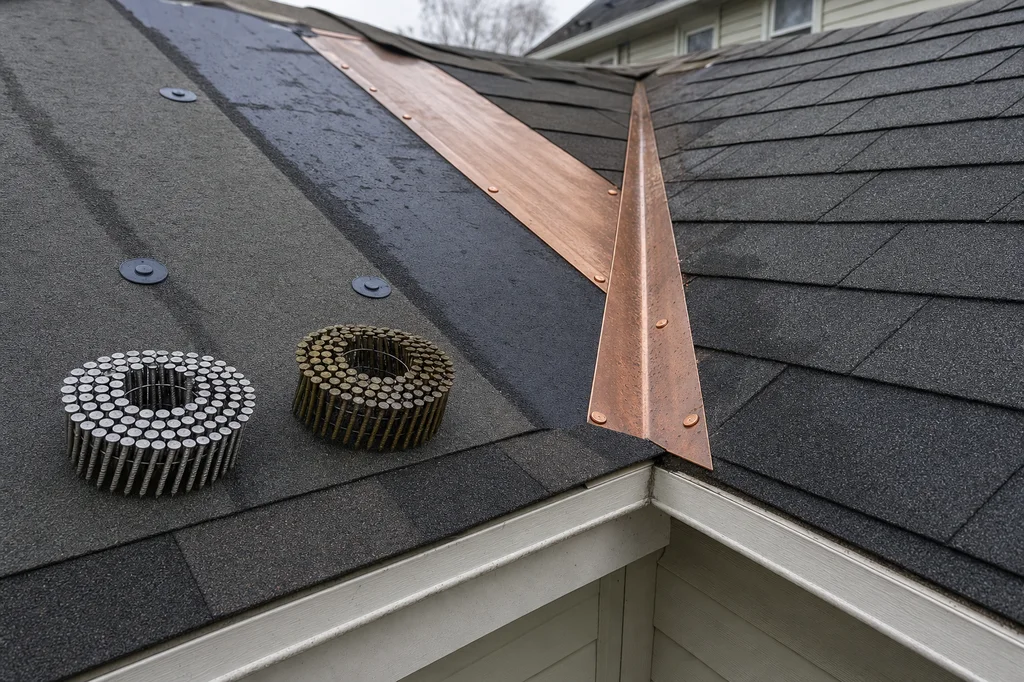
On a low-slope shingle roof, the choice between stainless steel and galvanized roofing nails is not cosmetic. Galvanized coil nails are common and economical, while stainless steel offers added resistance to moisture-related rust. If your roof includes copper valleys, compatible copper nails are a separate requirement.
Why moisture exposure matters for shingle fasteners
A low-slope roof may hold trapped moisture beneath shingles longer than a steeper roof. That makes nail material more consequential because corrosion can eventually lead to leaks.
Stainless steel coil nails are presented as an added long-term safeguard where moisture is more likely to linger under the shingles, including low-pitch shingle installations with ice-and-water underlayment. The practical choice is not simply “best nail” versus “worst nail.” It is whether the fastener matches the roof design, materials, and moisture exposure.
Do not assume every roof needs stainless steel. It costs more than standard galvanized nails, and the roofing contract should identify where the upgrade is being used and why.
Galvanized coil nails are common because they balance cost and use
Galvanized smooth-shank coil nails are a standard fastener for shingle roofs. They are fed through a roofing nail gun and are typically the least expensive option among the coil nails described here.
Galvanized nails have a zinc coating that resists rust. Over time, that coating can weather away and expose the underlying steel, which can then rust. For a homeowner, this means galvanized does not mean permanently corrosion-proof.
There are hot-dip and electro-galvanized methods, but the key contract question is simpler: what galvanized nail is included, and is it appropriate for the roof’s slope and details? A written answer makes it easier to compare bids that may otherwise list only “new shingles” and leave fasteners unspecified.
Ring-shank nails add holding power, while stainless steel targets corrosion
Ring-shank and stainless steel nails solve different problems. Ring-shank nails have ridges that provide more bite in the wood and more resistance to being pulled back out, while stainless steel nails are selected for their resistance to rust.
A ring-shank galvanized coil nail can be a useful upgrade over a smooth-shank galvanized nail where increased withdrawal resistance is the goal. It is somewhat more costly and may be harder to obtain, but its benefit is mechanical grip rather than a different corrosion-resistant metal.
Stainless steel coil nails are the premium option described for shingle applications. They cost substantially more per box than galvanized nails, but they do not rely on a zinc coating for rust resistance. That distinction matters when the roof assembly may retain moisture.
- Smooth-shank galvanized coil nail: a common, budget-focused shingle fastener.
- Ring-shank galvanized coil nail: a galvanized option with ridges intended to improve grip in the decking.
- Stainless steel coil nail: a higher-cost option for corrosion resistance in moisture-prone shingle conditions.
These labels do not tell you whether nails were driven properly. Nail placement, depth, and the condition of the roof decking still affect how the roof system performs. Those installation details belong with a roofing professional, not a homeowner working on the roof.
Copper valleys need copper nails, not mixed metals
A copper valley or other copper roofing accessory should be fastened with copper nails. Mixing dissimilar metals can cause the materials to deteriorate each other over time, so a standard steel or galvanized nail is not the interchangeable substitute for copper work.
Copper nails are also used with specialty materials such as slate, wood shake, and certain designer shingles. They do not rust, although copper will patina and change color. They are softer than steel nails, so correct installation matters.
The homeowner takeaway is direct: if your proposal includes copper valleys, copper flashing, or another copper accessory, make the compatible fastener part of the specified system. Do not accept a vague allowance for “valley metal” without confirming the material and the fastening method.
Cap nails serve underlayment and rolled-roofing details
Underlayment and rolled roofing use cap nails rather than the same coil nails used for shingles. The cap spreads the holding area and is intended for a different layer of the roof assembly.
Plastic cap nails are commonly used to secure underlayment or felt. When driven straight and correctly, the plastic cap is intended to help create a tight seal at the decking while the roof is dried in before shingles are installed.
Metal cap nails have a larger metal washer-like cap and can be ring shank. They are used for rolled roofing, including use on a base sheet beneath peel-and-stick roofing, where they help secure the material against sliding or shifting. Their use on felt or ice-and-water products can vary by region and roof system, so the roofer’s specified assembly matters.
Put fasteners and metal compatibility in the roofing scope
The most expensive fastener mistake is often the one nobody wrote down. A proposal can name a shingle color and still leave out nail type, shank style, underlayment fastening, and copper compatibility.
Before signing, use these questions to compare the scope rather than trying to judge fasteners from the ground:
- Will the shingle field use smooth-shank galvanized, ring-shank galvanized, or stainless steel coil nails?
- Is any part of this roof low slope or otherwise likely to retain moisture below the shingles?
- What fasteners will secure the underlayment and any rolled-roofing base sheet?
- Does the project include copper valleys, flashing, or accessories, and will copper nails be used with them?
A roofer should be able to explain these choices in plain language and place the final material selection in the signed scope. Directorii lists verified contractors.
What to keep for your project records
Keep the signed scope, product names, and any written confirmation of nail and metal selections with your roof paperwork. This is especially useful when a proposal includes low-slope areas, specialty roofing materials, copper details, or several different roof coverings.
Source: Roofing nail comparison
FAQ
Should I use stainless steel nails on a low-slope shingle roof?
Stainless steel nails can be a sensible upgrade where a low-slope shingle roof may retain moisture beneath the shingles. They cost more than galvanized coil nails, so have the roofer explain why they are specified for your roof area and include that selection in writing.
What is the difference between ring-shank and smooth-shank roofing nails?
Ring-shank roofing nails have ridges that provide more bite in the wood and more resistance to pulling back out. Smooth-shank galvanized coil nails are a common shingle fastener, while ring-shank nails are a higher-cost option focused on increased holding power.
Can galvanized nails be used with copper valleys?
Copper valleys should use compatible copper nails rather than galvanized or other dissimilar-metal fasteners. Mixed metals can deteriorate each other over time. If copper is included in your roofing proposal, make sure the compatible nail material is identified in the scope.
Why do galvanized roofing nails rust?
Galvanized nails resist rust because they have a zinc coating over steel. That coating can weather away over time, exposing raw steel that can rust. Stainless steel does not depend on that zinc coating, which is why it may be selected for wetter roof conditions.
What nails should secure roof underlayment?
Plastic cap nails are commonly used to hold down underlayment or felt, while metal cap nails are used for rolled roofing applications such as securing a base sheet. The correct fastener depends on the roofing product and assembly, so verify the specified system with your roofer.