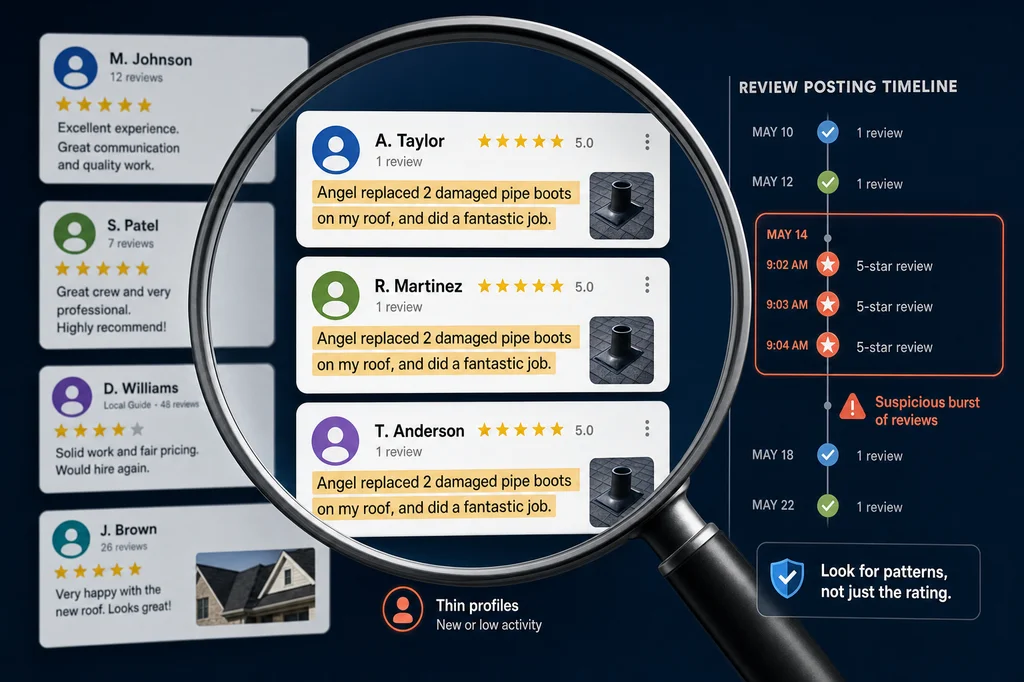
Fake Google reviews can make a roofing company look more established or consistently praised than its real customer record supports. Before you hire, inspect the full pattern: copied wording, thin reviewer profiles, sudden posting clusters, and reviews that sound oddly disconnected from an actual roof replacement.
Why roofing reviews need a closer read
Roofing is a service-area business, so reviews can come from many neighborhoods rather than one storefront. That makes a genuine review history look different from a restaurant’s, but it can also make suspicious activity harder to spot.
Google uses automated systems to filter reviews based on more than a suspicious internet address or offensive language. The system may consider the review wording, attached photos, reviewer history, where reviewers live and travel, the business category, star rating, and the speed at which reviews arrive. The exact scoring system is not public.
That means two things can be true at once: some fake reviews can remain visible, and legitimate reviews can be filtered out. Do not treat a missing review, a five-star rating, or one awkward sentence as proof that a roofer is dishonest. Look for several related signals across the company’s review history.
Copied wording is the clearest fake-review pattern
Near-identical reviews from different profiles deserve scrutiny, especially when they repeat unusual phrases, the same named employees, or the same sequence of praise. A real customer may use common language such as “professional” or “highly recommend.” Repeated distinctive sentences are more revealing.
In examples involving All Seasons Roofing and Restoration, Savage Roofing, and Viking Contractors LLC, reviewers posted identical or very similar language under different profiles. Those examples did not establish that any company bought reviews, but they show why homeowners should compare reviews with each other instead of reading them one at a time.
- Search for repeated phrases. Pick an unusual sentence from a glowing review and search within the review list for the same wording.
- Watch for copied website language. Reviews that read like marketing copy or repeat service-page claims may not sound like a homeowner describing a completed project.
- Read beyond praise. A credible roof review often gives ordinary details: the estimate process, scheduling, cleanup, communication, or how a problem was handled. It does not need to be long, but it should sound specific to a real project.
- Notice irrelevant details. A review that discusses services the company does not appear to offer, or barely mentions roofing at all, is less useful for your hiring decision.
Thin profiles and distant reviews are clues, not verdicts
A reviewer profile with only one or two reviews can be legitimate. Many homeowners leave their first public review after a large purchase such as a roof replacement. The concern grows when many thin profiles appear together and share other suspicious traits.
Open a sample of reviewer profiles rather than only reading the star rating. Profiles that review businesses far apart from one another, use awkward wording, or post unusually similar compliments may be less reliable. A profile with a modest, local-looking history and a project-specific review gives you more to work with.
Also separate the three broad types of questionable reviews. Friends, family members, or employees may post praise without using the service. Some businesses offer customers discounts, gift cards, or other incentives for a review; the Federal Trade Commission requires disclosure of that incentive in the review. The most serious category is a paid review from a person who has no knowledge of the company or its work. As a homeowner, you usually cannot prove which category applies. Your job is to avoid relying heavily on questionable reviews.
Check whether the review timeline makes sense
A sudden surge of reviews can be a warning sign when it appears alongside copied language or thin profiles. It can also have more than one explanation.
Use the review sorting and search tools to examine timing. Owner replies can appear in search results and affect what you see, so do not mistake reply dates for the dates when customers posted reviews. Compare the recent cluster with the business’s older pattern. A large batch of nearly identical five-star posts in a short period is more concerning than a steady stream of reviews with varied detail.
A rating distribution can add context. A business with only one-star and five-star reviews, with little in between, may warrant closer reading. Still, star patterns alone do not tell you whether reviews are fake. Read the middle-rated reviews and the owner’s responses to see how the company addresses delays, communication problems, or workmanship concerns.
What to compare before you choose a roofing company
Reviews should help you form questions, not replace a written scope or a careful estimate comparison. A company with fewer reviews may be a better fit than one with a huge, questionable-looking review count if its project details and documentation are clearer.
- Compare review detail across several roofers. Give more weight to consistent comments about the parts of the project that matter to you, such as communication, cleanup, scheduling, and follow-through.
- Read a spread of ratings. Start with recent reviews, then read lower and middle ratings to learn what went wrong and whether the company responded constructively.
- Match the estimate to the claims in reviews. If reviews praise a company for thorough work, the written proposal should identify the roofing work being included rather than rely on broad promises.
- Do not accuse a company based on a pattern alone. You may not have enough information to know whether a review is fake. Simply move your attention to evidence you can verify before signing.
Choosing the wrong roofer can be expensive, and a polished review profile should not be the deciding factor. Directorii lists verified contractors.
What to say when a review profile raises doubts
You do not need to debate a company about individual Google reviews. Keep the conversation focused on your project and whether its proposal gives you enough confidence to proceed.
- “Can you walk me through the work included in this estimate and what is excluded?”
- “Who will be my point of contact if I have a question during the project?”
- “How will you document any change to the original scope?”
- “Can you explain how you handle a concern after the work is complete?”
Clear, direct answers and a specific written proposal matter more than a perfect star average. If the company pressures you to decide before you can compare the scope, reviews, and terms, consider another option.
Source: How to Spot Fake Google Reviews for ANY Business
FAQ
How can I spot fake Google roofer reviews?
Look for a pattern rather than one suspicious review. Copied or nearly identical wording, repeated unusual phrases, thin reviewer profiles, reviews from widely separated locations, and a sudden burst of posts are all reasons to read more closely. None of those signals alone proves a review is fake.
Should I trust a roofer with only five-star Google reviews?
A five-star average is not automatically a problem, but it should not end your research. Read the actual comments for project-specific details, check whether the language repeats across profiles, and compare the review history with the written estimate. Reviews in the middle of the rating range can be especially informative.
Can a sudden cluster of roofing reviews be legitimate?
Yes, a sudden cluster can have a legitimate explanation. It becomes more concerning when the posts arrive in a short period and also use duplicated language, come from thin profiles, or contain unusually broad praise without project details.
Why do some Google reviews for roofers disappear?
Google uses automated filtering that can evaluate review wording, attached photos, reviewer history, business category, rating, and how quickly reviews arrive. Legitimate reviews may sometimes be suppressed along with suspicious ones. A missing review does not by itself indicate that a roofing company did anything wrong.
What should I do if a roofing company’s reviews seem suspicious?
Do not rely on the review count or star average alone. Compare several companies, read recent and lower-rated comments, and focus on the clarity of each written proposal. Ask how the company handles communication, scope changes, and post-project concerns, then choose based on information you can evaluate directly.