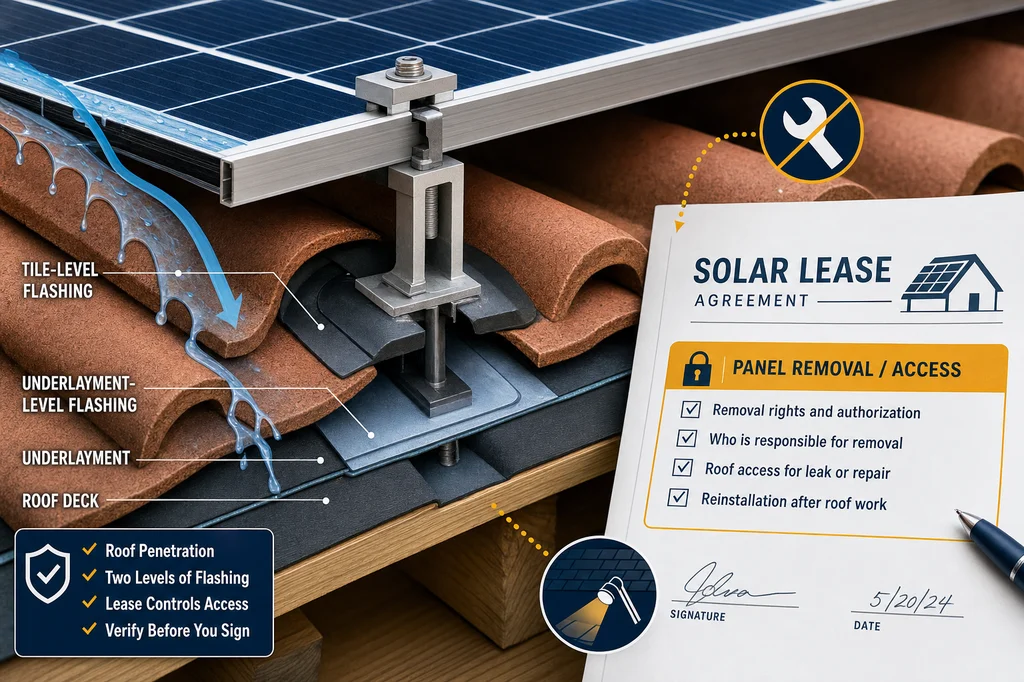
Use this solar panel lease roof-leak checklist before signing any agreement. Confirm who owns the equipment, how the mounting penetrations will be flashed for your roof type, and whether you can have panels removed for future roof repairs. A lease can turn a manageable leak into a much harder scheduling and contract problem.
Start with ownership and panel-removal rights
A leased system may remain the solar company’s property, even though it is mounted on your house. That distinction matters most when the roof needs repair, replacement, or investigation after a leak.
In one reported California case, a homeowner had a leased solar system on a concrete tile roof and could not get the panels removed so roof work could proceed. The reported contract arrangement limited the homeowner’s ability to authorize work on the equipment, while leaks continued beneath the installation area.
Before you commit, find the exact contract language covering system ownership, removal, reinstallation, maintenance, and roof access. Do not rely on a sales explanation of what will happen later. The signed agreement should identify who schedules removal, who pays for it, and what happens if the roof needs urgent work.
- Identify the owner. Determine whether you own the panels or whether they are leased or otherwise controlled by another company.
- Read the removal provision. Look for the process to remove panels for a roof repair or replacement, including who approves the work.
- Check for access restrictions. Understand whether your roofer can work around the system or whether the solar company must first remove it.
- Review dispute language carefully. A reported contract included language the homeowner understood as limiting lawsuits. Contract terms can matter greatly, so consider having counsel review a major solar agreement before you sign.
Match the solar mounting plan to your roof material
A solar mounting plan is not just an energy-production detail. Every attachment point is a roof penetration that must be designed for the roof covering, underlayment, structure, and water-shedding path.
The California case involved concrete tile. A local roofer reported that mounts had been screwed through tile and into the roof deck, with no base flashing visible and no secondary flashing. The roofer cited California Tile Institute guidance calling for two flashings at roof penetrations: one to shed water on the underlayment and another to shed water on the tile.
That detail is especially useful if you have tile. A sealant or butyl tape placed around a screw may not provide the same water-management approach as an integrated flashing system. The reported failure was not simply a bad-looking penetration; water entered the home around solar-mounted areas while other portions of the roof reportedly were not leaking.
Your installation documents should name the racking or mounting system, not merely the panel count, projected production, and payment amount. The racking system determines how the panels are supported and how penetrations can be flashed.
What a roof-compatible solar scope should spell out
A useful solar proposal explains how the roof will be altered, not just how much electricity the system is expected to produce. If the scope skips mounting and flashing details, you are being asked to accept a roof change without a clear water-management plan.
For tile roofs, the reported proper sequence required access to the roof structure, installation of mounting posts, restoration of the underlayment, and primary and secondary flashing before rails and panels were installed. The exact method for your home will depend on the roof material and the mounting system, but the principle is the same: the solar work must preserve the roof assembly rather than merely fasten equipment through it.
Ask for a written scope that identifies:
- the roof type and the planned attachment method;
- the racking system and flashing components;
- which party is responsible for roof damage caused by the solar installation;
- the installer’s relationship to the company selling the system; and
- how the work will be coordinated with your existing roofer, if you have one.
If your roof is under a separate roofing warranty, obtain the roofer’s written position on the proposed solar installation. A roofer cannot control a solar company’s work, but early coordination can expose incompatible mounting plans before the roof is penetrated.
Do not treat a permit inspection as a roof-leak guarantee
A permit and a passed inspection can be useful records, but they do not necessarily prove that every flashing detail will perform over time. In the reported California case, the solar work had passed inspection, yet the homeowner later faced leaks and reported electrical problems with improperly installed micro-inverters.
Local inspection practices and permit requirements vary by city and building department. Confirm local requirements with a licensed professional or the relevant building department, but keep your own project records as well. Save the signed contract, plans, permit information, photos supplied by the installer, equipment list, warranties, and all service communications.
If water appears inside after installation, document the location and timing, then contact the solar company and a qualified roofing professional promptly. Do not authorize roof work that affects leased equipment until you understand the contract and safety responsibilities.
Watch for subcontracting gaps before installation day
Subcontracting does not automatically mean poor work, but it can blur responsibility for the roof details. Larger solar sellers may use separate installation crews, and a scheduled subcontractor may be replaced if availability changes.
That creates a practical risk: the company that sold the system may not be the crew that decides how to mount and flash it. In the reported case, a subcontractor associated with SunPower was identified, while the reported installation used components from different manufacturers and allegedly did not follow manufacturer specifications.
Get one named point of contact who can answer for the roof scope, installation crew, service requests, and any leak claim. If the seller cannot identify who will perform the work or cannot provide the mounting-and-flashing plan, pause before signing.
When the roof and solar scopes need coordination, Directorii lists verified contractors.
Source: Solar Roofing Financing Nightmares: Numbers Don't Lie, People Do!
FAQ
Can a solar panel lease prevent me from repairing my roof?
It can complicate roof repairs if the lease gives the solar company ownership or control of the panels and requires its approval for removal. Read the agreement before signing to learn who can authorize removal, who schedules it, and how roof-related service requests are handled.
What should I check about flashing before solar panels are installed?
Ask for the mounting and flashing method in writing for your specific roof material. On the reported concrete tile roof, a local roofer described primary and secondary flashing as necessary to shed water at different layers of the roof assembly.
Should my solar contract name the racking system?
Yes, the contract or installation scope should identify the racking or mounting system and how it will attach to the roof. Panel counts and projected energy savings do not explain how penetrations will be supported, sealed, and flashed.
Does a passed solar permit inspection mean my roof will not leak?
No, a passed inspection is not a guarantee that roof details will remain watertight. In the reported case, the installation passed inspection but leaks were later reported around the solar-mounted areas. Confirm local requirements, but keep complete records and review the roof scope yourself.
What if the solar company uses a subcontractor for installation?
Subcontracting can make accountability less clear if the sales company and installation crew are separate. Before work begins, identify the installation party, the person responsible for the roof details, and the contact who will handle service if water enters the home.