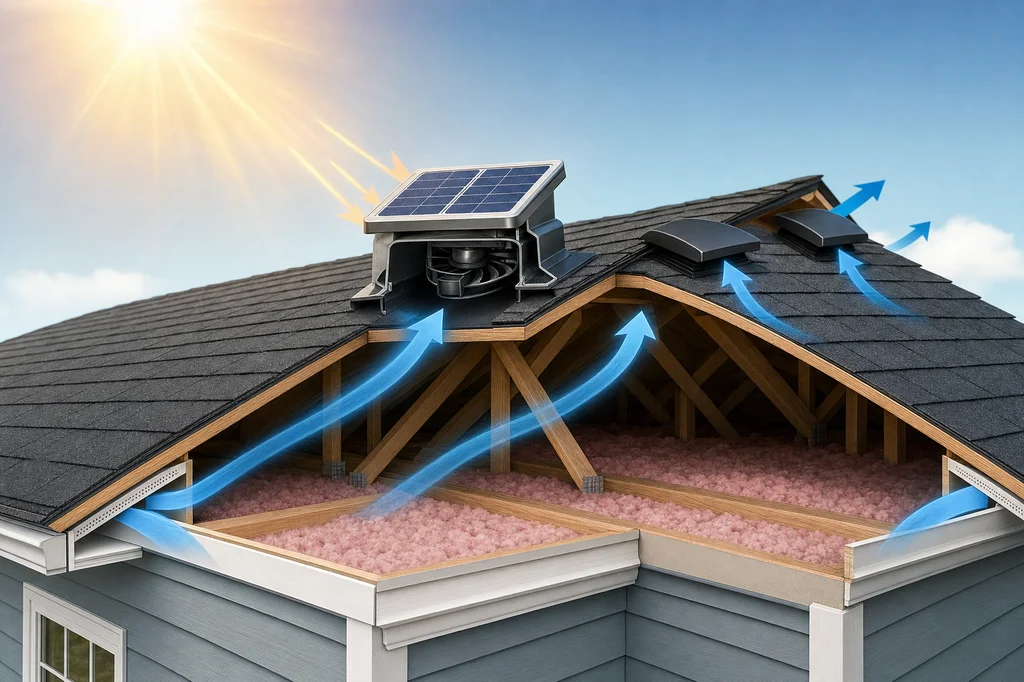
A Solar Blaster solar roof vent combines a solar-powered fan with a static roof vent, but it is not a replacement for a complete attic-ventilation design. Its claimed 39-CFM output may help move air through a vented space in sunlight, while the underlying vent still needs to fit your roof’s intake and exhaust layout.
What Solar Blaster is designed to do
Solar Blaster is a hybrid roof vent: it functions as a passive exhaust vent and adds solar-powered airflow when sunlight powers the fan. That distinction matters because a fan does not erase the need for balanced attic ventilation.
The product shown uses a 14-gauge aluminum base with no seam on the base. The manufacturer describes it as a handbuilt unit and compares its basic form to the vents roofers may call turtle vents, can vents, or RVO vents. For a homeowner, the practical appeal is a familiar roof-vent profile with an added fan rather than a large standalone solar attic fan.
That smaller profile also creates a limit: the unit is intended to work within a ventilation system, not take over the whole job of exhausting an attic by itself. The manufacturer specifically stated that adding Solar Blaster units does not mean reducing the number of static vents called for in the ventilation plan. In plain English, treat the fan as a boost to properly planned ventilation, not as permission to remove vents or skip intake ventilation.
How to interpret the claimed 39-CFM fan output
The smaller Solar Blaster fan is described as a 3-watt, 39-CFM fan. CFM means cubic feet per minute: the volume of air a fan is claimed to move in a minute.
That figure is useful only when you compare it with the size and layout of the space being ventilated. A simple volume calculation starts with length, width, and height. In the example provided, a 10-by-10-by-8 shed contains 800 cubic feet. At a stated 39 CFM, the calculation suggests one fan could exchange that volume in roughly 20 minutes under the assumed conditions.
That is an illustration, not a performance promise for your attic. Attics have rafters, insulation, partitions, ductwork, air leaks, intake openings, exhaust openings, and changing sun exposure. Those conditions can affect real airflow. A fan also cannot run at its stated solar-driven output without adequate sunlight.
Solar Blaster also showed a larger 10-watt, three-fan ridge-vent power unit rated at 96 CFM. The company presented that option as a way to increase airflow in applications such as a shed or ridge-vent setup. Do not assume the larger ridge option and the roof vent are interchangeable; they are different configurations with different installation locations.
Static vent versus solar fan: which benefit matters most?
The passive vent function may be the more dependable part of the design because it does not depend on sunshine. The solar fan is the added feature that may increase air movement during sunny conditions.
- Choose the hybrid concept if: your licensed roofing professional confirms that the vent’s location and intake/exhaust balance fit the roof design, and you want solar-assisted airflow in addition to static ventilation.
- Focus on conventional ventilation first if: the attic lacks adequate intake, has blocked existing vents, or has an unresolved moisture problem. A powered exhaust accessory is not a substitute for correcting those conditions.
- Consider a ridge-mounted fan unit only if: the ridge-vent assembly and attic layout are suitable for it. The smaller model shown was described as a shed application, while a larger three-fan unit was presented for greater airflow.
The manufacturer linked added airflow with moving moisture during cooler weather, when condensation can collect beneath roof sheathing. Moisture management is a legitimate reason to evaluate attic ventilation, but visible staining, warped sheathing, wet insulation, or recurring condensation needs a professional diagnosis. Those symptoms can involve ventilation, indoor moisture, roof leaks, or more than one cause.
What to verify before adding a Solar Blaster vent
Start with the attic and roof system, not the fan rating. A roofer should determine whether the roof has effective intake ventilation and whether its exhaust pattern is appropriate before proposing any powered or solar-assisted vent.
- Identify the actual moisture or heat complaint. Explain whether you have condensation, damp insulation, musty odors, hot upper rooms, or roof-deck staining. The cause guides the solution.
- Have the ventilation layout measured. Your roofing professional should assess the existing intake and exhaust openings and explain whether Solar Blaster adds to, replaces, or conflicts with the current layout.
- Confirm the solar exposure. A panel that receives limited direct sun may provide limited fan operation. Ask where the unit will sit and what roof features may shade it.
- Review roof compatibility. The no-seam aluminum base may be relevant to a flat-roof application, but flashing details, roof covering, slope, and local requirements still need to be evaluated for your specific roof.
- Get the product documents. Read the warranty and installation information supplied with the unit. Verify what is covered, who performs the installation, and which installation details could affect coverage.
Do not let a fan proposal hide a ventilation problem
A proposal becomes risky when it presents a solar fan as a cure-all while ignoring intake, passive exhaust, moisture sources, or roof flashing. The costly mistake is paying for more mechanical airflow without finding out why the attic is damp or overheated.
Ask for a written scope that identifies the existing vents, the proposed Solar Blaster locations, any vents that will remain, and the reason the layout is expected to work. If local code applies to your project, confirm the final design with a licensed roofing professional and the local building authority rather than relying on a product claim alone.
Directorii lists verified contractors.
Solar Blaster’s stated durability and installation details
For the ridge-mounted fan configuration, the company described an 80-millimeter, high-speed, two-ball-bearing fan and stated a 50,000-hour rating, calculated as nine hours per day for 15 years. That is a manufacturer-reported rating for that fan configuration, not a guarantee of installed service life on every roof.
Have the installer explain how the unit will be secured, how the roof penetration will be flashed, and how a future roof replacement could affect the vent. Source: Solar Blaster Roofing Fan unboxing and overview
FAQ
Does a Solar Blaster roof vent replace regular attic vents?
No, Solar Blaster was presented as a hybrid that adds solar-powered airflow to a static vent rather than replacing the ventilation layout. The manufacturer stated that the same number of vents may still be needed. Have a licensed roofing professional assess intake, exhaust, and local requirements for your roof.
What does the claimed 39 CFM rating mean for Solar Blaster?
The claimed 39 CFM means the fan is stated to move 39 cubic feet of air per minute under suitable solar conditions. It can help compare fan capacity with a space’s volume, but it does not predict attic performance because attic layout, vent openings, obstructions, and sunlight affect airflow.
Will a solar roof fan fix condensation in my attic?
Not necessarily. Solar-assisted airflow may help move moist air, but condensation can also stem from inadequate intake ventilation, air leakage from the home, insulation issues, roof leaks, or several conditions together. A roofing professional should identify the moisture source before recommending a fan.
Should I choose a Solar Blaster vent or a ridge fan unit?
Choose based on your roof’s existing ventilation design and the space that needs ventilation. The roof vent combines a static vent with a solar fan, while the larger ridge option was presented as a separate, higher-output configuration. Your roofer should confirm which location and arrangement suit the roof.
How do I know whether the solar panel will power the fan well enough?
Check the proposed vent location for direct sun and for shading from trees, chimneys, nearby structures, or roof features. The fan shown required sunshine to operate. Ask the installer to explain expected exposure at the installed location and how the unit will perform when sunlight is limited.