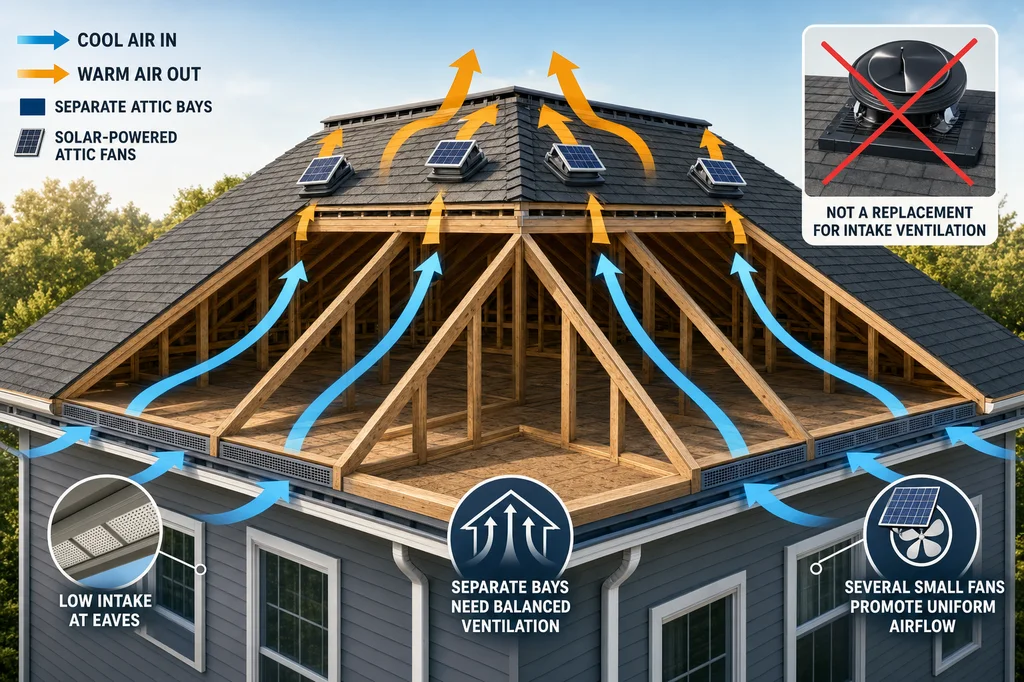
Solar Blaster attic fans are designed as small solar-powered additions to a roof’s existing ventilation system, not as a substitute for it. Before installing one, have a roofer assess intake ventilation, ridge openings, bathroom exhaust ducting, and the harder-to-balance airflow paths found on hip roofs.
What must move before an attic fan can help
An attic fan can only exhaust air effectively if replacement air has a clear path into the attic. The useful goal is a continuous movement of outside air from lower intake areas toward high exhaust areas, rather than a powerful fan pulling air from unintended gaps.
Solar Blaster’s approach is to supplement passive, convective ventilation with several small solar-powered fans. The company’s owner described the intended system as cool air entering near the eaves and warmer air exhausting near the ridge. That is different from treating one large powered fan as the entire ventilation plan.
For a homeowner, the key issue is not whether a fan looks small or large. It is whether the roof already has enough usable intake and exhaust openings for the fan to work with. A fan that cannot draw from the eaves may instead pull air through nearby roof vents or other unintended openings.
Why Solar Blaster favors several small fans over one large unit
Solar Blaster markets small, solar-powered roof vents that complement the roof’s passive ventilation. Its owner said that, in company testing on a 7/12-pitch roof with a code-mandated venting setup, the system increased air movement from 5 miles per hour to 15 miles per hour.
That is a company performance statement, not a promise that every attic will get the same result. Roof shape, vent layout, insulation, and blocked openings can all change what happens at your home.
The stated reasoning is balance and uniformity. A large fan in one location may create a strong pull in that area while leaving remote sections of the attic with little movement. It may also draw air from nearby openings that were not meant to serve as intake. Where a chimney is close to a large fan, the owner specifically cautioned about the possibility of drawing combustion-related air toward the attic rather than maintaining the intended eave-to-ridge path.
Hip roofs need a bay-by-bay ventilation plan
Hip roofs can be difficult to vent because they have broad eaves and a pointed top rather than one long ridge. Each attic bay may act like its own airflow channel, so one vent near the top may not improve every section equally.
This is where a roof-specific layout matters more than a product label. A roofer can identify whether the hip roof has accessible intake, whether ridge or other high exhaust openings are functional, and whether separate areas of the attic are cut off from each other.
- Check the low edge first: Intake near the eaves gives exhausted air somewhere appropriate to come from.
- Confirm high openings are real openings: A ridge vent installed over an unopened ridge may look ventilated from outside while providing little attic exhaust.
- Map separate roof sections: Hips, garages, additions, and valleys can create areas that need their own ventilation approach.
- Keep exhaust ducts out of the attic: Bathroom and kitchen exhaust should not dump moist indoor air into the attic.
These checks can reveal whether a solar fan is useful, unnecessary, or likely to create an imbalance. They can also uncover a problem that no roof vent can solve on its own, such as missing insulation or a disconnected exhaust duct.
Moisture problems are not automatically roof leaks
Attic moisture can mimic a roof leak, especially during cold weather. Warm, moist indoor air entering an attic can condense on cold surfaces and contribute to mold growth, even when the roof covering itself is not the source of water.
A former roofing contractor associated with Solar Blaster described a rental-home case where a bathroom fan duct terminated in the attic near a chimney. The attic reportedly contained widespread white mold. The repair involved correcting ventilation conditions, including creating intake and opening the ridge beneath an existing ridge vent, rather than repeatedly treating the issue as a chimney leak.
That example does not establish that every moldy attic needs a solar fan. It shows why diagnosis must come first. If you see staining, frost, damp insulation, a musty odor, or recurring indoor moisture, hire a qualified roofer to evaluate the roof ventilation and an appropriate licensed professional to address mold or indoor-air concerns. Local requirements and the scope of any remediation should be confirmed with licensed pros.
What Solar Blaster states about its fan and panel
Solar Blaster describes its fan as an industrial, two-ball-bearing fan rather than a sleeve-bearing or single-ball-bearing unit. The owner said the fan is rated for 50,000 hours, described as nine hours a day for 15 years, and said the fan can be replaced if it fails.
The company also states that its roof products use spun aluminum construction, a powder-coated finish, and solar panels sized above the motor’s wattage so the motor can regulate the power it takes. The owner said the products may still run under high clouds but not when skies are fully socked in.
Those are product and durability claims from the manufacturer’s side. Before buying, get the exact model, included flashing or mounting parts, replacement-fan availability, written warranty details, and instructions for your roof type. Do not assume a solar-powered fan will operate during every cloudy period or solve an attic issue without adequate passive ventilation.
Decide whether a Solar Blaster fan belongs in your scope
A Solar Blaster fan may make sense when a roofer finds a sound, balanced ventilation system that needs help moving air through a specific roof section. It is a weaker fit when the underlying problem is blocked intake, an unopened ridge, disconnected bath ducting, missing insulation, or an unaddressed moisture source.
Put the diagnosis and proposed ventilation layout in the written scope before approving work. The scope should identify the intake path, each intended exhaust location, any ridge work, and any ducting issue that must be corrected. That gives you something concrete to compare if another roofer recommends a larger powered fan or a different vent layout.
Directorii lists verified contractors.
Source: Solar Blaster interview on YouTube
FAQ
Should I install a Solar Blaster attic fan if I already have ridge venting?
Possibly, but only after the ridge opening and intake path are checked. A ridge vent can be present without a properly opened ridge beneath it, and a solar fan cannot replace missing intake near the eaves. A roofer should determine whether the existing system is balanced before recommending supplemental powered ventilation.
Are small Solar Blaster fans better than one large attic fan?
Small fans may be a better fit when they supplement balanced passive ventilation across separate roof areas. Solar Blaster’s stated design philosophy is uniform airflow from eaves to ridge rather than a large fan drawing from unintended openings. The right choice depends on your roof layout, usable intake, exhaust locations, and attic divisions.
Can an attic ventilation problem cause mold that looks like a roof leak?
Yes, moisture entering the attic can create condensation and mold that may be mistaken for a roof leak. A disconnected bathroom or kitchen exhaust duct, inadequate insulation, and poor airflow can all contribute. Have a qualified roofer diagnose the ventilation path, and use an appropriate licensed professional for mold or indoor-air concerns.
What should a roofer inspect before adding a solar-powered roof vent?
The inspection should cover intake near the eaves, the condition and opening of ridge ventilation, attic sections created by hips or additions, insulation, and where bathroom or kitchen ducts terminate. The goal is to confirm that outside air can move through the attic as intended instead of being pulled from gaps or interior-air sources.
Will a Solar Blaster attic fan run when it is cloudy?
It may run under some high-cloud conditions, according to the product owner, but it may not run when cloud cover fully blocks usable sunlight. Solar Blaster states that its panels are sized above the motor’s wattage to support operation in less-than-direct sun. Confirm expectations for the exact model and your roof’s sun exposure.