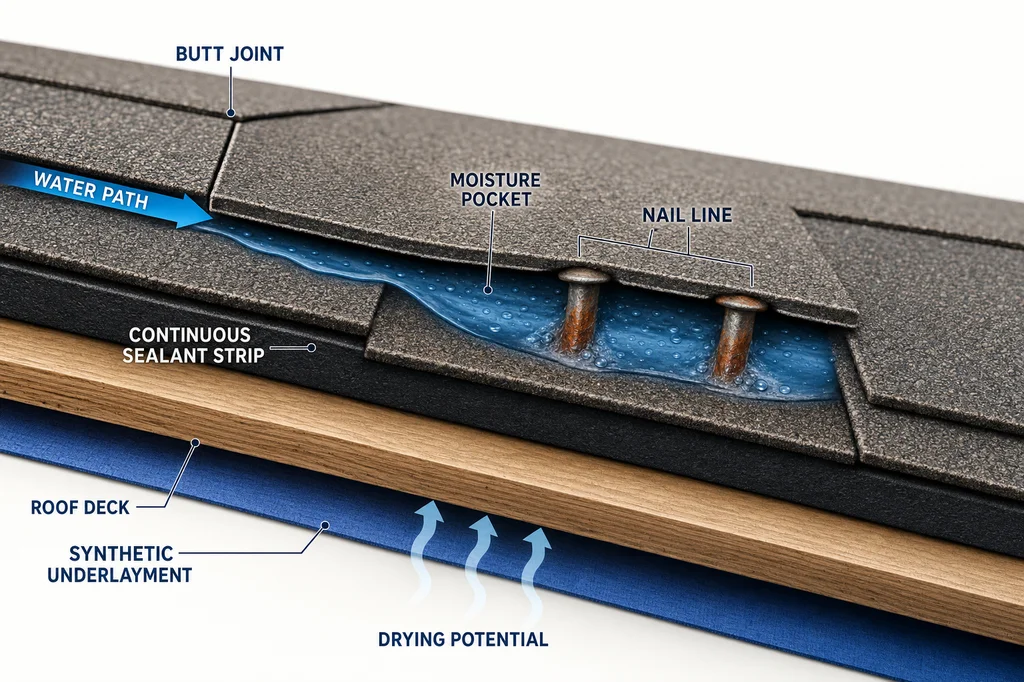
Shingle seal-strip moisture concerns deserve attention on a Florida reroof because moisture held near the nail line may contribute to nail rust and failed sealing. The shingle’s sealant pattern, the roof’s slope, and the underlayment layer can all affect whether trapped moisture has a path to dry.
Why nail-line moisture can become a shingle failure
Rusting nails may be a symptom of moisture being held between shingles rather than a problem with the nails alone. That distinction matters because replacing the nail type alone may not address the condition that keeps the nail line wet.
A reported Florida failure involved a solid seal running across a shingle. Moisture that got beneath the shingles reportedly could not dry as intended, and nails rusted within two years. As the nails rusted, the seal reportedly released and did not seal again. That can leave a route for water to get into the roof system.
Asphalt shingles need their overlapping layers to shed water while allowing incidental moisture to dry. A broad or continuous sealant line can change that drying behavior in certain roof conditions. This does not mean every shingle with a more continuous-looking sealant strip will fail. It means the complete roof assembly—not just the shingle color or wind rating—deserves review before materials are selected.
Low-slope roofs need closer review of the sealant layout
Low slopes may give water more opportunity to travel along a shingle course and collect near a nail line. Steeper roofs shed water more quickly, so the same overlap and sealant layout may behave differently.
The concern described for lower-pitch Florida roofs is a pocket created where shingle layers overlap. Water entering at a butt joint may travel toward that pocket and along the nail line. Double-laminated areas can add to the layering in that location. Since many Florida roofs are low-pitched, this is a practical material-selection and installation conversation, not a minor product detail.
- Roof slope: The installer should identify whether the pitch increases the chance of water moving sideways along the shingle course.
- Seal-strip placement: Compare how the proposed shingle applies sealant across the back or lower portion of the shingle, including whether it creates a largely continuous barrier.
- Butt-joint drainage: The layout should account for where water can go after reaching a shingle joint.
- Nail placement: Nails belong in the manufacturer’s designated fastening area. Incorrect placement can create a separate water-entry and sealing problem.
You do not need to inspect these details from the roof. A roofing professional can show you the proposed shingle sample, describe the nail line, and explain how its design fits your roof pitch.
Underlayment can affect drying above the roof deck
Synthetic underlayment may allow more air movement above the roof deck than older tar paper in the conditions described. That may reduce some moisture concerns, but it does not eliminate the need to evaluate moisture between shingle layers.
The reported explanation is that synthetic underlayment is not bound to the deck in the same way as older tar paper. Air and heat can move through plywood joints and between the deck and the synthetic layer. That movement was described as helping moisture dissipate below the shingles.
The more specific seal-strip concern is higher in the assembly: moisture held between shingle layers near the nail line. A reroof specification should therefore treat the shingle, underlayment, roof slope, fastening pattern, and details at joints as connected choices. Do not assume that selecting synthetic underlayment alone resolves a sealant-pattern concern.
How to review shingle options without relying on a sales claim
Compare the stated product design with reported field observations, then decide whether the assembly makes sense for your roof. Manufacturer literature can tell you what a shingle is designed to do; a roofer should be able to explain how that design will be installed on your particular slope.
Atlas shingles were described by a longtime user as retaining stickiness after years in service and resealing after being lifted and laid back down in hot conditions. That is a reported field observation, not a manufacturer specification for every Atlas product or roof. The same account noted that Atlas once had a machine-related issue that applied sealant across an area in a way that held moisture and contributed to nail rust, and that the issue was corrected.
Other shingles were described as having sealant lines that appear more solid across the back. A solid-looking line alone is not proof of a defect. It is a reason to request a clear explanation of the shingle’s intended drainage and sealing behavior on a low-slope roof.
Questions for the reroof proposal
- Which exact shingle will you install, and where are its sealant strips located?
- How does that sealant pattern work with my roof’s slope and butt-joint layout?
- What underlayment are you proposing, and why is it appropriate for this roof assembly?
- Where will nails be placed, and how will the crew verify consistent fastening?
- Will the written scope identify the shingle and underlayment products rather than using broad material descriptions?
A contractor who can answer these questions in plain language is giving you more than a wind-focused sales pitch. They are connecting material choices to the moisture path that can affect shingle performance.
When the installer’s plan matters more than the brand name
A good shingle can still underperform if the roof assembly ignores slope, fastening, or drying paths. The expensive mistake is accepting a vague proposal that names a shingle brand but does not show how the materials will work together.
Review the written scope before work starts, especially if your roof has broad low-slope areas. It should identify the selected shingle and underlayment and make clear who is responsible for following the manufacturer’s installation instructions. If roof design or moisture conditions are uncertain, confirm them with a roofing professional.
Directorii lists verified contractors.
Watch for early signs without going onto the roof
You should have a roofer investigate visible concerns rather than trying to lift shingles yourself. Loose tabs, recurring leaks, or staining that follows shingle courses can warrant a professional evaluation of fastening, sealant, and the surrounding roof assembly.
Rust itself may not be visible from the ground, and a leak can have more than one cause. A roofer should distinguish between a suspected nail-line moisture issue and other possibilities such as flashing, penetrations, or damaged shingles before recommending a repair or replacement.
Source: 2024 Roofing Shingle Guide: Problems with Sealants
FAQ
Can a shingle sealant strip cause nail rust?
A sealant pattern may contribute to nail rust if it holds moisture near the nail line and prevents that moisture from drying. A reported Florida failure linked a solid seal across a shingle to trapped moisture and rusted nails. Rust can also have other causes, so a roofer should evaluate the full roof assembly.
Why are low-slope Florida roofs a concern for shingle seal strips?
Low-slope roofs may allow water to travel farther along shingle courses and toward the nail line after it enters at a butt joint. Layered portions of the shingle can create a pocket in that path. The exact risk depends on the roof design, shingle layout, and installation details.
Will synthetic underlayment prevent moisture under shingles?
Synthetic underlayment may allow more air movement above the roof deck than older tar paper in the conditions described, which can help moisture dissipate below the shingles. It does not automatically resolve moisture held between shingle layers near a nail line. Review the underlayment and shingle design together.
Should I avoid shingles with a solid-looking sealant line?
A solid-looking sealant line is not, by itself, proof that a shingle will fail. It should prompt a specific conversation about the product’s intended drainage and sealing behavior on your roof slope. Ask the installer to explain the proposed shingle’s sealant layout and fastening area using an actual sample.
What should a reroof proposal say about nail-line moisture?
A useful proposal should identify the exact shingle and underlayment products and explain how they suit your roof’s slope. It should also address fastening according to the manufacturer’s designated nail area. Broad promises about wind resistance do not explain how moisture will move and dry within the roof assembly.