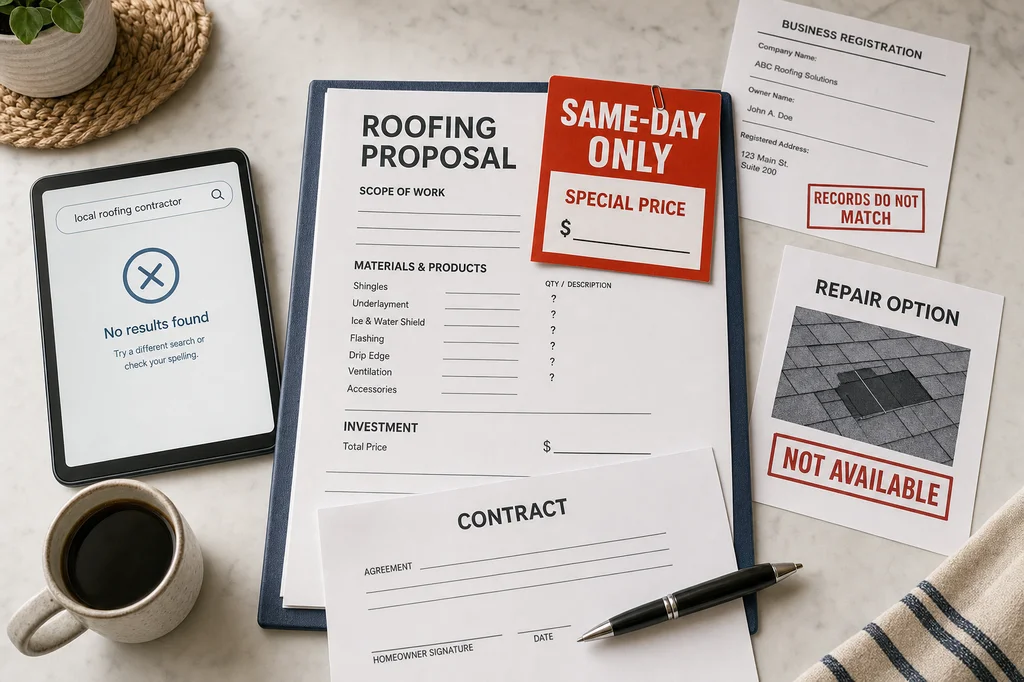
A roofer can sound convincing at the kitchen table and still leave crucial details off the paperwork. Watch for this particular combination: no written estimate, unnamed shingles and accessories, a price that disappears today, no repair option, and no clear answer about who owns the company.
1. The estimate is not in writing
A roofing proposal should leave you with a written scope of work and a price. If a contractor will discuss the job but will not provide an estimate in writing, that can create pressure to decide on the spot instead of giving you time to consider the offer.
A proposal that gives you time to review it is easier to compare with other estimates. A same-visit conversation is not a substitute for documents you can keep.
2. The estimate never names the products
“Generic shingles” does not tell you what is being installed. The estimate should identify the shingle product as well as underlayment and accessories. IKO, Owens Corning, Atlas, and Malarkey are among the manufacturers a roofer may specify, but the important point is that the proposal identifies the actual products being priced.
Less expensive materials are not automatically a bad choice. The problem is not knowing whether a lower price reflects a different shingle, underlayment, nails, or accessories. Product names and scope details make that comparison possible.
3. The price is good only today
A dramatic same-day discount can be a sales gimmick designed to secure a one-stop sale. Material prices can change over time, but a proposal that becomes thousands of dollars more expensive tomorrow deserves caution.
If you trust the contractor and are ready to proceed, you may choose to sign quickly. The concern is being pushed into that decision by an artificial deadline rather than by confidence in the scope, products, and company.
4. The company has no online listings
A contractor should be possible to find online. Search the company name and look for listings and public feedback on platforms such as Google, Facebook, or Thumbtack. An online record gives you a way to research the company and a public channel for feedback if there is a problem.
No online presence does not establish misconduct by itself, but it removes an important way to check a contractor’s reputation. When a company cannot be found online, pause before committing and consider what recourse you would have if the work goes badly.
5. The contractor travels from storm to storm
An out-of-state contractor can be harder to pursue when there is a money dispute or major workmanship problem. The concern is especially acute with small operations that move from market to market and may be difficult to locate after the roof is installed.
Size and track record matter. Apple Roofing in Lincoln, Nebraska, and Heath Hicks and AVCO Roofing in Texas were identified as examples of multi-location companies that may travel to storm-damaged areas. A company with several locations and an established reputation is different from a small traveling operation with no durable local presence.
Before hiring a contractor that came to town after a storm, find out who will be reachable if repairs are needed later and whether the business can meet applicable local permit requirements.
6. The company does not offer roof repairs
A replacement-only contractor has only one type of work to sell. That does not mean every roof can be repaired, but it can limit the options presented when a roof has an isolated problem or still has useful life left.
If you are told you need a full replacement, get opinions from local roofers that perform repairs as well as replacements. Compare whether they believe the condition can be repaired or supports replacement, rather than comparing replacement prices alone.
7. The person selling the job is not on the company paperwork
Check who is listed on the LLC or state business record and compare it with the company named on the proposal and contract. Ask questions when someone says they have been in business for many years but the company was registered only recently, or when the person presenting the contract is not connected to the entity on the paperwork.
There can be legitimate reasons for a newer registration or changed ownership. Get the explanation before signing. The contract should identify the business responsible for the work, and you should be able to identify who runs that business. Confirm the state registration, contract responsibility, and applicable permit or local requirements; if those issues remain unclear, consider consulting local counsel or the appropriate local authority.
The most concerning situation is not one missing detail alone. It is the pattern: pressure pricing, unnamed materials, no repair alternative, little online history, and unclear ownership. That pattern is a reason to stop, keep the paperwork, and seek clearer answers before signing.
Directorii lists verified contractors.
Source: 7 signs your Roofer is Shady: Roofing sales gimmicks explained
FAQ
What are the clearest signs a roofer may be shady?
Key warning signs include no written estimate, no named products, a same-day-only price, no online listings, a small out-of-state operation, no repair option, and unclear business ownership. Several of these signs together are more concerning than one issue by itself.
What should a roofing estimate identify?
It should provide a written scope of work and price, and it should name the products being used. That includes the shingles, underlayment, and accessories so you can compare what each contractor is actually proposing.
Why is same-day roofing pricing a warning sign?
A large discount that expires the same day can be used to push a one-stop sale before you can review the offer. Material costs can change over time, but an offer that is dramatically worse tomorrow is a reason to slow down and review the written proposal.
Should I get a repair opinion before replacing my roof?
Get opinions from roofers that perform repairs as well as replacements. Not every roof can be repaired, but a contractor that only sells replacements may not offer repair as an option when an issue is isolated or the roof still has useful life.
Should I automatically reject an out-of-state roofer after a storm?
Not automatically. The concern is whether the company will remain reachable if a workmanship issue or dispute arises. A multi-location company with an established reputation differs from a small operation that travels from market to market and may be hard to locate later.
How can I check who is responsible for a roofing contract?
Compare the company name on the proposal and contract with the state business record. Ask about recent registration, name changes, or ownership differences, and make sure the paperwork identifies the entity responsible for performing the work.