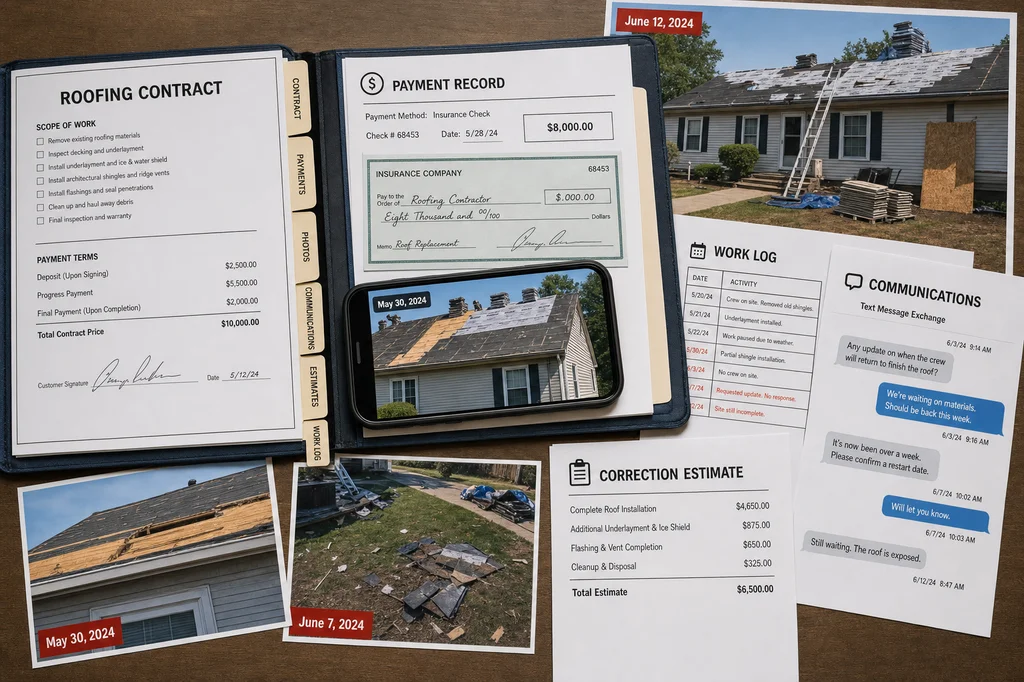
The complaints involving Rubinsky Roofing and the Texas Attorney General’s action show why homeowners should preserve proof the moment a roofer takes payment but work stalls. For any unfinished roofing job, a clear timeline, payment records, photos, and written promises can make a complaint easier to evaluate.
What the Texas action alleges about Rubinsky Roofing
The Texas Attorney General sued Gilad Rubinsky, owner of Dallas-based Rubinsky Roofing, alleging that homeowners paid for work that was never completed. The allegations include aggressive sales tactics, pressure to sign contracts, targeting elderly homeowners, and repeated excuses after payment.
The lawsuit reportedly seeks restitution for affected homeowners and penalties. Reported examples include one homeowner who allegedly lost $24,000 and another who said Rubinsky Roofing cashed a $10,000 insurance check before disappearing for six months. These are allegations in a state action, not proof that every Rubinsky Roofing project followed the same course.
For a homeowner, the key warning is not simply that a project is late. Roofing work can be delayed by weather, materials, permitting, or insurance questions. The concern becomes more serious when a contractor has substantial payment, cannot provide a specific restart plan, stops responding, or leaves promised work materially unfinished.
How homeowners documented a pattern of unfinished work
A group of roughly 40 homeowners reportedly organized through a WhatsApp group called Rubinsky Legal Matters. Aircraft mechanic Alvaro Camarena located people through Google reviews, Facebook posts, and roofing forums, then assembled their reports in a spreadsheet.
That approach gave separate complaints a shared structure. Participants reportedly collected names, phone numbers, amounts paid, promised work, and work actually completed. They also shared invoices, photos, screenshots, and accounts of missing money. A news report about the group chat was cited in the lawsuit.
That does not mean a homeowner needs to find other customers before raising a concern. It means your own file should be understandable to someone who was not there: an agency reviewer, insurer, attorney, or another roofing professional assessing the condition.
- Signed contract and addenda: These establish the promised scope, payment terms, and any change orders.
- Proof of every payment: Save copies of checks, card records, bank transfers, financing documents, deposit receipts, and images of any insurance check before endorsing it.
- A dated work log: Record who arrived, what was completed, what was left open, and each missed appointment or new promise.
- Photos and video from the ground: Document visible materials, exposed areas, debris, damage, and the condition of the home before, during, and after work. Do not climb onto the roof to collect evidence.
- All communications: Preserve texts, emails, voicemails, call logs, proposals, ads, and screenshots of messages that describe the schedule or explain delays.
- Written estimates for correction work: If another roofer identifies incomplete or defective work, retain that written assessment and scope.
What to do when a roofer has your money and stops responding
Move from informal calls to a concise written record. The goal is to give the contractor a fair, specific opportunity to respond while documenting exactly what remains unresolved.
Send one dated message that identifies the property, contract date, amount paid, work still incomplete, and the response you need. Avoid accusations you cannot support. Ask for a written schedule, a list of materials on order if that is the stated reason for delay, and a specific date for resuming work.
Keep the message factual. For example: “We paid [amount] on [date] under the attached agreement. The following contracted items remain incomplete: [list]. Please provide a written plan and start date by [date].” Retain proof that you sent it and any reply.
If the roof is open to weather or appears unsafe, contact a roofer promptly to assess and stabilize the condition. Your insurer may also need notice if there is storm-related damage or a claim involved. Coverage and claim handling depend on your policy, so confirm next steps directly with the insurer rather than relying on a contractor’s interpretation.
What to say in a complaint about Rubinsky Roofing or another roofer
A useful complaint separates verifiable facts from conclusions. State what you agreed to buy, what you paid, what was completed, what remains, and how the contractor responded when you requested completion.
- Identify the contractor, property, contract date, and project type.
- List each payment with its date, amount, method, and supporting record.
- Compare the written scope with the visible work that remains incomplete.
- Attach dated photos, communications, receipts, and your timeline.
- Describe the resolution you requested and whether the contractor gave a concrete written response.
Do not build a complaint around online speculation. Homeowners associated poker-tournament videos with possible gambling debts, but that connection was not verified. Stick to records that show your transaction and your property’s condition.
How to reduce the chance of being trapped in a stalled project
A contract and payment structure that let you track progress before more money changes hands can help you spot problems earlier. Before signing, make sure the written scope identifies the roof areas, materials, cleanup, payment milestones, and who handles insurance-related paperwork if a claim is involved.
Be wary of high-pressure requests to sign immediately or turn over insurance funds without a clear scope and schedule. A contractor’s good reviews or prior screening do not replace your own project records; the Rubinsky Roofing allegations show that problems may be difficult to see before work begins.
When selecting a roofing company, compare the written scopes rather than relying on a verbal promise. Directorii lists verified contractors.
If you are considering a formal complaint or a dispute over payment, preserve the originals, avoid altering records, and seek guidance from appropriate state agencies or a qualified attorney. Rules affecting contracts, insurance, and consumer complaints can vary by state and by the documents you signed.
Source: Mechanic Exposes Roofer Scamming Homeowners - Attorney General Takes Action
FAQ
What records should I save if Rubinsky Roofing left my roof unfinished?
Save the signed contract, all change orders, payment records, dated photos, messages, call logs, and a timeline of promised and missed work. The homeowners who organized complaints reportedly also compared amounts paid, promised work, and actual work completed. Keep originals and copies in one organized file.
Can I complain if a roofer took payment and then stopped answering?
You can document the problem and submit a fact-based complaint to the appropriate agency or seek legal guidance. First send a concise written request identifying the unpaid or incomplete scope and requesting a written completion plan. Preserve proof of delivery, your payment records, and every response or lack of response.
Should I endorse an insurance check to my roofing contractor?
Do not treat an insurance check as a substitute for a clear written scope, payment plan, and project schedule. The Rubinsky Roofing allegations included a homeowner who said a $10,000 insurance check was cashed before the contractor disappeared. Confirm check-handling requirements with your insurer because policy terms can differ.
How can several homeowners show a pattern of roofing problems?
A shared spreadsheet can organize separate reports without replacing each homeowner’s evidence. The group connected to the Rubinsky Roofing allegations reportedly collected contact information, amounts paid, promised work, completed work, invoices, photos, and screenshots. Each homeowner should keep records focused on their own contract and property.
What should I include in a complaint about unfinished roofing work?
Include the contractor’s name, your contract date, payments, the agreed scope, incomplete items, dated photos, and copies of communications. Explain what resolution you requested and whether you received a written response. Avoid unsupported theories about why the contractor acted as they did; clear transaction records are more useful.