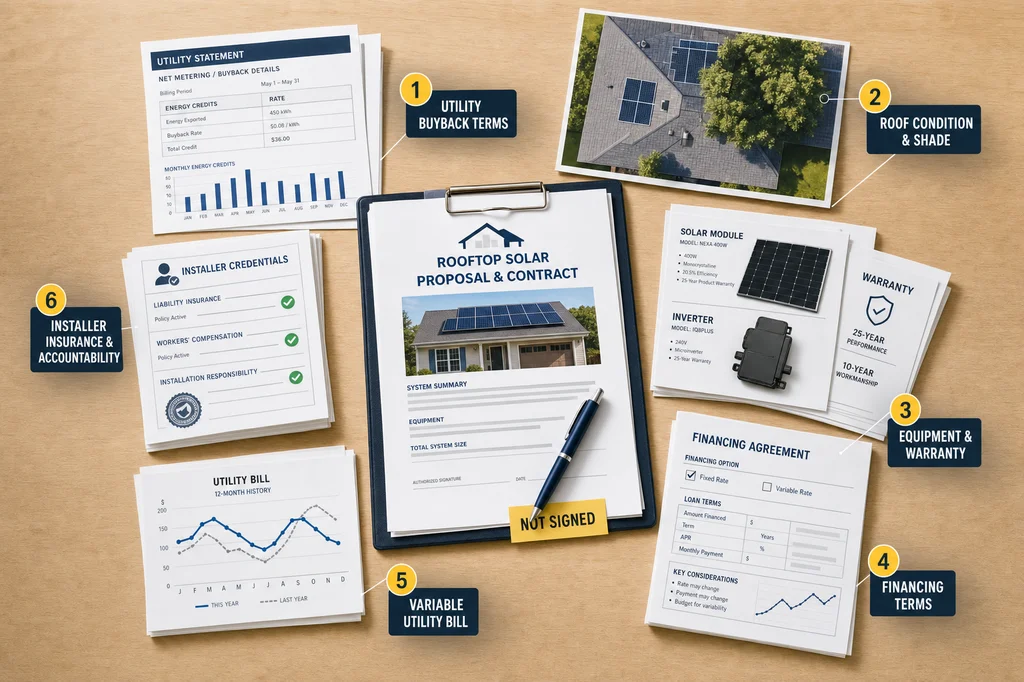
Before signing for rooftop solar, check how your utility credits extra power, whether the roof is ready, exactly what the contract promises, how financing works, and who will perform the installation. These six checks focus on the details that can change the value and experience of a solar project.
1. Check your utility's net-metering buyback rate first
Solar is not a one-size-fits-all purchase. Find out how your utility credits electricity your system produces but you do not use. A buyback rate that is not dollar-for-dollar can affect the financial result and may leave you paying more each month.
Review the utility's net-metering or buyback terms alongside the sales proposal. Make sure the estimate reflects the utility's actual credit treatment rather than a broad savings claim.
2. Make sure the roof is a fit for solar
Look at tree cover, usable roof space, and the roof's condition before selecting a system. The roof needs enough integrity to withstand the weight of a solar system.
A home with extensive tree cover or too little usable roof area may not fit the proposed system. Address known roof issues before the solar project is completed.
3. Get equipment, warranties, and promises in writing
Read the contract and all related paperwork. It should spell out the warranties, identify the equipment, and include the promises made during the sale. If a promise is not written in the contract, do not count on it.
Do not accept a vague equipment description. Confirm the specific panels and inverters proposed, how long their manufacturers have been in business, warranty length, industry track record, and whether there are concerns about failure rates.
4. Read the financing terms separately
If you are financing the system, understand the full financing agreement before signing. Check whether the cost is fixed or variable, whether the rate can change, and how billing will work.
- Rate type: Is the cost fixed or variable?
- Rate changes: Does the agreement state that the rate increases after a period of time?
- Billing start: Will billing begin immediately after installation, or is there a promotional period?
- Written terms: Read the financing paperwork as carefully as the solar contract.
A promotional period may delay the first bill, but it does not replace understanding the complete financing terms.
5. Do not expect the same utility bill every month
Solar does not mean a zero-dollar utility bill every month. A system may be designed to produce the amount of energy used during the previous year, while utility bills still vary by season. Summer months can bring higher bills and winter months lower bills.
Set expectations around annual energy use and the utility's billing treatment instead of assuming a zero balance every month.
6. Verify who is responsible for the installation
Check whether the company has general liability insurance and workers' compensation coverage, uses W-2 employees, and subcontracts work. Also look at how long the contractor has been in business, its financial stability, reviews, customer experiences, and whether it has active lawsuits or class-action lawsuits.
Subcontractors are not automatically a negative, but using many subcontractors can reduce quality control. Find out who will perform the work and how the company controls materials, workflow, and installation quality.
Directorii lists verified contractors.
Source: MUST KNOW FACTS about Roofing Solar Energy
FAQ
Why does the utility buyback rate matter for rooftop solar?
The buyback rate determines how the utility credits electricity your system produces but does not use. If the rate is not dollar-for-dollar, it can affect the financial result and may leave you paying more each month.
What should I check about my roof before installing solar?
Check tree cover, usable roof space, and roof condition. The roof needs enough integrity to withstand the system's weight, and known roof issues should be addressed before the solar project is completed.
What needs to be included in a solar contract?
The contract should identify the panels and inverters, spell out warranties, and include promises made during the sale. Do not rely on a promise that is not written in the contract.
What financing terms should I review before signing?
Review whether the cost is fixed or variable, whether the rate can change, when billing starts, and whether a promotional period applies. Read the financing paperwork completely.
Will solar eliminate my electric bill every month?
No. Solar does not mean a zero-dollar utility bill every month. A system may be designed around the prior year's energy use, while bills can still vary by season.
Should I ask whether the installer uses subcontractors?
Yes. Subcontractors are not automatically negative, but using many subcontractors can reduce quality control. Ask who will perform the installation and how the company controls materials, workflow, and installation quality.