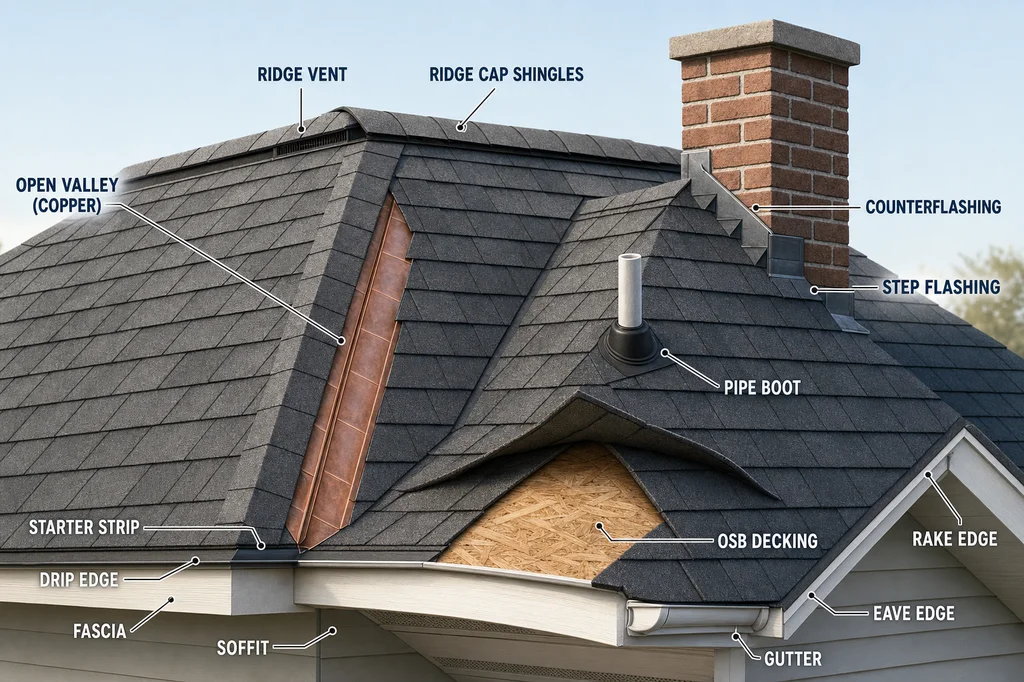
Roofing terms homeowners hear in a reroofing quote can identify the parts of the roof being discussed. This guide covers roof squares, decking, valleys, pipe boots, step flashing, and counterflashing—the components that help translate a scope into plain language.
Start with the roof measurements and edges
A slope, sometimes called a facet, is one plane of the roof. Its pitch describes steepness. Roofers may refer to a 9/12, 10/12, or 18/12 pitch; the higher number indicates a steeper roof.
A roofing square is a trade measurement equal to 100 square feet. A 19-square roof equals 1,900 square feet. When a quote states a square count, it is describing roof area.
- Eave: the horizontal lower edge of the roof, where shingling begins. Drip edge and starter strip may be installed here.
- Rake: the sloped or pitched edge of a roof. Drip edge and starter strip can also be installed along a rake.
- Gable: the triangle formed where two rakes meet. A vent in that triangle is a gable vent.
- Ridge: the peak where two roof slopes meet.
- Hip: the outward meeting point of two slopes.
Valleys, hips, and the ridge have different finishes
A valley is where two slopes join inward. Valley methods include woven valleys, no-cut valleys, and open valleys. One open-valley example uses copper W-shaped flashing.
A hip is the opposite arrangement: two slopes join outward. Ridge cap shingles cover the hip connection. At the roof peak, ridge vent runs along the ridge, and ridge cap shingles are installed over the vent.
When these terms appear in a reroofing scope, they distinguish separate roof features. An open valley with copper W-shaped flashing is not the same component as ridge vent covered by ridge cap shingles.
Decking is the layer shingles are nailed into
Roof decking, also called sheathing, is the layer shingles are nailed into. The illustrated decking is OSB sheathing. “Rotten decking” refers to deterioration in that layer.
Below the decking, rafters provide the roof structure. The portion of a rafter that extends past the house is the rafter tail. At the eave, fascia is behind the gutter, while the soffit is part of the underside of the overhang.
Pipe boots and flashing cover roof transitions
Penetrations and wall transitions use dedicated flashing components. Knowing their names helps distinguish the parts being discussed in a roofing scope.
A pipe boot, also called a pipe jack, seals PVC or other round pipes passing through the roof.
Step flashing is used where a roof meets a wall, chimney, or similar vertical surface. The individual metal pieces sit beneath shingles. Water hitting the metal pan drains to the next piece rather than going underneath the shingles. Step flashing can also be used around a skylight.
Counterflashing covers the top of flashing at a brick wall or brick chimney, where water could otherwise get behind the flashing. It may be cut into brick or installed with a bead of sealant.
Read a reroofing scope by its named components
Rather than treating every roofing term as interchangeable, match the listed component to the roof feature it describes:
- Confirm whether a valley is described as woven, no-cut, or open—and, for an open valley, whether copper W-shaped flashing is named.
- Separate ridge vent from the ridge cap shingles installed over it; ridge cap shingles may also be used on hips.
- Recognize OSB sheathing or roof decking as the layer shingles are nailed into.
- Identify pipe boots or pipe jacks for round roof penetrations.
- Look for step flashing where the roof meets a wall, chimney, or skylight, and counterflashing at a brick wall or chimney.
Directorii lists verified contractors.
Source: Roofing Insights: roof components and roofing terms
FAQ
What is a roofing square on a reroofing quote?
A roofing square equals 100 square feet of roof area. For example, 19 squares equals 1,900 square feet.
What is the difference between a roof valley and a hip?
A valley is where two slopes join inward. A hip is where two slopes join outward. Valley methods mentioned include woven valleys, no-cut valleys, and open valleys; an open valley can use copper W-shaped flashing.
What does roof decking mean?
Roof decking, also called sheathing, is the layer shingles are nailed into. OSB is one type of roof sheathing. The term rotten decking refers to deterioration in that layer.
What is a pipe boot or pipe jack?
A pipe boot, also called a pipe jack, is flashing used to seal PVC or other round pipes passing through the roof.
What is step flashing versus counterflashing?
Step flashing is used where a roof meets a wall, chimney, skylight, or similar vertical surface, with metal pieces installed beneath shingles. Counterflashing covers the top of flashing at a brick wall or brick chimney and may be cut into brick or installed with a bead of sealant.