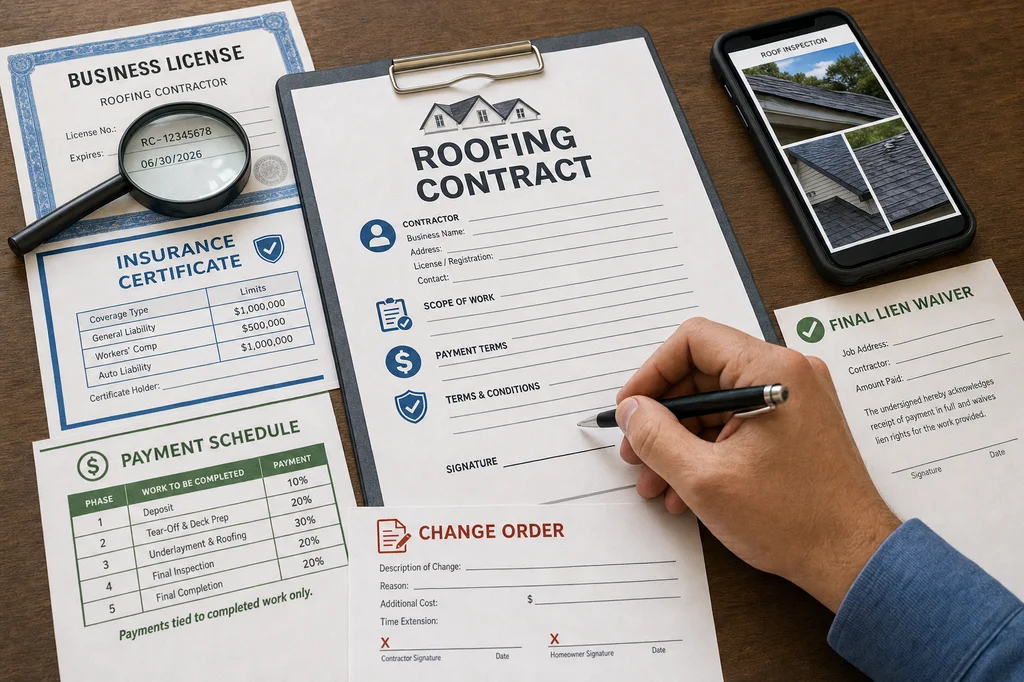
This homeowner roofing scam checklist can help you slow down before a contractor gets access to your roof, insurance claim, or money. Verify the company’s real local identity, require clear inspection evidence, connect payments to work completed, and keep signed paperwork for every added charge before you sign.
Verify that the roofer is actually local
A local phone number, polished website, top search placement, and five-star reviews do not prove that a roofing company has a real local presence. Some home-service listings have used false addresses, bought reviews, or routed calls through a national lead-generation operation.
The local identity check matters most before a storm-related contract. A contractor who leaves the area after the work may be difficult to reach if a leak or warranty issue develops.
- Look up the business registration. Check your state contractor database and confirm any license or registration number required where you live.
- Verify the street address. Make sure it is an actual business location, not a vacant lot, mailbox, unrelated store, or address that does not match the company.
- Confirm insurance documentation. Request proof of insurance rather than relying on a statement in an advertisement.
- Search the company and owner’s name. This can reveal prior complaints, enforcement actions, or name changes that deserve an explanation.
- Check local references. Ask who will handle service after the storm work has ended and where that team is based.
After hail, wind, or tornado damage, handle urgent protection without rushing into a full replacement agreement. A temporary tarp can limit additional water entry while you take time to verify the company that wants the larger job.
Require usable proof before accepting roof damage
A free inspection is not automatically suspicious, but an unknown roofer who insists on immediate roof access or pushes a replacement with blurry photos is a serious warning sign. The concern is not the word “free”; it is whether the inspection produces reliable, reviewable evidence.
North Carolina insurance investigators announced a roofing-scam sting in late 2025 involving allegations that a project manager bent shingles and then described the damage as wind and hail damage. The allegation illustrates why a homeowner should not accept a damage claim solely because a contractor made it.
Ask for clear photos or video of each claimed damaged area and a written explanation of what the images show. A paid roofing report may also provide written findings and documented images, but payment alone does not establish accuracy. For an insurance claim, involve your insurer’s adjuster or an independent inspector before signing a contract based on disputed damage.
Do not accept a pitch that your roof will be “free” because the contractor will handle the deductible. A deductible is part of your policy, and rules about deductible assistance vary by state and policy. The Texas Department of Insurance has stated that contractors cannot waive or help a homeowner avoid a deductible there. If a contractor proposes a credit, rebate, inflated estimate, or omitted work to offset it, call your insurer and get the proposal in writing before moving forward.
Match your payment schedule to visible progress
Large upfront payments can leave you with little leverage if work stalls, materials never arrive, or the contractor disappears. A reasonable deposit can be normal, but paying all or most of the contract amount before materials are delivered or work begins deserves a clear explanation.
Missouri’s attorney general announced a restitution judgment in 2025 involving Excel Roofing, doing business as Love Our Roof, after the state said consumers made large advance payments for roofing work that was not completed. Separate reports have also described contracts with substantial cancellation fees, including fees that could apply even when little or no work was performed.
Use a written payment schedule tied to identifiable project stages, such as a deposit, delivered materials, completed tear-off, installation progress, and completion. The contract should state what triggers each payment, not merely list a sequence of dates. Read the cancellation language closely before signing, including any percentage-based fee and the conditions that trigger it.
Do not approve surprise work without a signed change order
Hidden decking damage, flashing problems, ventilation concerns, and other conditions can be real, but urgency does not replace proof. A contractor should explain foreseeable unknowns before work begins and document any newly found condition before charging for it.
Police in Redmond, Washington, warned residents in early 2026 after a homeowner reported a roofing and construction scheme that allegedly expanded from roofing work into claimed urgent repairs and very large payments. The risk increases once tear-off has started because homeowners may feel they have no practical choice but to agree.
Use this three-part rule for added work:
- Proof: Request clear photos or video showing the condition.
- Price: Get the additional scope and price in writing before the work is done.
- Permission: Sign a change order only after you understand it. For an expensive or alarming claim, seek another qualified opinion if circumstances allow.
Before the original contract is signed, ask whether the contractor inspected the attic and what parts of the roof assembly could not be evaluated from accessible areas. That conversation will not eliminate hidden conditions, but it can make potential costs less of a surprise.
Collect payment and lien paperwork before final payment
Final payment should come with documents that match the agreed scope and show how project participants were paid. A payment dispute can create title problems if a contractor, supplier, or subcontractor records a lien, depending on the contract and your state’s lien laws.
Florida enforcement reporting in 2026 included allegations involving deceptive practices and allegedly baseless liens after consumer disputes. Those allegations are not proof about every contractor, but they underscore why homeowners should treat lien waivers and supplier-payment records as project documents, not afterthoughts.
- Compare the final invoice with the signed contract and every signed change order.
- Request lien waivers appropriate to the work and payment stage.
- Request proof that suppliers and subcontractors have been paid when relevant to your project.
- Keep copies of the contract, invoices, payment receipts, inspection evidence, and change orders together.
Requirements for lien waivers and supplier claims vary by state and contract. If you receive a lien notice, demand for payment, or legal threat, review it promptly with a qualified attorney or your state consumer-protection office rather than relying on a roofer’s interpretation.
The most expensive mistake is often hiring the contractor who creates urgency but avoids documentation. Directorii lists verified contractors.
Source: 7 Roofing Scams to Avoid in 2026
FAQ
How can I tell whether a roofer with a local phone number is really local?
Treat the phone number as a starting point, not proof of a local business. Check the company in your state contractor database, verify its street address, request insurance documentation, and search both the company and owner’s name. A vacant lot, mailbox, or address unrelated to the business is a reason to stop and investigate further.
Should I let a roofer who knocks on my door perform a free inspection?
You can consider a free inspection, but do not allow immediate roof access without first checking the company and agreeing on documentation. Request clear photos or video of every claimed damaged area and a written explanation. If an insurance claim is involved, involve your insurer’s adjuster or an independent inspector before signing a contract.
What should I do if a roofer says they can make my deductible disappear?
Pause the transaction and call your insurance company before agreeing to the proposal. Deductible rules vary by state and policy, and the Texas Department of Insurance has said contractors cannot waive or help avoid a deductible there. Ask for all pricing, credits, rebates, and scope details in writing so your insurer can review them.
How should roofing payments be scheduled to reduce scam risk?
Payments should be connected to visible, defined progress rather than concentrated before work begins. Your contract can identify milestones such as a deposit, materials delivered, tear-off, installation progress, and completion. Review cancellation terms carefully, especially any percentage-based fee, before signing and before handing over a large advance payment.
Can a roofer charge more after tear-off for hidden roof damage?
A roofer may find legitimate concealed conditions after tear-off, but you should receive proof, written pricing, and a signed change order before added work proceeds. Ask for photos or video of the condition and a clear scope of repair. If the added charge is substantial, seek another qualified opinion when practical.
What paperwork should I get before final payment for a roof replacement?
Get a final invoice that matches your signed contract and approved change orders, plus lien waivers and relevant proof of supplier or subcontractor payment. Keep all contracts, invoices, receipts, photos, and change orders together. Lien rules vary by state, so obtain qualified legal guidance promptly if you receive a lien notice or payment demand.