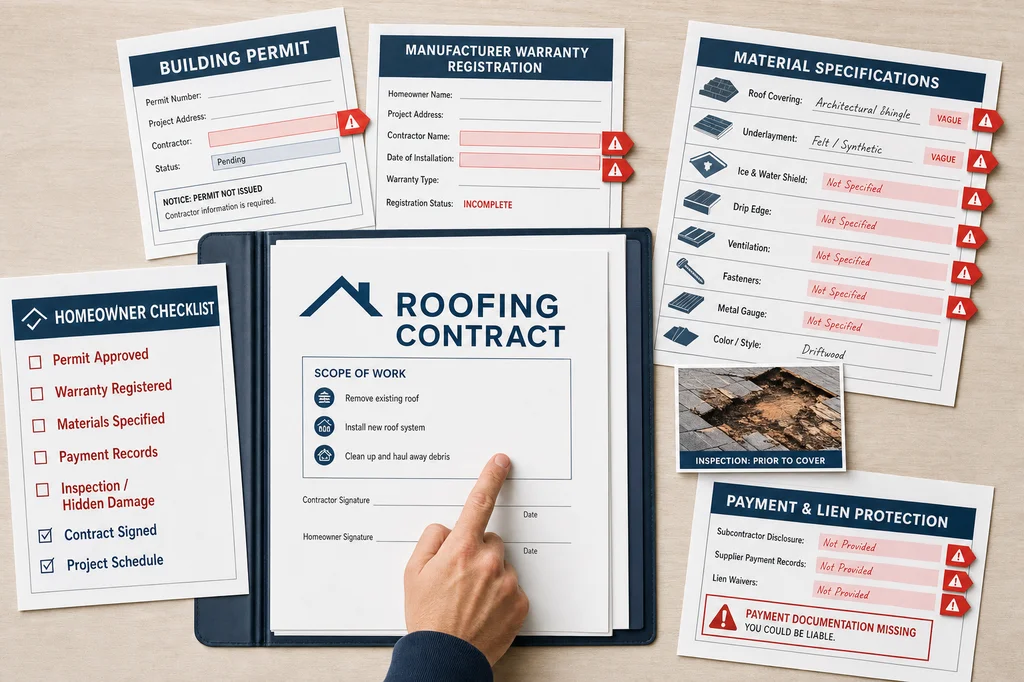
A roofing contract can look complete while leaving out the records that identify who is responsible, what materials will be used, and how the work will be documented. This checklist follows seven red flags: missing permits, unregistered warranties, vague materials, concealed rot, unpaid workers, unpaid suppliers, and a contractor who disappears through bankruptcy.
1. A permit is missing or tied to the wrong party
A permit is paperwork that registers the work with the government. Where permits apply, they can help connect a roofing job to the company and business owner behind it. That record may make it easier to trace a pattern when a business closes and reopens under another name.
In Minneapolis, roofers, general contractors, and remodelers need a license to pull permits. Processes differ by location and by project, so ask whether a permit applies to your roof and who will be listed on it. Be cautious when a company dismisses the question without a clear explanation.
2. The warranty is promised but never registered
Sales claims about premium brands or warranty coverage are not the same as warranty registration. A contractor may say it has a relationship with a major manufacturer, yet fail to complete the paperwork that supports the warranty.
Ask whether the warranty will be registered, who handles the paperwork, and what records you will receive. Keep the warranty documents with the contract. Missing paperwork does not prove a roof will fail, but it can leave a homeowner with less documentation if a dispute arises.
3. The contract names the roof color but not the full system
Writing down only a shingle type, color, or broad label such as “metal roof” leaves room for cheaper substitutions. Underlayment, accessories, and metal thickness can materially change what is installed.
For standing-seam metal roofing, 26-gauge and 29-gauge metal have a significant cost difference. A contractor could also save money by using cheaper underlayment or accessories when those items are not specified in writing.
- Identify the roof covering and relevant specification, such as metal gauge when applicable.
- Name the underlayment instead of leaving it as a generic item.
- List the accessories included in the price.
- Compare written specifications with any material specification included in an insurance claim.
Ask these questions before signing, then keep the answers in the contract.
4. Soft or rotted wood is covered instead of replaced
Rotted or soft wood can be concealed once the roof is covered. The risk is not limited to roofing: old or damaged materials can be covered over in flooring, framing, siding, and exterior work as well.
Ask who will manage the job, who will supervise subcontractors, and how concealed damage will be documented before it is covered. Roofing companies may use subcontractors, but the important question is whether someone is watching the work and performing a quality check.
5 and 6. Workers or suppliers are not being paid
A contractor who does not pay subcontractors, laborers, or suppliers can create a serious problem for the homeowner. Payment disputes may lead workers or material suppliers to contact the property owner and ask for lien-related paperwork.
Before hiring, read reviews and ask questions about the company’s payment reputation. If payment or lien concerns arise, ask what payment documentation is available for the job. Do not rely on a roofer for legal advice about unfamiliar lien forms, notices, or disputes; consult qualified local legal counsel.
7. The contractor has a pattern of closing businesses
Contractors can go out of business, and a business owner may later operate through another company. Deposits followed by long delays, reports of unpaid workers or suppliers, and a repeated pattern of business changes are reasons to investigate further.
Reviews can reveal concerns that do not show up in a sales presentation. Look for reports that homeowners paid a deposit and received no work for months, or that workers and suppliers were left unpaid. Directorii lists verified contractors.
A short roofing paperwork checklist
- Ask whether a permit applies and who will be listed on it.
- Get the promised warranty paperwork and ask whether registration is part of the job.
- Put the roof covering, underlayment, accessories, and applicable metal gauge in writing.
- Ask who supervises the crew and how hidden damage will be documented.
- Ask about available payment documentation if subcontractors or suppliers are involved.
- Read reviews for reports of unpaid bills, abandoned work, or repeated business changes.
Source: 7 Ways Contractors Scam Home Owners
FAQ
Why does a roofing permit matter?
Where a permit applies, it registers the work with the government and can help connect the job to the company and business owner behind it. In Minneapolis, roofers, general contractors, and remodelers need a license to pull permits. Ask whether a permit applies to your project and who will be listed on it.
What roofing materials should be written into the contract?
The agreement should identify more than the visible roof color or a broad roof type. Put the roof covering, underlayment, accessories, and relevant specifications in writing. For standing-seam metal, the gauge matters: 26-gauge and 29-gauge metal have a significant cost difference.
How can I check whether a roofing warranty was registered?
Ask whether registration is part of the promised warranty, who will complete it, and what paperwork you will receive. A claim that a contractor works with a major brand is not the same as completed warranty paperwork.
What should I ask about rotted wood found during roofing work?
Ask who will manage the job, who will supervise subcontractors, and how concealed damage will be documented before it is covered. The concern is that soft or rotted wood may be covered instead of replaced when there is no meaningful quality check.
What if a roofing contractor has not paid workers or suppliers?
Ask what payment documentation is available and keep records related to the job. Reviews may also reveal reports of unpaid workers, suppliers, or long delays after a deposit. If you receive a lien-related notice or do not understand a form, seek qualified local legal advice.