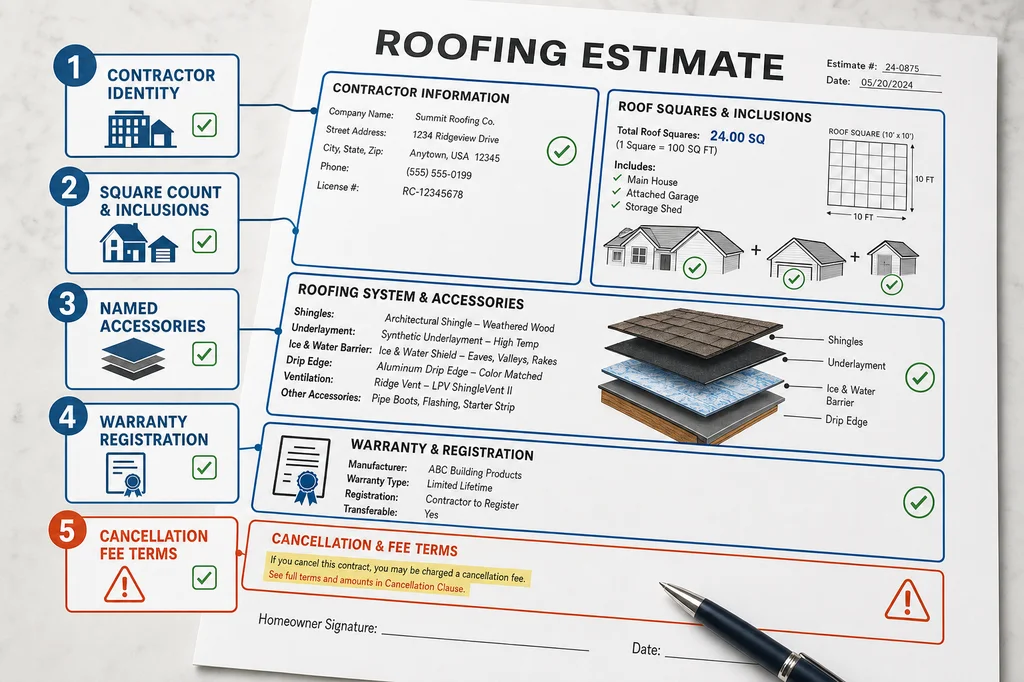
A roofing estimate can look complete while leaving out the details that define the job. Before signing, check five items: the company’s identifying information, the roof-square quantity and structures included, named accessory materials, warranty-registration responsibility, and cancellation-fee language.
1. Can you identify and reach the company?
Start with the information printed on the estimate: company address, phone number, and license information. These details make the business easier to trace and give you a way to reach an office if a dispute or cancellation issue arises.
Scammers can pose as another company. In one Minneapolis case, people represented themselves as a real company; a call to the office would have shown that the sales representative did not work there. For a large project, especially one costing more than $20,000, consider visiting the address listed on the estimate to see whether the business has a physical location.
- Is an address listed?
- Is there an office phone number you can call?
- Is license information included?
- Does the office confirm that the salesperson represents the company?
2. Does the quantity explain what roof area is priced?
Roofing is measured in squares. One square is a 10-foot-by-10-foot area, or 100 square feet. The square count helps define material quantity and the scope of replacement.
Some estimates show a quantity of “1” beside a lump-sum price. That is not automatically a problem if the written description clearly explains the complete replacement, removal of old materials, installation of new materials, dumpster service, and other work. Still, ask what that “1” represents and why the estimate does not show the actual number of squares.
Aerial measurement reports from EagleView can provide roof measurements without requiring a contractor to climb the roof. The roofer should be able to explain the square count and the waste factor used for materials.
Read the scope for every roofed area. Is an attached garage included? What about an attached shed? Is the estimate for a full replacement or only the portion an insurance company is paying for? Unclear quantities and descriptions can lead to arguments over whether the bid covered 2,200 square feet when the home has a 28-square roof.
3. Are underlayment and accessories named?
A shingle name does not identify the entire roof system. An estimate may prominently list a shingle line while saying little about the underlayment, synthetic felt paper, ice-and-water materials, and other accessories.
Ask for the accessory materials in writing. Useful details include product type, brand, and grade where applicable—not a vague promise of “quality materials.” The difference between premium, generic, and builder-grade accessories can be significant on a large roof, and the estimate should show what is being installed.
This matters when replacing a roof with premium materials through an insurance claim. If the estimate names only the shingles, it can be difficult to tell whether the rest of the proposed system matches the quality of the materials being replaced.
4. Who provides the warranty, and who registers it?
“Lifetime warranty shingles” does not explain the full warranty. The estimate or contract should identify the warranty term, who stands behind it, and how you will receive proof after installation.
Ask whether the warranty comes from the roofing company or the manufacturer. Also ask whether the roofer will register the installation and upload material receipts or other documentation. An estimate is not a warranty certificate.
Some higher-tier manufacturer warranties may require several specified accessories—and sometimes all of them—to come from the same brand. Ask what materials are required for the warranty being offered and what certificate or confirmation will be provided after the job is complete.
5. What does it cost to cancel?
Read the cancellation language before signing. Look for the percentage charged, when it applies, and what work the fee is meant to cover. A roofer may spend time meeting an adjuster or communicating with an insurance company, and a written charge for that work may be part of an agreement. But a percentage fee can become large on a high-value roofing project.
One example involved C Market Roofing and Construction in Florida and 25% cancellation fees. On a $50,000 job, that percentage is $12,500. Whatever the amount, do not assume you can cancel without cost simply because no materials have been installed. Read the fine print and understand the fee before approval.
If a cancellation clause is unclear or high-stakes, have a qualified local attorney review it before signing.
Compare two estimates by filling in the blanks
Put the estimates side by side and write down the answer to the same five items for each one: company address and license information; square count and included structures; underlayment and accessory names; warranty provider and registration paperwork; and the cancellation amount. A blank answer is useful information: it shows exactly what needs to be clarified before you choose.
Directorii lists verified contractors.
Source: How to Read Roofing Estimates: Roofer's Tips for Home Owners
FAQ
What is a roofing square on an estimate?
A roofing square is a 10-foot-by-10-foot area, equal to 100 square feet. The estimate should make clear how many squares are being priced and how that quantity relates to the roof areas included in the work.
Why is a quantity of “1” on a roofing estimate a concern?
A single lump-sum quantity can be acceptable when the description clearly explains the entire scope. If it does not, ask what the “1” represents and request the actual square count. Without it, it can be difficult to determine whether garages, sheds, or the full roof are included.
Should a roofing estimate list underlayment by name?
It should identify the underlayment and other accessory materials clearly. A named shingle line alone does not tell you whether the estimate includes synthetic felt paper, ice-and-water materials, or the accessory grades you expect.
What warranty details should be in a roofing contract?
The contract should state the warranty term, whether the company or manufacturer provides it, whether the roofer will register the installation, and what certificate or confirmation you will receive after installation. Some higher-tier manufacturer warranties may require several specified accessories from the same brand.
What should I look for in a roofing cancellation fee?
Check the fee amount, whether it is a percentage, when it starts to apply, and what work it covers. Read the agreement before signing, particularly when the fee is a high percentage of a large roofing project. Consider a qualified local attorney for an unclear or high-stakes clause.