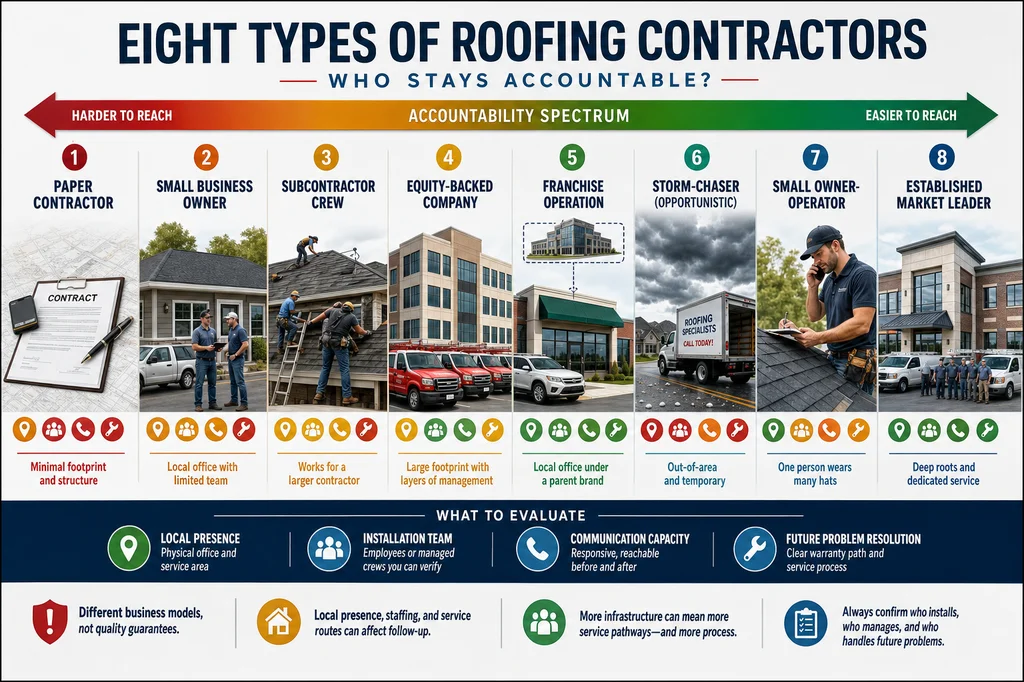
Not every roofing company is built to handle the same kind of work—or the same kind of problem after installation. Looking at a company's operating footprint can reveal more than a sales pitch: whether it has a local office, a team, an established service process, and someone who can respond when the roof needs attention later.
The eight business models below range from lightly established operations to large local names. A label alone does not determine workmanship, but it can help explain differences in price, customer service, and post-installation accountability.
1. Paper contractors: paperwork without much operating footprint
A paper contractor may have an LLC, logo, and contract documents while having little visible business infrastructure. This type may work from home, have no employees or office, sell a job, and then find someone else to perform it.
That structure does not determine workmanship by itself. The concern is accountability: a business with little established footprint may be easier to close, rename, or become difficult to reach after a dispute. Confirm where it operates, whether it has employees, and who will perform and manage the work.
2. Small business owners: a team with reputation at stake
Small business owners are a distinct category from solo owner-operators. These firms are often roughly $3 million to $10 million businesses; this is a practical benchmark, not a universal rule. They may have an office, managers, employees, a few crews, sales representatives, training, certifications, and manufacturer relationships.
These companies may not have the advertising reach of the largest firms, but their reputation can matter to continued growth. Look for a clear team structure, including project managers and office staff, and understand how the owner remains involved when a problem needs resolution.
3. Subcontractors: lower price, less homeowner-facing leverage
Subcontractors often work for builders or larger roofing companies. Some also take direct homeowner jobs, sometimes at a lower price. On paper, a subcontractor may look much like another roofing business, with an LLC and license, but its business may be built around serving larger accounts rather than maintaining homeowner relationships.
When hiring a subcontractor directly, establish who is responsible for the finished roof and stay engaged while the work is underway. If communication stops or contact information changes, getting corrections can be difficult.
4. Equity players: resources and layers of management
Large equity-backed roofing companies may have extensive advertising, many vehicles, multiple managers, and substantial resources. This category can include companies with $100 million or more in sales that grow through private-equity investment or acquisitions.
Scale can create more paths to raise a problem with management. It can also mean more bureaucracy, less personal service, premium pricing, and subcontracted labor. Identify the installation team and the manager responsible for a workmanship concern.
5. Franchises: evaluate the local franchisee, not just the name
A franchise combines a recognizable brand with a local business that buys into and operates under that brand. A familiar name does not remove the need to assess the local franchisee that will sell, install, and service your roof.
Focus on the local operation's ownership, history in your area, and process for handling post-installation issues. The company performing the local work is the business a homeowner will deal with if problems arise.
6. Storm-chasers: temporary operations after hail or wind
A storm-chaser is not simply a roofer that works on insurance claims. It is a contractor that travels to an area where it did not previously have an office to pursue work after a hail or wind event.
These companies may arrive with sales and marketing staff but rely on local labor to produce the work. Their stay can be temporary, making warranty service and future problem resolution a larger concern once storm demand slows. Verify whether the company operated locally before the storm, where it will be afterward, and who will receive future service requests.
7. Small owner-operators: direct involvement with limited capacity
A small owner-operator may answer calls, write estimates, manage jobs, and oversee quality personally. That hands-on involvement can be valuable, particularly when the owner cares deeply about the finished roof.
The tradeoff is capacity. When one person handles estimating, scheduling, communication, and job management, calls, invoices, or updates can be delayed during busy periods or an absence. Establish how communication and job oversight will continue when the owner is on another project.
8. Market leaders: established reputation, higher cost and wait times
A market leader is a large, familiar local company that has been around for decades, has broad name recognition, and has a substantial review record. These firms may be visible through advertising and prior work in the community.
They may also cost more and take longer to schedule. An established reputation can provide an incentive to resolve problems, but it does not make a roofing project risk-free. Weather, safety incidents, material failures, and installation mistakes can affect any roofing company.
Read the business footprint before signing
Rather than treating any category as an automatic yes or no, compare four practical details: the company's local presence, the people who will install and manage the job, its capacity to communicate during the project, and the route for resolving a problem afterward. Match those details to the company name on the estimate and contract, the stated scope of work, and its local history.
Price matters, but the business structure can shape what happens when a roof needs follow-up.
Directorii lists verified contractors.
Source: 8 Type Of Roofers (Guide for Home Owners)
FAQ
What is a paper roofing contractor?
A paper contractor may have an LLC, logo, and paperwork but little visible operating footprint, such as no office or employees. The key issue is who will perform the work and whether the business will be reachable if the roof needs correction.
How are small business owners different from owner-operator roofers?
Small-business-owner companies are often roughly $3 million to $10 million businesses, although that is not a universal size rule. They may have a team, office, managers, training, and manufacturer relationships. A small owner-operator is more likely to have one person handling estimates, calls, job management, and quality oversight.
What makes a roofing company a storm-chaser?
A storm-chaser travels to an area where it did not previously have an office to pursue work after hail or wind damage. It is not simply a company that handles insurance-related roofing work. Its temporary presence can make later service a concern.
Should a roofing franchise be evaluated differently?
Yes. A franchise has a larger brand, but the local franchisee operates the local business that sells and performs the work. Evaluate the local company's ownership, history, and service process instead of relying on the brand name alone.
Why might a subcontractor offer a lower roofing price?
A subcontractor may take direct homeowner work in addition to working for builders or larger roofing companies, which can reduce the initial price. If hired directly, clarify who is responsible for corrections and monitor the work while it is being completed.
Are market-leading roofing companies always the safest choice?
Market leaders may have decades of local history, broad recognition, and a substantial review record, but no roofing company is immune to weather disruptions, material failures, safety incidents, or installation mistakes. They may also charge more and have longer wait times.