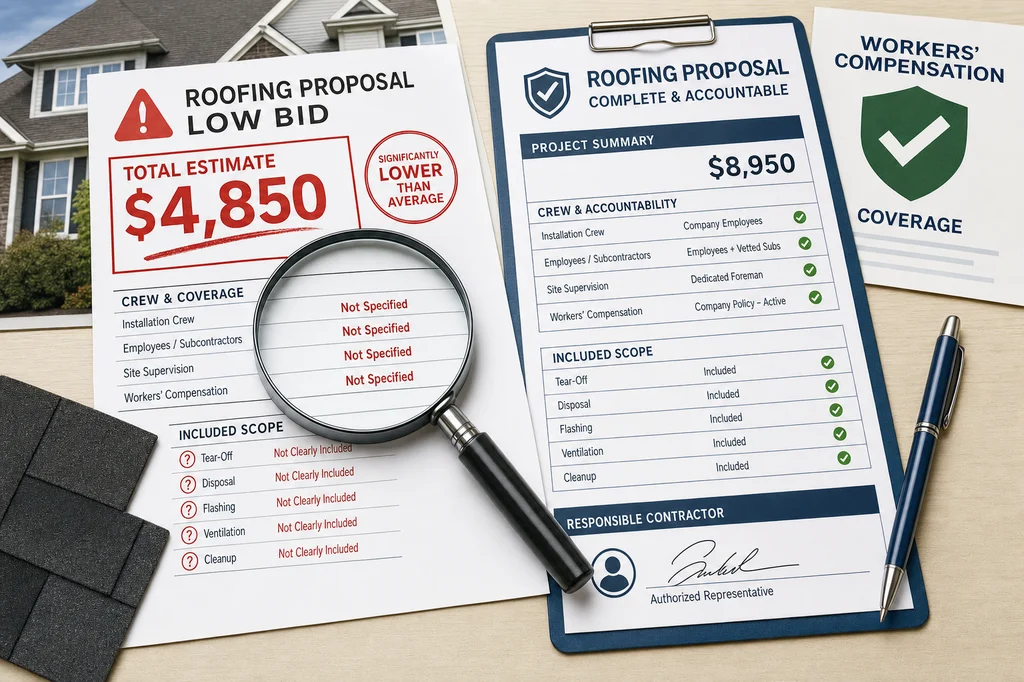
When a roofer’s bid is far lower than competing estimates, ask whether the company carries workers’ compensation and how it classifies the crews performing the work. A low price is not proof of a problem, but it is a reason to compare the company’s staffing and coverage answers alongside its scope of work.
Why labor practices affect a roofing estimate
Labor is more than the hourly amount paid to a person installing shingles or siding. Payroll taxes, workers’ compensation, and other employment-related costs can add to what a roofing company needs to charge for the same work.
Construction workers and union representatives in Connecticut raised concerns about wage theft and employment misclassification at a Hartford rally. They alleged that some companies classify workers as independent contractors for tax purposes when the burden should instead be handled by the employer.
For a homeowner, the practical point is simpler: an unusually cheap estimate may reflect a different labor model, not a more efficient roof replacement. You do not need to decide whether a worker has been classified correctly. You do need enough information to compare bids on an honest, like-for-like basis.
Independent roofing subcontractors are not automatically a red flag
A roofing company can use subcontractors, employees, or a mix of both. The label alone does not tell you whether the arrangement is proper, whether the workers are skilled, or whether your roof will be installed well.
The concern is whether the company has a clear and accountable arrangement for the people doing the work. At a stopped conversion project at 55 Elm Street in Hartford, a state investigation involved cash payment, taxes, and workers’ compensation issues. Work was halted until the job was brought into compliance. That example is not a rule for every roofing project, but it shows why labor-related shortcuts can disrupt construction work.
What matters to you is accountability. The company selling you the roof should be able to explain who will perform it, who supervises the crew, and how workers’ compensation is handled while work is underway.
What to check before accepting the lowest roofing estimate
Use the estimate review to identify gaps early. A contractor that answers directly and documents the scope gives you a more useful basis for comparison than one that only offers a low total.
- Who is doing the installation: Ask whether the people on site are company employees, independent subcontractors, or both. This clarifies the company’s staffing plan.
- Who manages the crew: Find out who is responsible for site supervision and for correcting installation or cleanup problems. You should know your point of contact before materials arrive.
- Workers’ compensation coverage: Ask whether the company carries workers’ compensation for its employees and how coverage is handled for the crews assigned to your project.
- The written scope: Compare materials, tear-off work, disposal, flashing details, ventilation work, and cleanup across every bid. A lower price can result from excluded work rather than lower labor costs.
- Payment terms: Make sure the contract identifies the contracting company, describes the work, and states when payments are due. Avoid relying on a verbal promise about who is responsible for the crew.
Do not try to verify worker classification by watching the crew or making assumptions based on language, vehicles, clothing, or payment rumors. Classification depends on the actual working arrangement. If you have a serious concern, ask the company for clarification and seek guidance relevant to your state.
What to say when one roofing bid is dramatically lower
A calm, specific question is more useful than an accusation. Give the contractor an opportunity to explain what is included and how the work will be staffed.
- “Please confirm whether the installation crew will be employees, subcontractors, or a combination.”
- “Who will supervise the work and handle installation concerns while the job is open?”
- “How is workers’ compensation handled for the crew assigned to this project?”
- “What accounts for the difference between your proposal and the other bids?”
A straightforward answer does not guarantee a perfect project, but evasive answers make it harder to judge the risk behind the price. Be especially cautious if a contractor cannot identify the business responsible for the work, will not put the scope in writing, or pressures you to overlook unanswered questions.
Choose a bid with a clear chain of responsibility
The best choice is not automatically the highest or lowest bid. It is the proposal that gives you a defined scope, a responsible contracting company, understandable answers about crew arrangements, and a credible plan for completing the roof.
That does not mean every lower bid is improper. It does mean you should compare what each company is actually providing before treating price as the deciding factor.
When the crew arrangement and workers’ compensation answers remain unclear, move on to a company that can explain its role. Directorii lists verified contractors.
Source: Construction Workers Rally Against Tax Fraud
FAQ
Are roofing crews usually employees or subcontractors?
Roofing companies may use employees, independent subcontractors, or both. Neither arrangement alone tells you whether the company is responsible or properly run. Before hiring, ask who will perform the installation, who supervises the crew, and which company is accountable for the work described in your contract.
Should I worry if a roofing company uses subcontractors?
Not necessarily. Subcontracting can be part of a construction arrangement, but you should understand who is responsible for your project. Ask the company to explain the crew arrangement, site supervision, and how workers’ compensation is handled, then compare those answers with the written scope and terms of the estimate.
Why is one roofer’s estimate much lower than the others?
A lower estimate may reflect a narrower scope, different materials, lower overhead, or a different approach to labor and workers’ compensation. Compare tear-off, disposal, flashing, cleanup, and supervision before judging the price. Ask the contractor to explain the difference rather than assuming all bids cover the same work.
Can I ask a roofer about workers’ compensation?
Yes. You can ask whether the company carries workers’ compensation for its employees and how coverage is handled for the crew assigned to your job. If the company cannot clearly explain its arrangement, consider whether another bidder provides a clearer chain of responsibility.
What should I do if a roofing contractor will not explain who the crew works for?
Treat the lack of a clear answer as a reason to pause before signing. The contracting company should be able to identify who will perform and supervise the work and provide a written scope. Consider another bidder if the company cannot explain its role or responsibility for project problems.