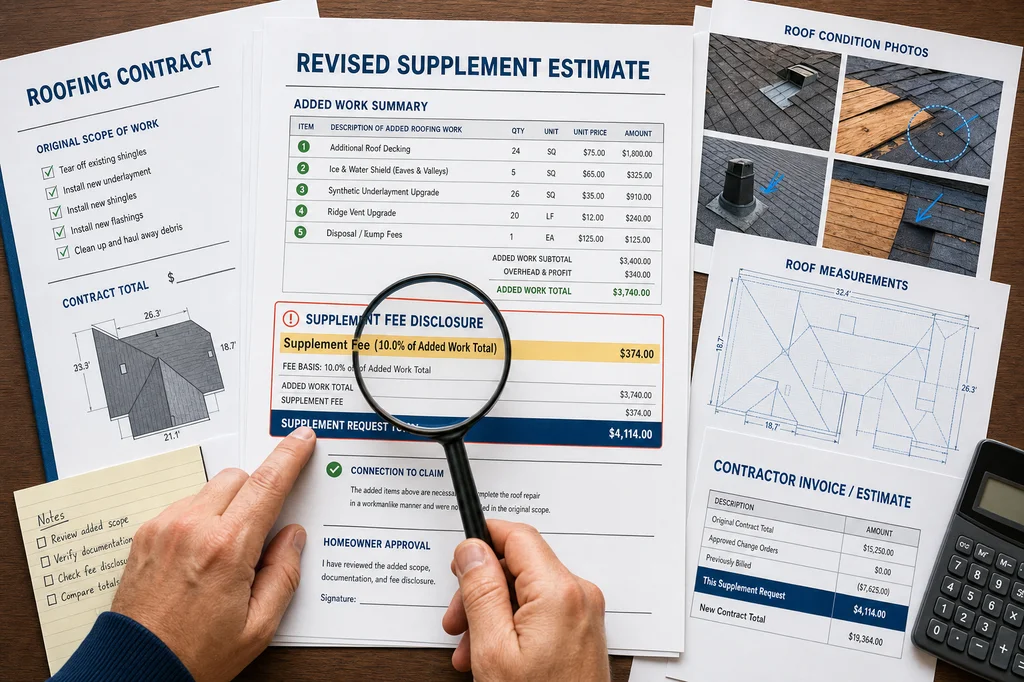
Whether a roofer can pass along a percentage-based insurance supplement fee depends on the contract, the disclosure, and the work supporting the added claim amount. The fee itself is less useful to judge than the paperwork, the company’s role, and whether anyone is negotiating your claim without the proper license.
What a roofing supplement company actually does
A supplement company typically works behind the scenes for a roofing contractor after an insurance claim has been submitted. Its role may include turning the contractor’s scope, measurements, photos, invoices, and damage documentation into an estimate and sending that information to the insurance carrier.
That is different from a public adjuster’s role. A public adjuster represents the policyholder, may inspect and document damage, review policy terms, and negotiate directly with the insurer on the homeowner’s behalf. The distinction matters because public adjusting is licensed work in many states.
For you, the practical question is simple: is the roofing company documenting work it actually found and performed, or is a third party taking over decisions about your policy and claim? A supplement firm may be providing administrative support to the contractor. It should not be presented to you as your personal claim representative unless it is properly licensed for that role.
Why percentage-based supplement fees deserve a closer look
Some supplement companies charge a contractor a flat fee. Others charge a percentage of the approved supplemental amount, sometimes called the new money collected. Estimate Experts, for example, described a fee of 5% of approved supplemental claims.
A percentage fee is not, by itself, proof of wrongdoing. An attorney who represents insurance carriers stated that charging a contingency-style fee is not automatically illegal. But the structure can create a conflict: the larger the approved supplement, the larger the fee.
That does not mean every supplemental request is inflated. Extra work can emerge after a roofing project begins, such as materials that could not be saved or decking that needed replacement. The homeowner issue is whether each added item is real, documented, and connected to the repair or replacement work—not whether the supplement happened to increase the claim total.
- Reasonable supplemental item: An added scope item is tied to a specific condition, supported by photos or other documentation, and appears in the contractor’s work scope.
- Concerning supplemental item: The amount rises without a clear explanation of what was found, why it was necessary, or whether the contractor will actually do the listed work.
- Concerning fee arrangement: A fee is passed to you without being identified in the contract, estimate, invoice, or other written pricing document.
Can a contractor pass the supplement cost to you?
A contractor may try to include a supplement-related charge in its pricing, but whether that is permitted and how it must be disclosed can depend on your contract and state rules. The key consumer-protection concern is transparency.
Read the contract and any revised estimate before approving work. You should be able to identify the roofing scope, the price, any supplement or claim-management charge, and whether the amount changes only if the insurer approves additional work. If the company cannot show where a charge appears, treat that as a reason to pause.
Do not assume an insurer’s payment automatically answers whether you agreed to a separate contractor fee. Insurance coverage depends on your policy, while your payment obligation can depend on the contract you signed. If the documents conflict or the charge appears after the fact, consider having a local consumer-law attorney or your state insurance department help you understand the applicable rules.
When supplementing can resemble unlicensed public adjusting
Preparing an estimate from a contractor’s documentation is not the same as representing you in a claim. Risk increases when a roofer or supplement company negotiates policy coverage, disputes denials on your behalf, or holds itself out as your public adjuster without the required license.
Definitions vary by state, and public-adjuster rules often focus on negotiating a claim for the policyholder. In some states, the definition may also cover preparing a claim for a policyholder or third-party claimant. A licensed insurance professional or attorney in your state can clarify how the rule applies to a specific arrangement.
You do not need to decide the legal label yourself. You do need to know who is speaking to the carrier, whose interests they represent, and whether they are making statements about your coverage rather than explaining the contractor’s own work.
Documents to request before approving claim-related roofing work
Get the paper trail before work begins or before you approve a revised scope. Clear documents make it easier to compare the contractor’s promised work with what is being submitted to the insurer.
- The original contract and estimate. Confirm the agreed roofing scope and total price.
- A written supplement breakdown. It should identify each added item and why it was needed.
- Supporting documentation. Photos, measurements, invoices, and a revised scope can show what changed.
- Fee disclosure. Ask whether a supplement company is involved, how it is paid, and whether any charge is included in your price.
- The company’s role in the claim. Ask whether it is only submitting contractor documentation or whether it claims to represent you in policy discussions.
A contractor should be able to explain the physical work behind a supplement in plain language. If you hear broad promises about maximizing the claim but receive no itemized scope, do not authorize added charges until the documentation is clear.
What to say if the fee or added scope is unclear
Keep the conversation focused on written facts, not a promise of a larger insurance payment. You can say: “Please show me each added work item, the documentation supporting it, whether a supplement fee is included in my price, and who is communicating with my insurer.”
If the contractor wants you to rely on a claim representative, ask whether that person is licensed in your state and whether they represent you or the contractor. If you are considering competing roofing proposals, compare the written scope and fee disclosures rather than comparing only the claim amount each company says it can pursue.
Choosing a company that documents its work and states its charges clearly can prevent a dispute after the claim changes. Directorii lists verified contractors.
Source: Are Roofing insurance supplement fees Illegal? Unlicensed practice of public adjusting
FAQ
Can a roofer charge a percentage of an insurance supplement?
A percentage-based fee is not automatically illegal, but it can create an incentive to pursue a larger supplement. What matters most is whether the added claim items reflect actual work, the fee is disclosed in writing, and the company stays within the role allowed by your state’s insurance rules.
Should a supplement fee be listed in my roofing contract?
You should be able to identify any supplement-related charge in the contract, estimate, invoice, or another written pricing document. A fee that appears without clear disclosure can raise consumer-protection concerns. Review the original agreement and every revised scope before agreeing that you will pay an added amount.
What proof should support a roofing insurance supplement?
A roofing supplement should connect each added item to documented work or conditions found during the project. Useful support can include photos, measurements, invoices, and a revised scope of work. If the company cannot explain why an item was needed or whether it will be completed, pause before approving it.
Can my roofer negotiate my insurance claim for me?
A roofer may provide documentation about its work, but negotiating policy coverage or representing you in a claim can fall within public-adjuster rules. Those rules vary by state and often require a license. Ask who is communicating with the insurer and whether that person represents you or the contractor.
Is a supplement company the same as a public adjuster?
No, the roles can be different. A supplement company may prepare estimates and submit contractor documentation, while a public adjuster represents the policyholder and may negotiate the claim. The line can become unclear if a supplement company discusses policy coverage, disputes denials, or presents itself as your claim representative.