Church-deposit theft cases are a sharp warning for any homeowner worried that a roofer has collected a deposit but has not begun work. Before handing over a large payment, check for prior business failures and complaints, tie payments to real progress, and identify who will receive the funds if the job stalls.
Why a large roofing deposit can become a serious loss
A deposit is meant to help move a project forward, not become unrestricted cash for a contractor’s other problems. The danger rises when the contractor collects substantial money, does not order materials or schedule work, then stops responding.
One Kentucky church reportedly paid about $200,000 for a roof replacement that never began. Police later located the roofer in Florida, and he faced criminal charges. In another case involving Shield Roofing and Construction, police said deposits totaled about $28,000 across Ohio and West Virginia, including $6,000 from a Baptist church; the work was reportedly left unfinished. The parties later agreed to repay $38,000 to nine victims, while felony charges were dropped and misdemeanor theft pleas followed.
Those outcomes are not a roadmap for every dispute. A delayed project, a poor installation, and an intentional theft allegation are different situations. But they show the practical problem: once a large payment has left your account without matching progress, recovering it can be slow, expensive, and uncertain.
Check for the pattern behind church-deposit theft cases
A polished proposal or a familiar local connection does not erase a contractor’s record. The useful check is whether the company and its owners show a pattern of failed businesses, unresolved complaints, or work promised in more than one state without follow-through.
In the Kentucky case, the roofer had previously operated a company called My Affordable Roof after a hurricane, then filed for bankruptcy and had customers in Alabama. That does not mean every bankruptcy proves misconduct; businesses can fail for many reasons. It does mean a prior bankruptcy, repeated company name changes, or complaints in multiple states should prompt closer review before you prepay a major portion of a roof.
- Search the legal business name and owner names. A contractor may market under a trade name while contracts, lawsuits, or dissolved entities appear under another name.
- Look beyond one review platform. Search for complaint patterns, court records where available, and state licensing or registration records where applicable.
- Notice geographic hopping. Complaints tied to several states can be more concerning than a single disagreement over one project.
- Read the contract entity carefully. Make sure the company receiving your payment is the same company obligated to perform the work.
- Do not treat a shared church, neighborhood, or family connection as vetting. Trust can be part of a decision, but it is not a substitute for checking records and written commitments.
The point is not to predict a contractor’s intentions. It is to reduce the chance that you give a large payment to a company with warning signs you could have found before signing.
Set payment milestones that keep your leverage
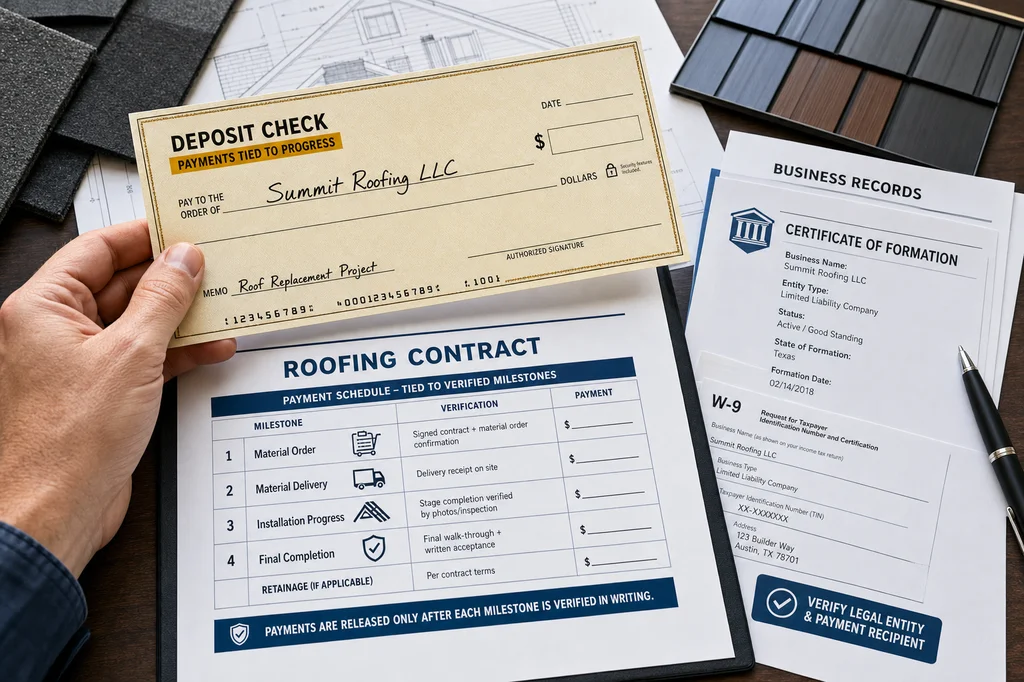
Your money is your leverage until the contractor earns it through documented progress. A contract with vague upfront payment language leaves you exposed if materials never arrive and the crew never appears.
Before paying, have the payment schedule written into the contract. The schedule should identify what each payment corresponds to, such as a documented material order, delivery, completed installation stage, or final completion. Avoid relying on verbal assurances that a deposit will be used only for your job.
Also identify who will receive each payment. If a contractor asks you to pay an individual, a different company, or a supplier directly, stop and make sure the arrangement matches the written contract. Payment terms, deposit limits, and consumer protections can vary by state and contract, so confirm local requirements with the appropriate state agency or a qualified professional.
What to say when a roofer requests a large deposit
You do not need to accuse a roofer of wrongdoing to ask direct questions. A legitimate company should be able to explain its payment structure, project schedule, and how your funds are handled.
- “What specific work, materials, or scheduling commitment does this first payment cover?”
- “Will the contract show each payment milestone and the condition that triggers it?”
- “Which legal business entity will receive my payment?”
- “Who owns materials after they are delivered, and who is responsible if they disappear before installation?”
- “Have you operated under other company names, and can you provide the names?”
- “If work cannot begin as scheduled, what does the contract say about my deposit?”
Clear answers do not guarantee performance, but evasive answers are useful information before money changes hands. Do not let urgency after a storm turn an unclear payment request into a rushed decision.
Choose a roofer before the deposit becomes the dispute
The most expensive contractor mistake often happens before construction starts: paying a large amount without verifying the company, the contract entity, and the payment path. Compare the written terms, not just the promised start date or the lowest bid.
Directorii lists verified contractors.
If a roofer already has your money and has not started, keep a dated record of the contract, payment proof, messages, promised start dates, and any material documentation. Contact your bank or card provider promptly to ask what options may apply. For insurance, contract, or possible criminal concerns, confirm your next steps with a qualified attorney, your state insurance department, or local law enforcement as appropriate.
Source: Holy Theft: When Roofers Steal from the House of God
FAQ
What should I do if a roofer took my deposit and never started?
Start by preserving your contract, payment records, texts, emails, promised start dates, and any material-delivery documents. Contact the contractor in writing and request a specific response. You can also contact your bank or card provider promptly to ask about available options. For possible theft or contract issues, confirm next steps with qualified legal counsel or local authorities.
How can I check whether a roofer has prior bankruptcies or complaints?
Search the contractor’s legal business name, owner names, and any former company names rather than relying only on the marketing name. Review public business and licensing records where applicable, and look for complaints spanning more than one state. A bankruptcy alone does not establish misconduct, but repeated failures or unresolved complaints deserve closer scrutiny before a large payment.
Should I pay a roofer a large deposit before materials are delivered?
Pay according to a written schedule that explains what the payment covers and what progress triggers the next payment. Your contract should identify the company receiving the money and address what happens if the start date slips. Deposit rules and contract protections vary, so confirm applicable requirements in your state before signing.
What questions should I ask about a roofer’s deposit request?
Ask what the first payment specifically funds, which legal entity receives it, and whether each payment milestone will appear in the contract. You should also ask about former company names, the planned start date, material delivery timing, and what the agreement says if work does not begin. Clear written answers help you compare companies before paying.