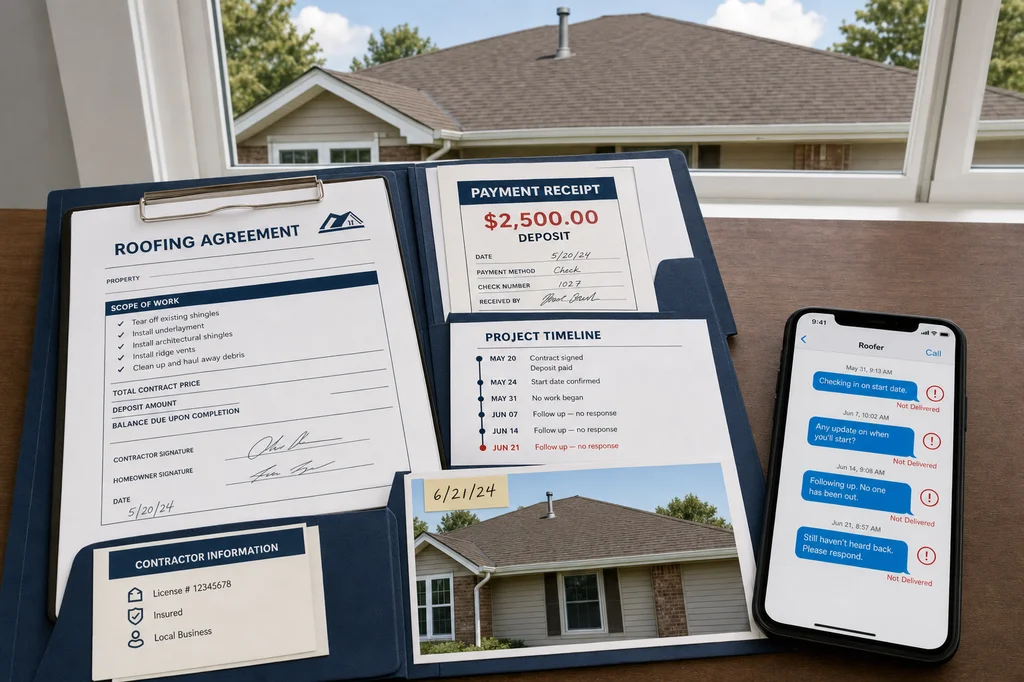
The Chris Moyos grand-theft case shows how hard it can be to respond when a roofer takes a deposit, performs no work, and the complaint is initially treated as a civil dispute. Homeowners need a clear record of the agreement, payment, promised work, and every failed attempt to obtain a response.
Why a no-work roofing deposit can be difficult to classify
A contractor dispute and an alleged theft are not automatically the same thing. A disagreement over workmanship, scope, delays, or an unfinished job may look different from a situation where money was collected and no work was done.
That distinction matters because law enforcement may initially view a payment dispute as something for civil court. In the Moyos matter, Tampa Bay homeowners said he took cash rather than repairing their roofs. Hernando County deputies had closed the case as a civil matter in 2022.
For a homeowner, the practical lesson is not to assume that a police report alone will settle the issue. Preserve facts that show what was promised and what actually happened. Avoid describing a contractor's conduct as a crime in your own paperwork; stick to dates, documents, payments, missed commitments, and the condition of the project.
What happened after the Chris Moyos case was reopened
The case changed after a news reporter questioned why it had been closed. Hernando County deputies reopened the matter one day after those questions, and Moyos was later booked and charged with three grand-theft felonies involving three alleged victims.
A charge is not a conviction. Moyos was due for arraignment and was presumed innocent. Still, the sequence illustrates why complete documentation can matter if an agency reconsiders whether a complaint is purely contractual or may warrant further investigation.
The Florida Department of Business and Professional Regulation also filed two administrative complaints against Moyos. At the time reported, his license remained active. An active license, by itself, is not proof that a contractor will complete your job or promptly return money if a dispute develops.
Build a record before the roofer disappears
Your strongest protection is a file that makes the timeline easy for someone else to understand. Save it as soon as payment changes hands, not after phone calls start going unanswered.
- The signed contract: Keep the full agreement, including the contractor's business name, scope, deposit amount, payment schedule, and any stated start date.
- Proof of payment: Retain copies of checks, card receipts, financing records, bank confirmations, and any receipt provided by the roofer.
- Written communications: Save texts, emails, voicemails, and messages that show scheduling promises, requests for updates, or unanswered attempts to reach the company.
- Photos of the property: Dated photos can show that roofing materials were not delivered and that work had not begun.
- Business and license details: Record the name used on the contract, license information if provided, phone numbers, addresses, and any website or listing details before they disappear.
- A simple timeline: List the contract date, payment date, promised start date, contacts made, and what work—if any—occurred.
This record does not guarantee a criminal case, a license action, or repayment. It does give a payment provider, attorney, state licensing agency, or law enforcement a clearer factual account to evaluate.
Respond in writing when the roofer has done nothing
Send one calm, written request that identifies the job, payment, and the work you expected. Ask the contractor to provide a specific plan for starting the project or to explain the status of your money.
Keep the message factual. State the date you paid, the amount, the contracted work, and that no work has occurred if that is accurate. Do not rely only on calls, and do not accept vague assurances without a written response. If the contractor replies, preserve that response rather than arguing by text.
If there is a real scope or scheduling dispute, your contract may control how it should be handled. If the contractor has stopped responding, has closed the business, or appears to have collected payments without performing work, consider speaking with an attorney about options under your contract and state law. You can also check the relevant state licensing agency for complaint procedures. Available options can vary by the contract, payment method, and state.
Screen the company before paying a roofing deposit
A deposit creates risk because you have paid before the roof is complete. Reduce that risk by checking the company behind the salesperson, not just the estimate or online ad.
Confirm that the business name, contact information, and license details match the contract. Read the payment terms closely and make sure the scope identifies what the roofer is supposed to provide. Be cautious if the company pushes for immediate payment but will not provide a clear written scope or a reliable way to reach the business afterward.
Choosing the wrong company can leave you chasing both unfinished roof work and missing funds. Directorii lists verified contractors.
What to ask before you sign a roofing contract
Use these questions to test whether the contractor's paperwork and business identity are clear enough for a major payment. The goal is a documented commitment, not a verbal promise.
- What exact work does the deposit cover, and what must happen before the next payment is due?
- What business name and license information will appear on the contract and payment receipt?
- Who will be my written point of contact if the start date changes?
- What happens under this contract if work does not start as scheduled?
- Will you provide written confirmation of material delivery and the project start date?
If an answer conflicts with the contract, pause before paying. A licensed roofing professional can help explain the scope and installation plan, while an attorney can advise on contract or recovery questions.
Source: Chris Moyos grand-theft case report
FAQ
What should I do if a roofer took my deposit and never started work?
Start by preserving the contract, proof of payment, written messages, photos, and a dated timeline of missed commitments. Send a factual written request for a project status or explanation. If the company remains unresponsive, review your contract and consider contacting the relevant licensing agency, payment provider, attorney, or law enforcement based on the facts.
Can police treat a roofer deposit dispute as a civil matter?
Yes, police may initially view a roofing payment dispute as civil, especially where the facts suggest a contract disagreement rather than an alleged intentional taking of money. The Chris Moyos matter was initially closed as civil in 2022. Clear records of payment, promised work, no work performed, and communication attempts can help an agency evaluate the complaint.
What does the Chris Moyos case mean for homeowners?
The case shows that a complaint initially labeled civil can later be reopened when additional scrutiny or information raises different concerns. Moyos was charged with three grand-theft felonies involving three alleged victims, but charges are not convictions and he was presumed innocent. For homeowners, the key takeaway is to document the transaction from the first payment onward.
Should I trust a roofer because the license is active?
No, an active license is only one item to check. In the Moyos matter, the license was reported as active when the Florida Department of Business and Professional Regulation filed two administrative complaints. Also verify the business identity on the contract, retain written payment terms, and make sure you have reliable contact information for the company.
What proof helps if a roofing contractor does no work after taking payment?
Useful proof includes the signed contract, payment records, receipts, texts, emails, voicemails, photos showing the work was not started, and a timeline of your contact attempts. Keep records in their original form where possible. These materials help others understand the promised scope, the payment made, and what happened after the roofer received funds.