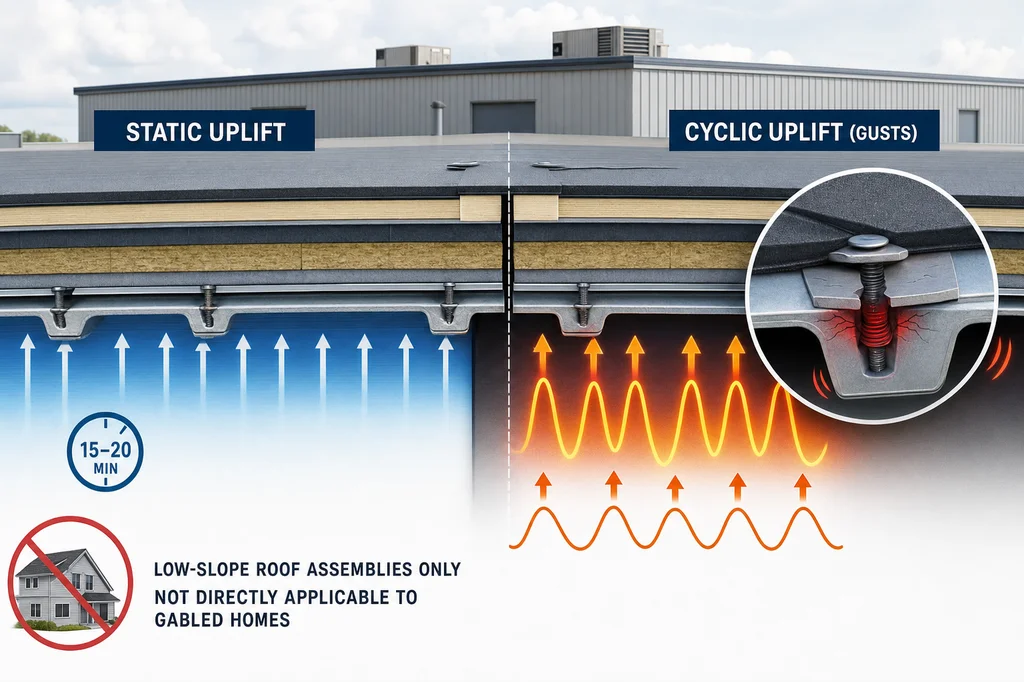
A roof can hold one steady pressure yet respond differently when uplift rises and falls in repeated gusts. Static testing measures a held load, while dynamic testing is intended to represent changing wind loads and the fatigue they can create in a roofing assembly.
A held pressure is not a gust cycle
Western Michigan University’s Bronco Construction Research Center evaluates roofing systems from the deck upward, including the components installed above the deck. Its dynamic wind-uplift work focuses on how the complete assembly behaves under changing loads.
In a static, or monotonic, test, pressure is held for roughly 15 to 20 minutes. A dynamic test instead applies cycles of loading derived from wind-pressure data. The difference is fatigue: repeated loading can affect components and connections in ways that a single held pressure may not show.
Forensic analysis at the center examines how a system failed, what fatigued first, and which component intensified failure across the assembly. Hurricane damage has sometimes shown roofing systems failing at loads below their wind design load.
Canada and U.S. testing use different paths
The dynamic load protocol discussed at the center was developed as a Canadian standard. To certify a product for sale in Canada, it must meet the dynamic CSA123 load protocol. For the same product in other U.S. markets, a static or monotonic test that holds pressure for 15 to 20 minutes is sufficient.
Static testing can compare systems under the same held-pressure conditions. It does not include fatigue effects in the way a cyclic protocol is intended to do.
The important limit: this is low-slope research
The chamber and load protocol are for low-slope roofs, particularly industrial and warehouse-style buildings. The cycles were developed from wind-tunnel pressure measurements on flat roofs.
They are not a direct testing method for a gabled house or another residential roof shape. A separate method would be needed for residential geometries. A low-slope dynamic result therefore should not be treated as direct proof of how an asphalt-shingle gable roof will perform.
How to compare a wind-performance claim
When a low-slope roofing system is presented as wind-rated, compare the test context rather than the rating alone:
- Loading method: Was the result produced with static pressure, cyclic loading, or both?
- Roof geometry: Does the evidence concern a low-slope assembly, or is it being applied to a different roof shape?
- Complete assembly: What deck-up components and connections were part of the evaluated system?
- Failure information: Does the evaluation identify how the assembly responded and what component fatigued first, rather than only reporting pass or fail?
The key question is whether a stated wind result reflects a steady-pressure condition or repeated gust loading.
Solar panels can change low-slope uplift loading
Bronco Construction Research Center is also studying geometries fastened above low-slope roofs, including solar panels and hot-water tanks. A solar panel inclined at 40 degrees can increase uplift forces and fatigue loading on some low-slope roofs. These added geometries are part of the system behavior being studied, not proof that every rooftop installation will cause failure.
Directorii lists verified contractors.
Source: Why Roofing Systems fail wind warranties in USA? Engineers explain lab testing
FAQ
What does cyclic gust testing do for a roofing system?
It applies changing, repeated uplift loads rather than one held pressure. The purpose is to represent wind’s dynamic behavior and account for fatigue effects within the roofing assembly.
How long is the static pressure test described at Western Michigan University?
Pressure is held for roughly 15 to 20 minutes in the static, or monotonic, test.
What is CSA123 in this discussion?
CSA123 is the dynamic load protocol required to certify roofing products for sale in Canada.
Does a low-slope dynamic wind test apply directly to a gabled home?
No. The chamber and protocol were developed for low-slope roofs using flat-roof wind-pressure data. Residential shapes, including gables, need a different method.
Why are solar panels relevant to low-slope wind testing?
Solar panels and other rooftop geometries can change uplift forces and fatigue loading. A solar panel inclined at 40 degrees was identified as an example.