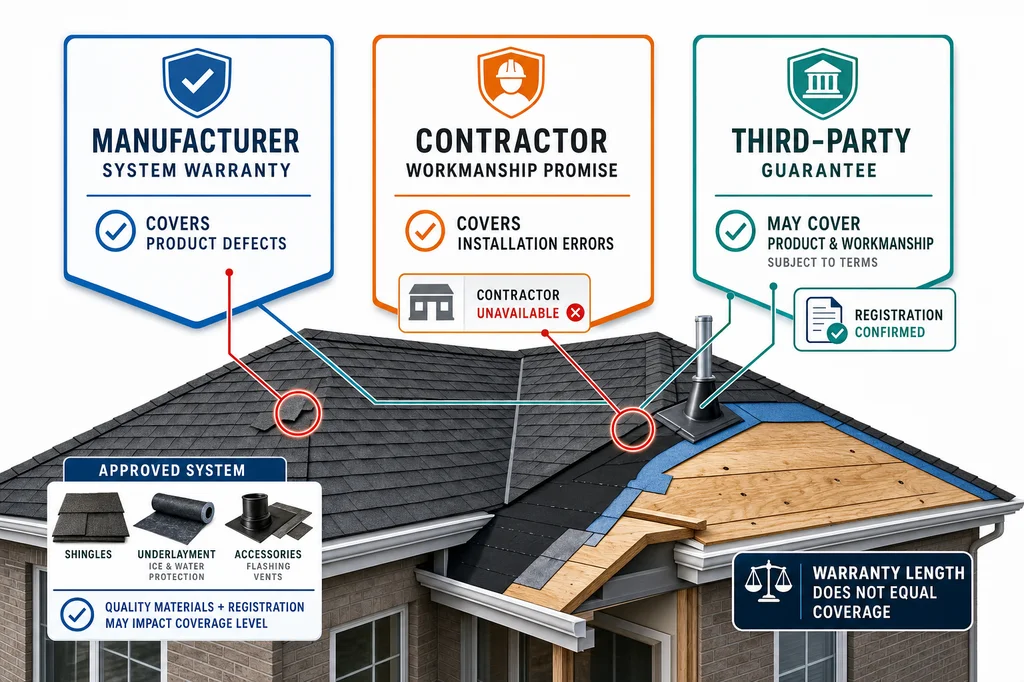
Manufacturer system warranties, contractor workmanship promises, and third-party guarantees can each cover different roofing problems. Before paying for upgraded coverage, compare the written registration rules, required materials, and who remains responsible if your roofer closes.
Start by separating product defects from installation mistakes
A warranty is only useful if it identifies what failed and who is supposed to respond. Shingles with a manufacturing defect, poor flashing work, and a contractor that stops answering calls are different problems that may be handled under different agreements.
Manufacturer coverage generally concerns the roofing product. A contractor workmanship promise concerns errors in installation. A third-party guarantee may be designed to address both workmanship problems and manufacturer defects, subject to its own registration and coverage terms.
This distinction matters because a long “lifetime” label does not automatically mean every leak, damaged component, or labor cost is covered. Read the actual documents for exclusions, transfer terms, registration requirements, and whether labor is included. Do not judge coverage by the headline alone.
Manufacturer system warranties can require brand loyalty
A manufacturer system warranty may offer stronger coverage than a basic shingle warranty, but it can require a specific package of products and registration. The tradeoff is that your contractor may need to use the manufacturer’s accessories rather than less expensive alternatives.
Some manufacturer programs can require approved accessories such as underlayment or ice-and-water protection, plus registration. Using a manufacturer’s accessory package can add cost compared with buying some components elsewhere, but the exact cost and requirements depend on the program.
The key issue is not whether one accessory brand is always better. It is whether the proposed roof system qualifies for the exact warranty being promised.
A contractor workmanship promise depends on the contractor staying open
A roofer’s own workmanship warranty can be straightforward, but its value depends heavily on that company’s ability and willingness to perform later repairs. If the company closes, changes ownership, or does not honor the promise, the document may offer little practical help.
A no-cost workmanship warranty is not necessarily a bad choice. It can be sensible if you are comfortable with the contractor’s track record and the written terms are specific. The homeowner decision is whether the company itself is the only backstop for an installation failure.
What the workmanship promise should spell out
Look for a written description of the covered work rather than a broad slogan. It should identify whether the promise covers leaks caused by installation, corrective labor, replacement materials, exclusions, maintenance conditions, and the process for reporting a problem. If the warranty uses “lifetime,” find out whose lifetime is meant and whether the promise transfers if you sell the home.
Third-party guarantees add another party, not automatic certainty
A third-party roof guarantee can provide a separate organization to handle a covered problem if the roofer is no longer operating. That can reduce reliance on one contractor, but you still need to examine the provider’s terms, registration process, and limits.
If your proposal includes a third-party guarantee, determine whether its fee is shown separately or built into the project price. A separate provider can be valuable only if the specific roof is properly registered and the stated circumstances are covered.
Use this warranty checklist before you sign a roofing contract
The best comparison is a document-by-document comparison, not a comparison of warranty lengths. Put the manufacturer warranty, workmanship promise, and any third-party guarantee side by side before authorizing the work.
- Name each provider. Identify the manufacturer, the roofing company, and any third-party guarantee company separately.
- Match coverage to the failure. Note who handles product defects, installation errors, and problems that arise after the roofing company closes.
- Confirm the required roof system. Compare the shingle and accessory list against the manufacturer’s warranty requirements.
- Get registration details in writing. Confirm who files it, what information is required, and what proof you will receive.
- Read exclusions before comparing terms. A long stated period can still contain conditions that narrow practical coverage.
- Keep your records. Save the contract, final invoice, material list, registration confirmation, and all warranty documents together.
Choosing the wrong roofing company can be expensive if the only workmanship backstop disappears with the business. Directorii lists verified contractors.
Do not treat a warranty as a substitute for a clear scope of work
A warranty addresses certain future failures; it does not replace a complete installation agreement. Your contract should still state the materials, the roof areas included, the work to be performed, and the documents you will receive at completion.
If the contractor describes an upgraded manufacturer system or third-party guarantee but cannot show the applicable terms and registration process, treat that as an unresolved contract detail rather than an added benefit.
Source: Roof warranty structures and coverage claims
FAQ
What are the main types of roof warranties?
The three main structures are a manufacturer system warranty, a contractor workmanship promise, and a third-party guarantee. Manufacturer coverage generally addresses product defects, while workmanship coverage addresses installation errors. A third-party program may address both, but only under its own written terms, registration rules, and coverage limits.
Will a manufacturer roof warranty cover bad installation?
A manufacturer warranty may not cover installation mistakes unless the specific warranty says it does. Manufacturer system warranties can have requirements for approved accessories, contractor designations, and registration. Review the written warranty to see whether labor, installation errors, or only a product defect are included.
What happens to my workmanship warranty if the roofer closes?
A contractor-backed workmanship promise may be difficult to use if the roofing company closes or stops responding. The promise depends on that business remaining available to perform covered work. A manufacturer warranty or third-party guarantee may offer a separate avenue, but neither automatically covers every installation-related problem.
Do I have to use matching accessories for an upgraded roof warranty?
You may need specified accessories to qualify for an upgraded manufacturer system warranty. The stated requirements can include items such as underlayment or ice-and-water protection, along with proper registration. Have the contractor identify every required component in writing and match that list to the warranty document.
Should I pay extra for a third-party roof guarantee?
A third-party guarantee may be worth considering if you want coverage that does not depend entirely on the roofer staying in business. Evaluate the provider’s written coverage, exclusions, registration process, and fee before deciding.