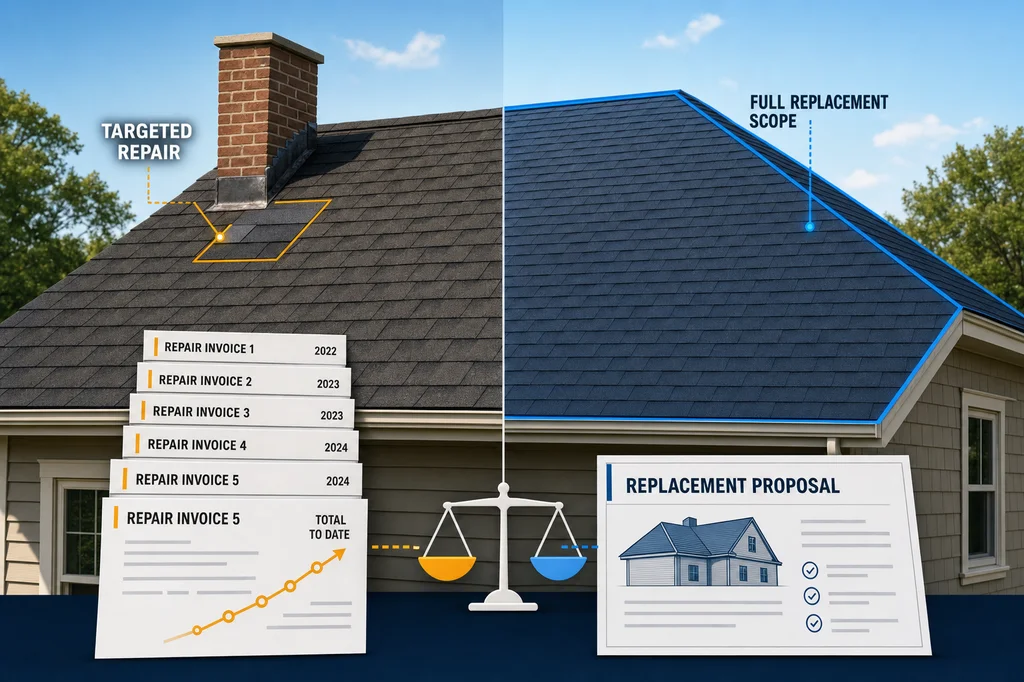
For a leaking roof, the repair-versus-replacement decision does not automatically point to a new roof. A targeted repair may buy useful time, especially when damage is limited, but repeated small fixes can add up fast. The key is comparing the current leak, the roof’s wider condition, and the total cost of postponing a replacement.
Start with the leak’s actual scope, not the biggest possible project
A repair is most reasonable when the problem is isolated and the rest of the roof is still performing adequately. A contractor who can identify a limited issue may be able to propose work on one affected area rather than treating every leak as proof that the entire roof has failed.
Examples discussed by a repair-focused roofer included a pipe collar, a few shingles, chimney-related work, flashing work, and a single roof slope near a leaking chimney. These are not interchangeable problems. A pipe collar issue may call for a very different scope than water entering around a chimney or damage spread across several roof areas.
That matters because “repair” should describe a defined correction, not a vague promise to stop a leak. Your estimate should state the affected area, the components being addressed, and what work is excluded. If the proposed repair is limited to one slope, make sure you understand why that slope is the chosen area and whether other roof sections show separate concerns.
When a small repair is a practical choice
A modest repair can make sense if your immediate goal is to stop an active leak while you plan for larger work later. It may also be the sensible choice when the contractor can point to a specific defect and does not find broader conditions that warrant replacement now.
- The problem is localized: The proposed work targets a defined component or section, such as a pipe collar, a few shingles, flashing, or a chimney area.
- You need time to plan: A repair may bridge a period when replacement is not financially workable.
- The contractor offers a clear scope: You can see what will be repaired instead of receiving only a broad recommendation for a new roof.
- You understand the limitation: Fixing one leak does not guarantee that unrelated aging or damage elsewhere will not need attention later.
The homeowner benefit is simple: you should be able to choose a limited fix when it fits the roof and your circumstances. A repair contractor may charge more per unit of work than on a full replacement because small jobs still require diagnosis, setup, materials, and skilled labor. That does not make a repair unreasonable; it means the scope should be specific enough to judge.
Repeated repairs can become the expensive option
Repairing a roof over and over can cost more than acting sooner on replacement. One roofer described a homeowner whose roof had been repaired for seven or eight years, with cumulative repairs reaching roughly $9,000 to $10,000. The homeowner had handled expenses in smaller increments, but the accumulated total could have changed the replacement decision.
This does not mean every repair is wasted money. A repair can solve a real, limited problem. The risk is making each decision in isolation: paying for one leak now, another later, then another without tracking the total spent or reconsidering the roof’s overall condition.
Keep every invoice and make a running total for repairs, leak investigations, and related work. Before approving another patch, compare that total with a current replacement proposal. Also consider whether the roof has begun to produce different problems in different locations. A single corrected defect is one thing; a series of unrelated failures may point to a larger decision.
Compare the options as scopes, not sales pitches
The most useful comparison is between two written paths: a defined repair and a defined replacement. You are not choosing between a “cheap” contractor and an “expensive” one. You are deciding whether a narrow correction is enough for the roof you have today.
A repair-focused contractor cited an average repair of about $3,800 and an average replacement around $20,000, but those figures came from that business and should not be treated as national pricing. Your home’s roof design, damaged area, materials, access, and needed related work can change both options substantially.
Review each proposal for the actual work included:
- Repair option: Identify the leak location, the components to be corrected, the materials involved, and whether the work addresses one area or several.
- Replacement option: Review the full roof scope and every included line item rather than relying on a single total.
- Future exposure: Ask whether the repair is expected to address a known defect only or whether the contractor sees separate conditions likely to require additional work.
- Total repair history: Add prior repair spending before deciding that another small invoice is automatically the lower-cost choice.
One warning sign is a contractor who offers only replacement without clearly explaining whether a targeted repair is technically feasible. The opposite can also be a problem: a contractor who repeatedly repairs a roof without helping you see the cumulative spending and larger condition. You need the tradeoff stated plainly.
What to ask before approving another roof repair
Ask questions that force a clear diagnosis and a real choice. The goal is not to demand roof-level technical instructions; it is to understand what the professional found, what the proposed work can reasonably accomplish, and what it cannot.
- What specific component or area is believed to be causing this leak?
- Is this a stand-alone repair, or are there other roof areas showing separate concerns?
- What is included in the repair scope, and what is specifically excluded?
- What replacement work would you recommend now, and why is that broader scope warranted?
- How does my previous repair spending affect the decision to repair again or replace?
- If insurance is involved, can you provide detailed photographs and a clear invoice for the work proposed?
Insurance coverage and claim handling depend on your policy and the facts of the loss. A roofing contractor can document visible conditions and provide an estimate, but you should review coverage questions with your insurer and, if needed, a licensed insurance or legal professional.
Choosing a contractor who can explain both paths helps you avoid a false either-or decision. Directorii lists verified contractors.
Do not let urgency erase the comparison
An active leak deserves prompt professional attention, but urgency does not require an open-ended commitment. Have a roofer assess the affected area, protect the home as appropriate, and give you a written scope for the repair option and any replacement recommendation.
If the contractor identifies a limited failure and the rest of the roof does not show broader concerns, repair may be the sensible first move. If repairs have become recurring expenses across multiple areas, a replacement comparison becomes harder to avoid. The right answer is the one supported by the roof’s condition, the written scope, and the cost of continuing to defer larger work.
Source: Why 70% of US Roofers Don’t Offer Repairs — But He Does $1.8M/Year
FAQ
Can a leaking roof be repaired instead of replaced?
Yes, a leaking roof may be repaired when the problem is limited to a defined area or component. Examples can include a pipe collar, a few shingles, flashing, or a chimney-related area. The repair scope should identify what is being corrected and explain whether other roof sections have separate concerns.
When should I stop repairing my roof and consider replacement?
You should compare replacement when repairs keep recurring, appear in different areas, or have added up to a substantial total over time. One repair-focused roofer described a home with roughly $9,000 to $10,000 spent across seven or eight years of repairs. Your roof’s overall condition should guide the decision.
Should a roofer give me both repair and replacement options?
A roofer should be able to explain whether a targeted repair is technically feasible and why replacement may or may not be warranted. You need a written scope for each path, not just a recommendation. That lets you compare the immediate correction, broader roof condition, and likely consequences of delaying larger work.
Why can a small roof repair cost more per area than a replacement?
Small repairs can carry significant labor and setup demands even though the affected area is limited. Diagnosis, access, materials, and skilled repair work still need to be covered. The important issue is whether the scope clearly matches a real defect, not whether the unit cost resembles a full replacement price.
Can I use a roof repair estimate for an insurance claim?
A roofing contractor can provide detailed photographs and an invoice or estimate for proposed work. Whether the loss is covered and how a claim is handled depends on your insurance policy and the facts involved. Review coverage questions with your insurer and seek licensed professional guidance when needed.