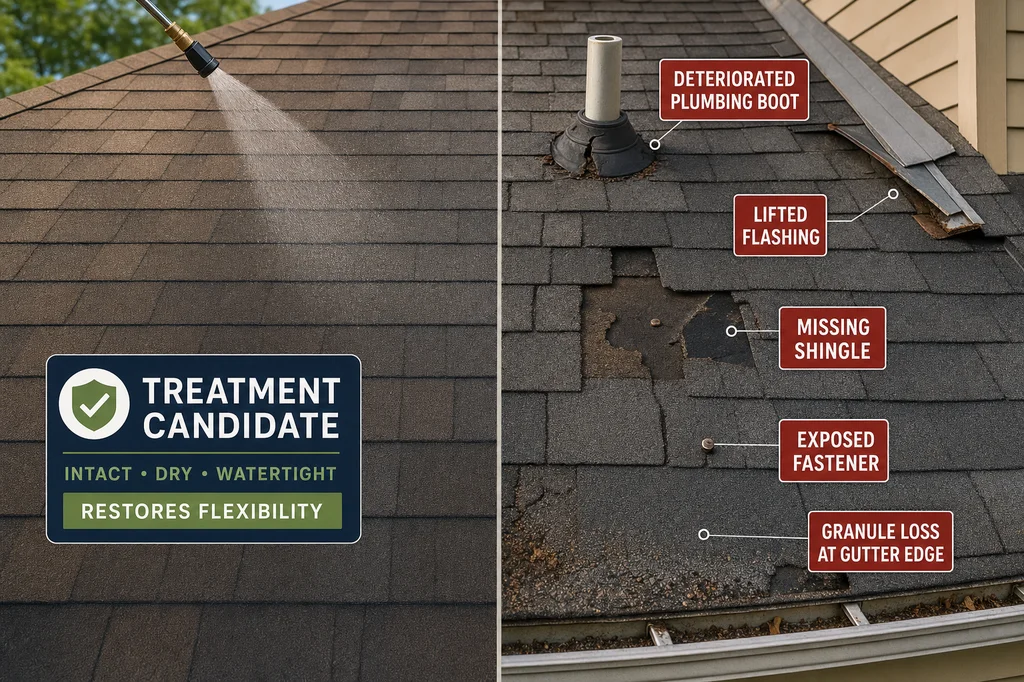
A Roof Maxx treatment may be worth considering for an aging asphalt-shingle roof that has become dry and brittle without developing repeated leak problems. It is not a replacement for correcting missing shingles, cracked flashings, exposed fasteners, or failed plumbing-boot gaskets before deciding whether reroofing can wait.
What Roof Maxx is intended to change in aging shingles
Roof Maxx is marketed as a treatment that restores flexibility to dried asphalt shingles. The company describes its product as a plant-based bio-oil intended to replenish oils lost as the asphalt portion of a shingle dries out over time.
That distinction matters because a treatment addresses one aging mechanism: brittleness. It does not rebuild a worn shingle, replace lost granules, or correct a defect where water is already getting through the roofing system. A roof can be old, dry, and still a candidate for maintenance. It can also be old and too compromised for a surface treatment to make sense.
In a demonstrated application, the treated side of a roof appeared oily and more pliable soon after application, while the untreated side absorbed differently. That is a visual observation, not proof that every roof will gain the same result or remain serviceable for the same period.
Separate normal brittleness from active roof failures
The key decision is whether age-related dryness is the primary problem or whether the roof has a history of water-entry and repair issues. Roof Maxx is presented as maintenance for a roof that has not been problematic, not as a leak solution.
Repeated failures in different areas are a stronger warning sign than simple stiffness. For example, a skylight leak followed later by a chimney leak can indicate that the roof needs a broader evaluation rather than a rejuvenation treatment. The same applies if a roofer finds defects that need correction before any coating or treatment is considered.
- Cracked or missing shingles: These are direct repair items. A flexibility treatment does not replace damaged shingles.
- Exposed nails or lifted flashings: These can create water-entry paths that need roofing repairs, not merely conditioning.
- Dry-rotted plumbing-boot gaskets: Rubber gaskets around plumbing penetrations can deteriorate and should be addressed as part of roof maintenance.
- Heavy granule loss: Granules collecting in gutters and visible deterioration, especially on a sun-exposed slope, deserve a professional assessment of remaining roof condition.
- Multiple prior leaks: A pattern of leaks calls for finding the causes before spending money on a treatment designed for brittleness.
Plainly put, a treatment may extend the usefulness of a roof that is aging evenly but still functioning. It is a poor substitute when the roof has unresolved openings, failing details, or recurring water problems.
Why the tune-up work comes before treatment
A Roof Maxx application may be paired with a roof tune-up, but the maintenance work is not optional window dressing. The roof should first be checked for cracked or missing shingles and common penetration and flashing defects.
This sequence protects you from treating a roof while leaving known repair needs untouched. Get the scope in writing so you can see what is included in the tune-up, which defects will be repaired, and which conditions would cause the contractor to recommend against treatment.
Application time can vary with roof steepness, walkability, and condition, so do not treat a quick application estimate as a condition assessment.
How to interpret flexibility and granule loss together
Flexibility can be useful because brittle shingles may crack or crease more easily when disturbed. Roof Maxx refers to a bend test used within its warranty process to evaluate whether shingles can be bent repeatedly before creasing.
For a homeowner, the practical point is not to test shingles yourself. Shingles, flashing, and seal strips can be damaged by foot traffic or handling. Instead, have a roofing professional evaluate whether the shingles are brittle, whether granule loss is localized or widespread, and whether the roof remains watertight.
One example involved an approximately 18-year-old roof with degranulation on its southern slope. A Roof Maxx representative estimated that treatment could provide five more years of flexibility and suggested the roof could potentially be treated again later. That is a project-specific expectation, not a universal lifespan promise. Your roof’s existing leaks, repairs, and shingle condition should drive the decision.
Do not buy Roof Maxx for a cleaning promise
Roof Maxx has described potential cleaning benefits, including reports from dealers that some roofs looked cleaner after months of weather exposure. However, the company had not made a broad cleaning claim while it continued refining that aspect of the product.
If algae streaks are your main concern, do not assume a rejuvenation treatment will solve them. Ask for a written explanation of what appearance change, if any, is included in the proposed service. Keep the decision centered on roof condition and water management rather than a hoped-for cosmetic result.
Questions that decide whether treatment is a detour or a good bridge
You need a condition-based recommendation, not a sales pitch built around either replacement or maintenance. A contractor should be able to identify the specific defects that need repair and explain why the roof can or cannot safely remain in service.
- Has this roof had more than one leak, and were the causes fully repaired?
- Which items need repair before treatment: shingles, flashing, exposed fasteners, or plumbing-boot gaskets?
- How much granule loss is present, and is it concentrated on one slope?
- Is the recommended treatment covered by a Roof Maxx warranty, and what condition requirements apply?
- What would make you recommend reroofing instead of treatment?
Choosing the wrong path can be expensive: reroofing too early may discard remaining serviceable life, while treating a roof with unresolved leaks can delay necessary repairs. Directorii lists verified contractors.
When reroofing is the more realistic answer
Reroofing is the stronger option when a professional finds conditions that treatment cannot correct, especially repeated leaks or multiple failed roof details. It may also be appropriate when deterioration has advanced beyond simple dryness and brittleness.
Do not rely on a treatment to make a damaged roof insurable, prevent future storm damage, or settle an insurance claim. Coverage and claim decisions depend on the policy and insurer. If insurance is part of your decision, review your policy and confirm questions with your insurer or a qualified insurance professional.
Source: Roof Maxx pliability test
FAQ
Can Roof Maxx fix a roof that already leaks?
No. Roof Maxx is presented as a treatment for aging, brittle shingles rather than a leak repair. If your roof has recurring leaks, damaged flashing, exposed nails, cracked or missing shingles, or failed plumbing-boot gaskets, those conditions need to be evaluated and repaired before deciding whether treatment has value.
How do I know whether my aging shingle roof is a candidate for Roof Maxx?
A better candidate is an aging roof whose main issue is dryness and brittleness rather than repeated water-entry problems. Have a roofer assess shingle condition, granule loss, prior leaks, flashing, penetrations, and repair needs. A written recommendation should explain why treatment is suitable instead of reroofing.
Will Roof Maxx replace shingles that are cracked or missing?
No. A treatment does not replace shingles or repair openings in the roof system. Cracked or missing shingles, lifted flashings, exposed fasteners, and deteriorated plumbing-boot gaskets are maintenance or repair items. Make sure the proposed scope identifies which defects will be corrected before treatment is applied.
Can Roof Maxx stop granule loss on my roof?
The treatment is intended to restore flexibility in aging asphalt shingles, not rebuild lost granules. Visible degranulation and granules in gutters should be assessed in context with the roof’s overall condition. A roofer can determine whether the loss is limited or whether it accompanies deterioration that makes replacement more appropriate.
Will a Roof Maxx treatment clean algae streaks from shingles?
You should not count on it as a cleaning service. Dealers reported that some roofs appeared cleaner after months or a year, but Roof Maxx had not made a broad cleaning claim. If appearance is important to you, request a written description of any expected cosmetic result before approving the work.
Should I choose Roof Maxx or reroof my house?
Choose based on the roof’s condition, not its age alone. Treatment may be a bridge for a dry, brittle roof without a history of major problems. Reroofing is more realistic when there are repeated leaks, unresolved defects, or deterioration that a flexibility treatment cannot repair.