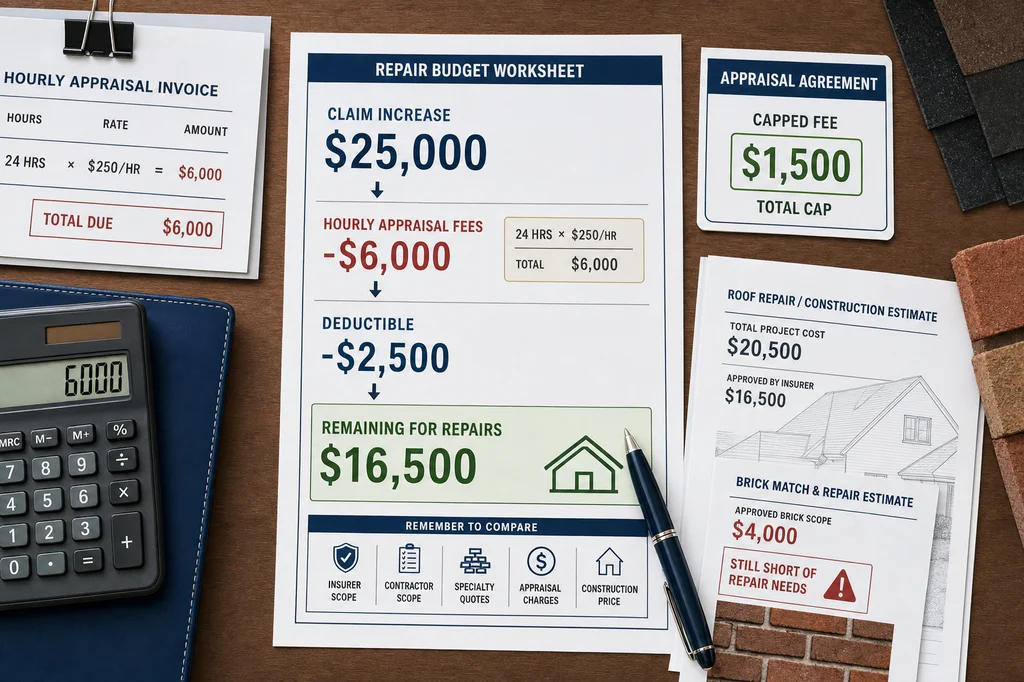
A claim increase can look substantial until appraisal charges and unresolved repair scope are counted. Nick Forsell described a homeowner whose claim increased by about $26,000 but who paid $6,000 for appraisal work under an hourly agreement. He also described a separate brick claim in which a higher item count still did not, in his view, support the needed repair.
The $26,000 increase and the $6,000 bill
Forsell said one residential claim rose by about $26,000 after appraisal. He estimated the overall job at roughly $50,000 to $60,000. The homeowner’s appraisal agreement was hourly, and Forsell said the bill was $6,000: 24 hours at $250 per hour.
Forsell said the actual appraiser was another person at the firm, not Steve Patrick personally. His objection was not that hourly billing is inherently improper. He said the fee left the homeowner paying more out of pocket in addition to the deductible while he was still performing the added work.
The useful comparison is the claim increase against the costs attached to pursuing it. Before signing an hourly agreement, read the written rate, who may bill time, and how charges will be recorded. Review the insurance policy, appraisal agreement, and construction agreement with appropriate licensed advisers if you need coverage or legal guidance.
A $1,500 cap offered a different calculation
Forsell contrasted that bill with a newly signed appraisal agreement that, he said, had a $1,500 cap. He estimated a potential increase of about $25,000 to $30,000 on that matter. The cap gave him a defined cost to weigh against the possible result.
That comparison does not establish what any appraiser should charge. It shows why the fee arrangement belongs in the decision before work begins: an hourly agreement can be evaluated differently when there is a stated ceiling than when the total depends on accumulated time.
More brick counted, but a repair gap remained
Forsell’s College Station example centered on an older home with hail-damaged clay brick. He said the insurer’s allowance increased from 50 to 150 individual bricks. The award valued the 150 bricks at $4,000.
Forsell said matching the older brick created a practical repair problem and that $4,000 would not fund the work he believed was needed. He estimated replacing the 150 bricks at $12,000 to $15,000 and replacing all brick on the house at $40,000. Those were Forsell’s estimates and views of the repair, not a general pricing rule.
He also said an umpire signed the award, ending his client’s appraisal result. That account is a reason to examine the scope and values proposed for a particular appraisal before moving forward, especially where a material match or a major repair approach is disputed.
Separate the increase from the reason it increased
In the same College Station matter, Forsell said his scope was about $66,000 while the insurer was at $42,000. He said the amount eventually reached the level he had sought, but that an additional $6,000 to $7,000 came from an HVAC quote for an exterior condenser rather than from new appraisal work.
For a homeowner, that distinction can make the numbers easier to assess. Put the insurer’s starting scope, contractor scope, specialty quotes, appraisal charges, and proposed construction price side by side. The goal is to see what portion of an increase is tied to each item and what funds may remain for the actual repair.
Forsell's concern about lump-sum work
Forsell said a lump-sum approach had not worked for him. He described an arrangement in which a contractor finances work, the homeowner submits the completed scope as incurred cost, and the contractor seeks additional payment afterward. His concern was that, if the insurer disagreed with reimbursement, the homeowner could be left in the middle.
This was Forsell’s account and opinion about that approach, not a conclusion about every construction or claim-service arrangement. Read proposed payment terms carefully and keep the construction price, payment schedule, included work, and appraisal-service charges clear in writing.
Directorii lists verified contractors.
Source: Roof appraisal fee and lump-sum debate
FAQ
How did a $26,000 claim increase become a budget concern?
Forsell described a claim that increased by about $26,000, while the homeowner paid $6,000 for 24 hours of appraisal work at $250 per hour. His concern was the amount left after that charge and the homeowner’s deductible, not the increase alone.
What was the capped-fee alternative Forsell mentioned?
Forsell said he had just signed an agreement with a $1,500 cap for a matter with a potential increase of about $25,000 to $30,000. He presented the cap as a clearer cost to evaluate against the potential result.
Why did 150 bricks still leave a concern about repairs?
Forsell said an older home’s hail-damaged clay-brick allowance rose from 50 to 150 bricks, but the award valued them at $4,000. He believed that amount did not cover the needed work or address the challenge of matching older brick.
Who performed the appraisal work in Forsell's hourly-fee example?
Forsell said another man at the firm was the actual appraiser and that Steve Patrick did not personally perform that work anymore.
What should I compare before agreeing to hourly appraisal fees?
Compare the written hourly rate, who can bill, how time is recorded, any cap, the insurer’s scope, specialty quotes, and the construction price. For policy or legal questions, review the relevant agreements with appropriate licensed advisers.