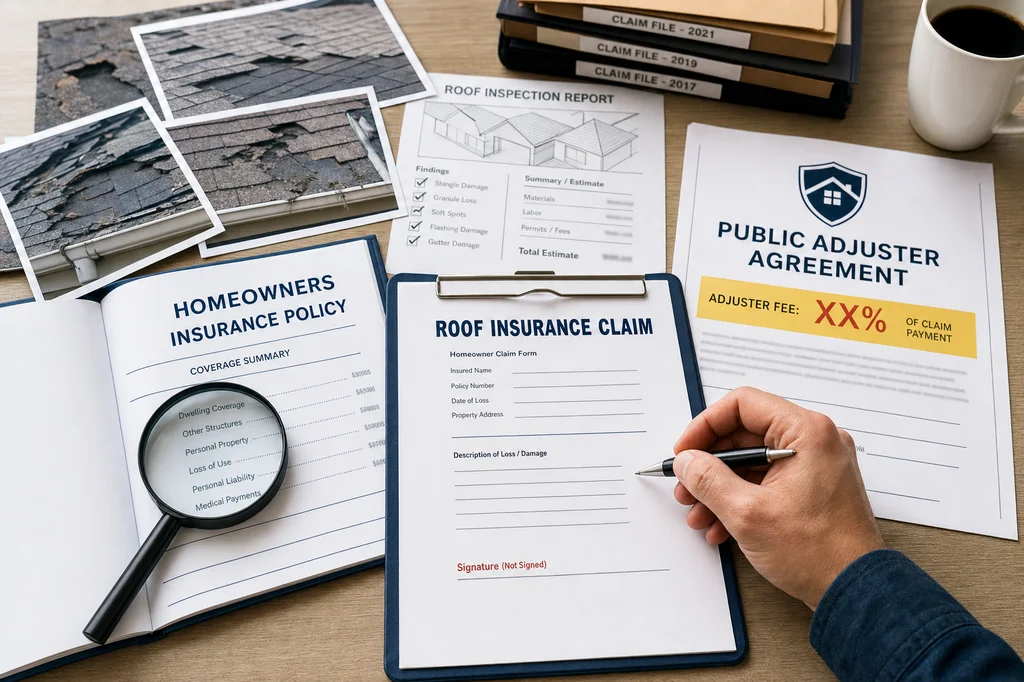
A public adjuster can be part of a roof-claim decision, but hiring one does not turn an uncertain loss into a strong claim. Mathew Mulholland’s central warning is aimed at claims filed simply to see what will happen: repeated or frivolous filings can create consequences beyond the immediate inspection.
Do not treat a roof claim like a free inspection
Mulholland warned that claims can accumulate in a policyholder’s history. In his view, multiple claims may lead an insurer’s underwriting department to view a customer as a higher risk, particularly when that person later needs coverage for a different home.
Claim-history and pricing consequences can vary by insurer, policy, location, and applicable rules. The narrower takeaway from Mulholland’s comments is not to file a claim just to throw “jello against the wall” and see what sticks.
Start with the actual roof condition, the event believed to have caused damage, and the coverage purchased.
Two public-adjuster fee models can create different pressures
Mulholland grouped public-adjuster work into two broad categories: firms that become involved with a new claim from the beginning, and firms that take on claims that were already opened, denied, or underpaid.
He said the fee basis may differ between those models. On a new claim, a public adjuster may charge a percentage of the total claim amount. On an existing claim, the fee may be a percentage of the additional money recovered above the prior adjustment.
Mulholland’s concern was that a firm paid only from the gap between an earlier payment and a possible higher amount may face pressure to make that gap larger. He did not say every firm handling denied or underpaid claims acts improperly; he described broad categories and said unethical practices can occur in either approach.
Before signing, identify what the percentage applies to: the full claim payment, an increase over an earlier payment, or another amount.
Get and read the policy you bought
Mulholland said roof policies have become far less uniform than they were years ago. In his account, policies from the same carrier can differ over time, and a homeowner should not assume one policy covers the same things as another.
Obtain a complete copy of the policy and read it before making assumptions about a roof loss. If the wording or a claim dispute is significant, contact your insurer, state insurance department, or qualified counsel.
Keep the claim tied to the roof evidence
Mulholland described disputed or underpaid claims as one context in which homeowners may evaluate whether professional representation is appropriate. His larger point was that the decision should remain tied to the roof and the evidence, not to a promise that every roof should produce insurance money.
He also raised concerns about inspections performed by third-party ladder-assist personnel and reviewed remotely by a desk adjuster. He described situations in which the person on the roof was not a licensed adjuster and the decision-maker was not on site. If an inspection is disputed, retain the photographs, reports, estimates, and correspondence connected to the roof claim.
Directorii lists verified contractors.
Source: Roofing Insights interview with Mathew Mulholland
FAQ
Can a weak roof claim affect future insurance options?
Mulholland warned that multiple claims can accumulate in a policyholder’s history and may affect underwriting, including when a homeowner seeks coverage for another house. Outcomes can vary by insurer, policy, location, and applicable rules.
Why did Mulholland warn against filing a claim just to see what happens?
He compared that approach to throwing “jello against the wall” to see what sticks. His concern was that frivolous or repeated claims can create consequences beyond the immediate inspection.
What is the difference between a new claim and an underpaid-claim public adjuster?
Mulholland described firms that work on new claims from the start and firms that take on claims already opened, denied, or underpaid. A new-claim agreement may use a percentage of the full claim amount, while an existing-claim agreement may use a percentage of additional money obtained.
What should I check in a public-adjuster fee agreement?
Identify exactly what the percentage applies to: the full claim payment, an increase over an earlier payment, or another amount. Mulholland emphasized that these fee bases can create different incentives.
Why should I read my complete roof insurance policy?
Mulholland said policies can differ substantially, including policies issued by the same carrier at different times. Get a complete copy and read it rather than assuming coverage based on the insurer’s name or another homeowner’s policy.