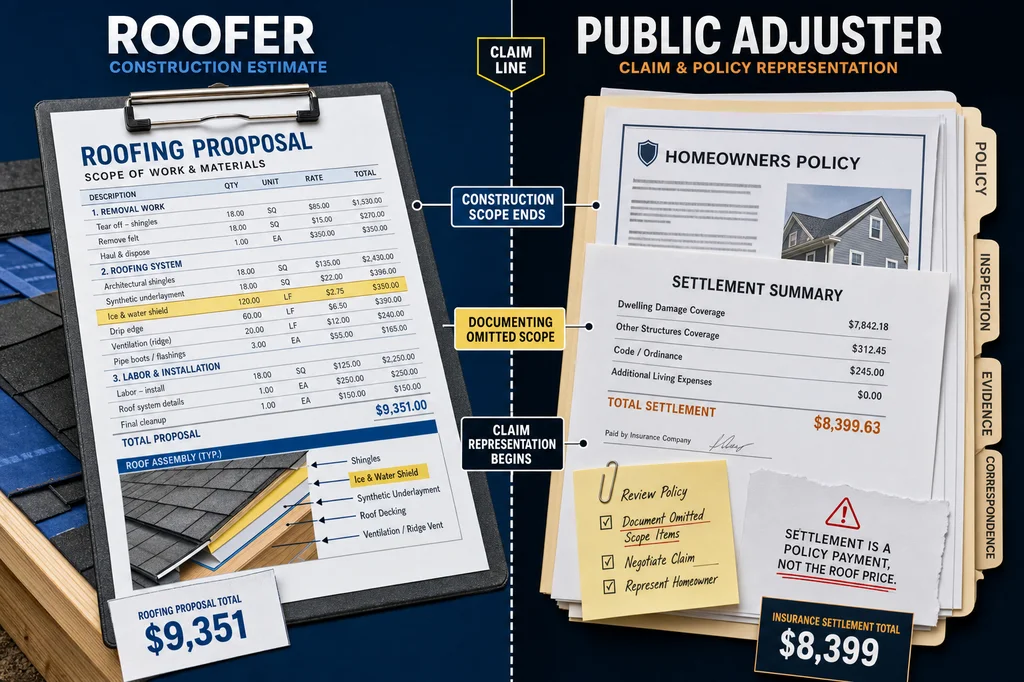
An $18,000 insurance settlement for a roof described as costing about $10,000 raised a sharp question: can a roofing contractor defend a construction estimate with an insurer, or does that communication become claim representation?
Two positions emerged. The public adjuster maintained that a claim is a policy matter and that a homeowner needs representation focused on what the policy owes. The roofing contractor maintained that a contractor can write an estimate, identify omitted construction items, and discuss the scope needed to complete the roof without interpreting policy coverage.
Defending a roofing estimate vs. representing a claim
The disagreement centers on where a contractor's scope-of-work role ends.
The roofing contractor's position was that a roofer can compare an insurer's estimate with the work required to complete the proposed roof. Removal rates and ice-and-water protection were examples of line items that may be reduced or omitted. Under this view, the contractor can document the missing item and explain why it belongs in the roofing scope.
The public adjuster's position was that a contractor may write and defend an estimate but may not negotiate the claim. In that view, the question is not limited to what the roof work costs; it is also what the homeowner is owed under the policy.
Keep those questions separate in writing: What work does the contractor say is necessary? and Is the remaining disagreement about construction scope, policy coverage, or claim procedure? A detailed roofing estimate addresses the first question. When the dispute turns on policy language or representation, seek appropriately licensed claim help.
Why an $18,000 settlement is not automatically a roofing price
A roughly 20- to 25-square roof was described as receiving non-insurance bids of about $10,000 while an insurance claim was said to pay $18,000. The public adjuster said he had not seen the claim paperwork and argued that the settlement still might be incomplete. The roofing contractor argued that a claim payment does not establish what a contractor should charge.
An insurance settlement is money paid under a homeowner's policy. A roofing proposal is a contractor's price for a stated scope of work. Neither total alone resolves every question about the other.
Use the contractor's written estimate to understand the proposed work and price. Do not assume that a settlement total is automatically the right contract price, or that a lower roofing bid proves the policy payment was correct.
Put the scope differences on the page
The contractor described reviewing a lower insurer estimate line by line. Reduced removal rates and omitted ice-and-water protection were the examples raised. The contractor's approach was to identify the missing item and provide the construction basis for including it.
A useful roofing estimate should identify the removal work, materials proposed, and items the contractor considers necessary for the job. When the insurer's estimate and the contractor's estimate differ, request the specific scope difference rather than relying on one total.
Whether communication about those differences is ordinary scope support or claim negotiation was disputed. Rules governing insurance representation and contractor communications can vary by jurisdiction.
Appraisal follows the policy form
Appraisal was raised as an option when an insurer agrees that damage exists but the amount owed remains disputed. Policy language may require procedural steps before an appraisal demand.
One State Farm policy form was described as requiring notice 10 days before demanding appraisal. That example does not establish a universal rule. Review the policy that applies to the claim before sending an appraisal notice or relying on a general timeline.
Follow the problem, not the settlement total
- Start with the roof work. Obtain a written roofing estimate identifying the proposed work and the reason for any item missing from the insurer's scope.
- Compare line items. If removal rates or ice-and-water protection differ, identify the item and the contractor's construction basis for it.
- Identify what remains disputed. The contractor's estimate is central to a disagreement about the work required. Questions about policy coverage, procedure, or homeowner representation may require licensed claim assistance.
- Read the policy before pursuing appraisal. Procedures and notice requirements may differ by policy form.
Directorii lists verified contractors.
Source: Public Adjuster debates Roofing Contractor on Insurance Fraud
FAQ
Can a roofer write and defend an estimate for insurance-related roof work?
Both positions accepted that a contractor can write an estimate and defend it. The disagreement was whether discussing missing scope items with an insurer remains construction support or becomes claim negotiation.
Why is an insurance settlement different from a roofer's price?
A settlement is a payment under the homeowner's policy, while a roofing proposal prices a stated scope of work. An $18,000 settlement and a roof price of about $10,000 were cited as different figures that did not, by themselves, resolve whether either amount was appropriate.
What estimate items were disputed?
Removal rates and ice-and-water protection were cited as examples of items that may be paid differently or omitted. A written scope can show where the contractor's proposed work differs from the insurer's estimate.
When is the disagreement about policy coverage rather than roofing scope?
A disagreement about the physical work needed can be documented in the contractor's estimate. Questions about what the policy covers, claim procedure, or representation go beyond the stated construction scope and may require appropriately licensed help.
Does every policy use the same appraisal notice rule?
No. A State Farm policy form was described as requiring 10 days' notice before an appraisal demand, but that was one example. Review the policy that applies to the claim before acting.