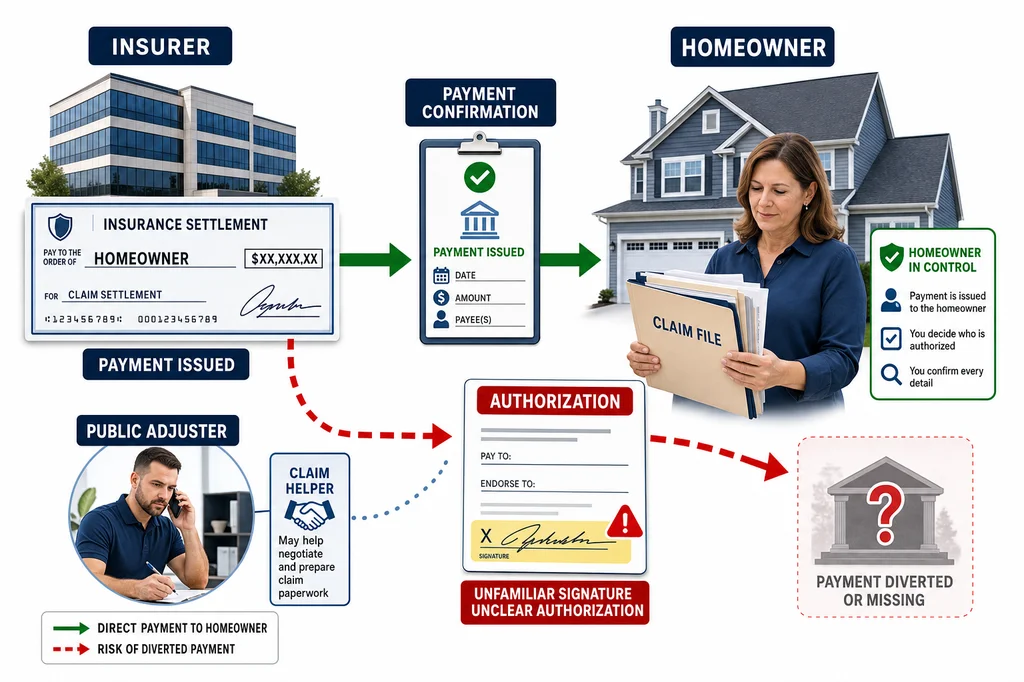
Andrew Mitchell’s theft case is a warning to homeowners who hire a public adjuster after storm damage. A public adjuster may negotiate a claim on your behalf, but you should closely control payment routing, read every authorization, and investigate delays that do not have a clear written explanation.
What happened in the Andrew Mitchell case?
Louisiana authorities said Mitchell, also known as Andrew AGA, forged homeowners’ signatures and took insurance payouts intended for Hurricane Ida victims. He was sentenced to 20 years in prison after pleading guilty to theft and forgery charges connected to more than $200,000 in stolen insurance money.
The case involved a professional who had agreed to help homeowners negotiate storm-damage claims. That role can involve sensitive documents, settlement discussions, and access to information about when an insurer has issued payment. For a homeowner, the key lesson is simple: hiring someone to assist with a claim should not mean losing sight of the money or the paperwork.
Investigators also accused Mitchell of theft involving homeowners in Texas and other Louisiana parishes. Those allegations and pending matters are separate from the Louisiana conviction and sentence. They do show why a homeowner should treat unexplained payment problems as something to document and escalate, rather than a routine inconvenience.
How the Andrew Mitchell payment-routing scheme raised alarms
Delays became more concerning after an insurance payment had reportedly been issued. In one Minnesota church roofing claim, Repair King CEO Mike Holmes said Mitchell had been hired to handle a denied claim that went to appraisal. After the appraisal payment came through, Mitchell reportedly stopped answering calls.
Holmes said Mitchell later promised to send a check and provided a FedEx tracking number. The church waited for the shipment, but no check arrived. Holmes then contacted other clients and said he learned of a similar alleged signature-forgery problem.
A tracking number, a promise that a check is coming, or a vague explanation about processing does not prove funds were sent. What matters is whether you can independently confirm the payment status and destination. If an insurer has paid the claim but the repair funds have not reached the person or account identified in your agreement, move from phone calls to a written record.
Keep control of claim payments and authorizations
The safest arrangement depends on your policy, mortgage lender, and written agreements, but you should know exactly who is authorized to receive, endorse, or direct claim funds. Do not assume an adjuster, roofer, or other representative needs control of the payment simply because they are helping with the claim.
- Read the representation agreement before signing. Identify the public adjuster’s fee, the services being provided, and any language concerning settlement checks, endorsements, payment direction, or authority to sign documents.
- Request copies of every authorization. Keep the version you signed, with dates and complete pages. A missing page or unfamiliar signature is a serious issue.
- Ask the insurer how payment will be issued. Confirm the named payees, whether a lender will be included, and whether payments have already been sent. Get the response in writing if possible.
- Maintain your own claim file. Save the policy correspondence, estimates, settlement documents, emails, texts, and payment notices in one place.
- Check that payment activity matches the repair scope. A settlement, an adjuster fee, and the construction agreement should make sense together. Do not approve a payment direction you do not understand.
This is not about taking over the claim negotiation yourself. It is about retaining visibility. A public adjuster can assist with a claim, while you remain the person who reviews the authorization and confirms what happens to the proceeds.
What to do when a claim payment seems delayed or diverted
An unexplained delay deserves a specific response, especially after an insurer indicates that funds have been released. Start by confirming facts directly with the insurer rather than relying only on an intermediary’s update.
- Contact the insurer using the claim contact information you already have. Ask whether payment was issued, the date, the payees, the amount, and the delivery method.
- Send a written request to the public adjuster. Ask for a complete accounting of funds received, fees taken, payments made, and documents authorizing each transaction.
- Preserve messages and documents. Save tracking numbers, emails, texts, voicemail records, settlement notices, and copies of checks or payment confirmations.
- Do not sign replacement documents without reading them. A rushed request for a new authorization, assignment, or endorsement should be reviewed carefully.
- Get appropriate outside help if money is missing. Depending on the facts and your state, that may include your insurer, the state insurance department, law enforcement, and a lawyer.
Coverage, payment handling, and the authority granted to a public adjuster can vary by policy, contract, and state. If you believe a signature was forged or funds were misdirected, do not rely on a roofer to determine your legal rights or insurance coverage. Confirm the next step with the insurer and qualified local counsel or your state insurance department.
Why delayed money can damage the repair plan
Missing or delayed funds can affect more than the claim file. In the Minnesota church matter, Holmes said the church ultimately received its roof, but his company absorbed the public adjuster fee and worked from an appraisal amount based on older pricing. He reported that recovering the church’s money took three and a half years.
That is a useful distinction for homeowners: an insurance settlement and a workable repair contract are connected, but they are not the same thing. If funds are held up, clarify what work can proceed, what payment is due when, and whether the written construction scope still reflects the funds available. Do not let uncertainty about claim proceeds turn into an unclear agreement with the repair company.
Choose separate roles carefully after storm damage
After a major storm, homeowners may encounter roofers, mitigation companies, engineers, attorneys, and public adjusters in quick succession. Each may have a different role. Keep those roles visible in writing so that claim representation does not quietly become control over construction money.
Before you hire a roofing company, compare the repair scope, payment schedule, and communication process. Directorii lists verified contractors.
Source: Andrew Mitchell public-adjuster theft case
FAQ
What should I do if a public adjuster is not explaining where my insurance payment went?
Contact your insurer directly to confirm whether payment was issued, when it was sent, and who was named as payee. Then request a written accounting from the public adjuster and preserve every message, authorization, payment notice, and tracking record. If you suspect forgery or missing funds, contact appropriate local authorities and qualified counsel.
Can a public adjuster receive my insurance claim payment?
That depends on your policy, the representation agreement, the insurer’s payment process, and applicable state rules. Before signing, identify exactly who may receive, endorse, or direct funds. You should retain copies of all authorizations and independently confirm payment status with the insurer rather than relying only on the adjuster.
What warning signs appeared in the Andrew Mitchell case?
Reported warning signs included communication stopping after an insurance payment was issued, a promised check that did not arrive, and a FedEx tracking number that did not result in delivery. A delay alone does not prove wrongdoing, but it should prompt direct confirmation with the insurer and a written request for an accounting.
Should I sign an authorization that lets someone handle my insurance claim?
You should sign only after you understand the authority being granted, the fee, and any language about settlement checks or payment direction. Keep the complete signed copy. If the document is unclear or you are being rushed, pause and have a qualified local professional explain the agreement before you authorize someone to act for you.
How can a delayed claim payment affect my roof repair?
A delayed or missing payment can leave the repair schedule, construction scope, and payment obligations unclear. In the Minnesota church claim described by Mike Holmes, older appraisal pricing and an adjuster fee affected the contractor after the funds were delayed. Get the repair company’s scope and payment schedule in writing while you resolve payment questions.