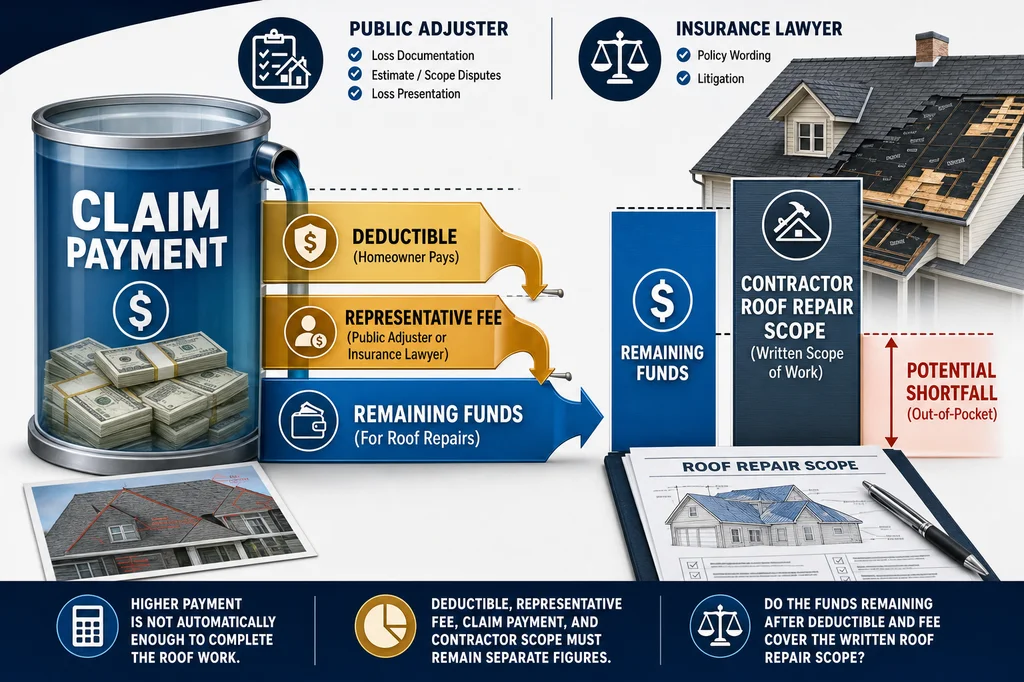
A disputed roof claim can create a hard practical question: if a representative is paid from claim proceeds, will enough money remain to complete the roof work? That question was contested in the debate. It does not have a one-size-fits-all answer, because it depends on the written fee arrangement, the payment available, and the actual repair scope.
Before choosing a public adjuster or insurance lawyer, put those three numbers beside each other. A higher claim payment is not automatically better if the fee arrangement leaves a gap between the remaining proceeds and the cost of the roof work.
The fee-versus-repair-scope tension
Contingency fees were central to the disagreement. Ten percent for a public adjuster and 45% for a lawyer were cited as examples, not standard prices. A contingency fee is tied to recovery, so the written agreement matters as much as the percentage.
One position was that public-adjuster fees often come from claim proceeds and can leave a homeowner short of the full repair amount. The opposing position was that homeowners may pay fees from other funds, finance them, or use payment for damage they do not plan to repair. Neither position eliminates the need to do the math for a specific roof.
- What is the contractor’s written scope and price for the roof work?
- What payment has been made or is being sought for the disputed damage?
- How does the agreement calculate the fee, and what money will pay it?
- After the deductible and representative fee, what amount remains for the repair scope?
A contractor’s price should not be quietly reduced to absorb a representative’s fee. Keep the roof scope, claim payment, deductible, and representation fee visible as separate figures.
Estimating disagreement is not proof of intentional underpayment
Roof claims can involve complex estimating and competing views of what damage requires repair. Hail damage, in particular, can be subjective. An initial estimate may omit items that another estimate includes, especially when the person preparing it lacks construction experience.
That does not by itself prove an insurer intentionally underpaid the claim. The debate recognized under-measured claims, exaggerated claims, and a broad middle ground of reasonable disagreement. Competing numbers can move toward a resolution when each side explains its damage findings, scope, and pricing.
The useful question is not simply whether the final payment increased. Identify what changed: Was there additional documented damage, a different repair scope, a pricing disagreement, or a dispute over what the policy covers?
Where each kind of help fits
A public adjuster may be involved when the disagreement centers on presenting the loss, documenting roof damage, or challenging an estimate and scope. An insurance lawyer may become relevant when policy wording or litigation is at issue.
Those categories can overlap, but they are not interchangeable. Do not treat a large estimate as a legal conclusion, and do not treat a legal dispute as a reason to ignore the actual roof scope. If policy language is the central issue, consult a qualified insurance attorney.
Fair payment is different from “maximizing” a claim
The debate drew a sharp line between pursuing a fair, coverage-supported payment and marketing a promise to “maximize” a claim. A fair result may still involve disagreement about what is damaged, what work is necessary, and what the policy pays. The goal is not the largest number that can be asserted; it is a payment supported by the damage, the repair scope, and the coverage.
Contingency compensation can create an incentive to seek a higher recovery, but that does not establish that every claim is inflated. Likewise, a lower initial estimate does not establish intentional underpayment. Focus on the support for each disputed item rather than assumptions about motives.
Keep the roles separate on a roof claim
Contractors, public adjusters, and insurers have separate roles. The contractor’s work is the roof scope and price. Claim presentation and estimating disputes are distinct from that repair work. Policy wording and litigation raise different questions again.
Ask for a clear explanation of the evidence behind disputed roof items and a written explanation of any fee arrangement. Compare that information with the actual work needed before committing claim proceeds to a representative fee.
Directorii lists verified contractors.
Source: Insurance Lawyer vs Public Adjuster: Who Really Protects Homeowners?
FAQ
Can a public-adjuster fee leave too little for roof repairs?
It can be a concern when a contingency fee is paid from claim proceeds, but the result depends on the actual agreement, the deductible, available payment, and the roofing scope. Compare the remaining funds with the contractor’s written price before signing.
Are 10% public-adjuster fees and 45% lawyer fees standard?
No. Those percentages were examples raised in the debate, not universal prices. Read the written agreement to see how the fee is calculated and what funds are expected to pay it.
Does a larger final roof-claim payment prove the insurer intentionally underpaid?
No. A higher final payment can reflect additional documentation, a changed scope, competing pricing, or reasonable disagreement about damage. Roof estimating is complex, and hail-damage calls can be subjective.
When is a public adjuster relevant to a roof claim?
A public adjuster may be relevant when the dispute concerns presenting the loss, documenting damage, or competing roof estimates and scopes. Compare the fee arrangement with the repair scope rather than relying only on a promised claim total.
When does a roof claim raise a reason to consult an insurance lawyer?
An insurance lawyer may be relevant when policy wording or litigation is at issue. If you are unsure what a policy provision means or how a representation agreement affects claim proceeds, consult a qualified insurance attorney.