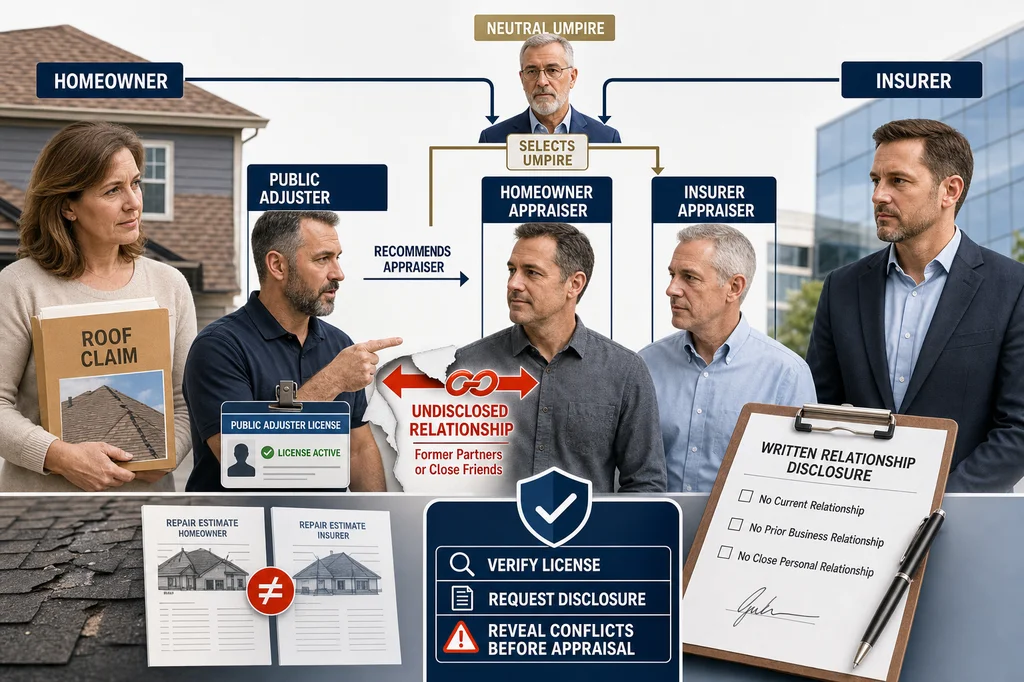
Before entering insurance appraisal, verify a public adjuster’s license and request written disclosure of any prior business or personal relationship with the appraiser they recommend. An undisclosed conflict can create serious consequences for a property claim.
A Washington fire claim ended with the policy voided
After a fire at an apartment building in Washington, the owners hired public adjuster Paul Morland. The claim went through appraisal, producing an additional $188,000 award.
Morland was not licensed during most of the claim. He also selected his best friend and former business partner as the owners’ appraiser without disclosing that relationship. The insurer sued, and the court found fraud and voided the policy, although the building owners had not done anything wrong.
The court opinion did not require the owners to return money already paid. Still, the owners needed a new insurance policy after the fire. The central lesson is stark: a hidden conflict involving a representative can harm the homeowner’s claim even when the homeowner did not know about it.
When appraisal fits—and why the appraiser matters
Appraisal is generally used when the insurer and policyholder agree there is property damage but disagree about the value or cost of repairs. For example, an insurer may estimate a roof repair at $20,000 while a contractor estimates $30,000.
Each side selects an appraiser, and the two appraisers select an umpire. The panel inspects the property and reaches an appraisal award. The process can be easier to understand than litigation, but it is not litigation.
Appraisal rules differ by state. In some states, appraisal can address causation; in others, it is limited to pricing or repair-scope disputes. The award can be binding. That matters when damage cannot be identified until work begins, such as roof decking or sheathing discovered after roofing materials are removed.
Four checks before approving an appraiser
- Check the public adjuster’s license status. State licensing information is public record. Confirm that the person is licensed and in good standing.
- Ask who the proposed appraiser is. Get the name before agreeing to appraisal.
- Request written relationship disclosure. Ask the public adjuster and proposed appraiser to disclose prior business relationships or personal relationships that could affect independence, including a former partnership or close friendship.
- Read the public-adjuster agreement. Identify the fee arrangement, the services promised, and what the agreement says if you later change representatives.
People in the same field may know one another. The issue is not acquaintance alone; it is whether a relationship that could affect independence is withheld from the homeowner.
Keep repair work separate from claim negotiation
An Illinois fire-loss dispute shows a different way a claim can go wrong. Matthew and Marica Bean hired Chicago Water and Fire Restoration for cleanup and reconstruction planning after a house fire. The company billed nearly $13,000 for initial cleanup, while the insurer approved $4,000.
Emails showed company staff saying they would negotiate with the insurer and reach an agreed price. They also said the homeowners would be responsible only for the deductible. The court found that the company acted as an unlicensed public adjuster and held the contract void.
A contractor can document repair needs and provide an estimate. Negotiating an insurance claim on a homeowner’s behalf is a separate role that may require public-adjuster licensing. If a contractor offers to negotiate with the insurer, confirm that the person is properly licensed for that role in your state.
Know the fee terms before changing representatives
In another fire-claim dispute, Danielle and Cynthia hired public adjuster Joseph on an 8% contingency fee. After they hired an attorney, arbitration produced a $400,000 award. A jury later awarded the public adjuster $29,000 for the reasonable value of work performed.
Before signing a public-adjuster agreement, identify the fee structure and the terms that apply if you end the relationship or another representative takes over. Because agreements and appraisal rules vary by state, consider having counsel review the agreement and policy’s appraisal clause before you sign.
For repair work after a covered loss, Directorii lists verified contractors.
Source: Morning Brew Show
FAQ
How can I verify a public adjuster’s license?
Check the public licensing information maintained by your state and confirm that the named public adjuster is licensed and in good standing. Verify the individual who will handle the claim, not only the business name.
What should a public adjuster disclose about an appraiser?
Request written disclosure of prior business or personal relationships that could affect the appraiser’s independence. In the Washington fire claim, the undisclosed appraiser was the public adjuster’s best friend and former business partner.
What does insurance appraisal decide?
Appraisal is generally used when damage is acknowledged but the parties disagree about repair value, cost, or scope. Its authority varies by state: some states allow causation issues in appraisal, while others limit it to valuation or scope disputes.
Why can undiscovered roof damage matter in appraisal?
An appraisal award can be binding. If roofing materials are removed later and concealed damage such as decking or sheathing is found, it can be difficult to get the insurer to revisit the amount.
Can a contractor negotiate with my insurer?
A contractor can provide a repair estimate and document repair needs. Negotiating an insurance claim for a homeowner may require public-adjuster licensing, depending on the state. Confirm the contractor’s permitted role before authorizing claim negotiations.