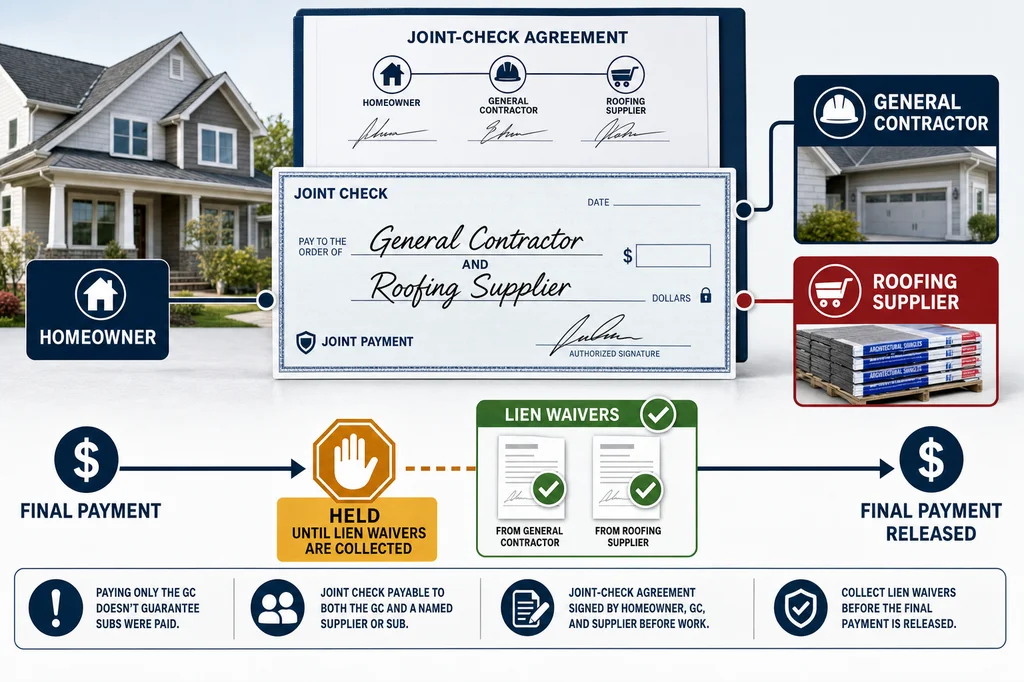
You can pay a general contractor in full and still face a lien claim if the contractor does not pay subcontractors or suppliers. The strongest protections happen before final payment: know who is working on the job, use a joint-check agreement when appropriate, and collect state-compliant lien waivers.
Why a lien can happen after you pay
A lien is a claim against property by someone who says they were not paid. On a construction project, a subcontractor or supplier may not have a direct contract with the homeowner, yet unpaid labor or materials can still create lien exposure under state law.
That can leave you with proof that you paid the general contractor while a subcontractor or supplier says it was never paid. A lien can interfere with selling or refinancing until it is removed.
Start with the payment chain
Before work begins, hire a licensed, legitimate contractor and get the names of the subcontractors and suppliers expected to be involved. Those names may appear in the contract, and knowing them gives you a clearer view of who may need to be paid.
Keep your contract, payment records, invoices, and communications together. If a payment dispute arises, proof that you paid and records showing who worked on the project are important.
Use a joint-check agreement before the project starts
A joint check is payable to both the general contractor and a subcontractor or supplier. It can help direct money to the party providing particular labor or materials rather than relying only on the general contractor to pass the payment along.
Writing two names on a check is not the same as having a joint-check agreement. For the arrangement to stand up in court, the homeowner, general contractor, and subcontractor or supplier should have a joint-check agreement before the project starts.
Joint checks are especially worth considering when a particular subcontractor or supplier represents a meaningful part of the work. They create a payment record, but they do not replace the need to track the parties involved in the project.
Get lien waivers before final payment
Before making final payment, obtain lien waivers from the subcontractors and suppliers involved in the work. A lien waiver is meant to show that the party has been paid and is giving up lien rights connected to that payment.
State rules differ. Some states require specific waiver forms, so use a waiver that follows the law where the property is located. Do not treat a generic form as a substitute for a state-compliant waiver.
The key timing is simple: collect the needed waivers before releasing the final payment. This helps close the gap between paying the general contractor and confirming that the subcontractors and suppliers were paid.
If a lien is already filed
First, contact the contractor. If the contractor says the subcontractor or supplier was paid, ask for proof. The request may prompt the contractor to resolve the unpaid bill.
Then review the rules that apply in your state. Lien requirements and timelines vary by state, and failure to follow the applicable rules may affect a lien claim. Keep your payment proof, contract, notices, and waiver records available for review.
If you need to sell the home and need the lien removed quickly, a bond can sometimes help, although it may involve a cost. If you have proof of payment and still face a lien claim, a lawyer can assess the situation and the options available under state law.
Source: 5 Ways to Stop a Contractor from Putting a Lien on Your Home
FAQ
Can a subcontractor file a lien after I pay the general contractor?
It can happen when the general contractor does not pay a subcontractor or supplier. State lien rules vary, but paying the general contractor does not necessarily show that every party providing labor or materials was paid.
What is a joint-check agreement?
A joint check is made payable to both the general contractor and a named subcontractor or supplier. A joint-check agreement is the arrangement among the homeowner, general contractor, and that payment recipient, made before the project starts.
When should I use a joint check?
Consider a joint check when a particular subcontractor or supplier is responsible for a meaningful part of the job. It can create a record that money intended for that party was directed to both the contractor and the named recipient.
Should lien waivers be collected before final payment?
Yes. Obtain lien waivers from the subcontractors and suppliers involved before releasing final payment. Use forms that follow the rules in the state where the property is located, since some states require specific waiver forms.
What should I do if I receive a lien claim?
Ask the contractor for proof that the claimant was paid and gather your contract, payment records, notices, invoices, and waivers. Because lien requirements vary by state, a lawyer can assess the claim and your records. A bond can sometimes help remove a lien quickly when a sale is pending, though it may involve a cost.