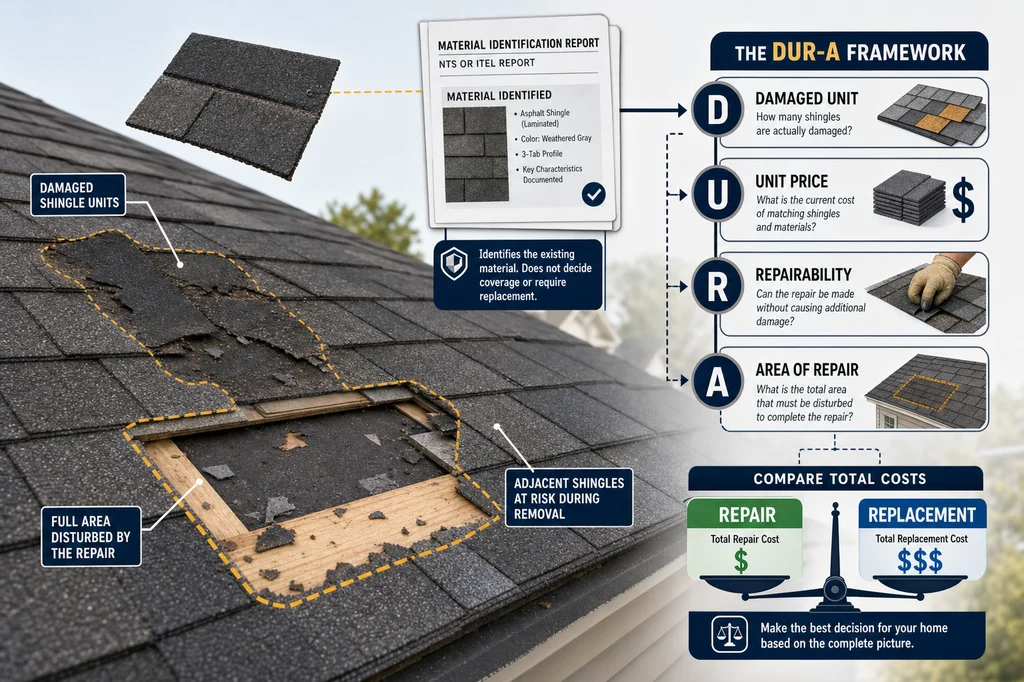
When an insurer agrees that a roof was damaged but proposes a repair instead of replacement, the key question is not how to make a claim larger. It is whether the roof can actually be repaired. Reports from NTS or ITEL may help identify the existing material, particularly when that material has been discontinued.
John Senac, president and co-owner of NTS, describes a repair-versus-replacement framework called DUR-A: damaged unit, unit price, repairability, and area of repair. It gives homeowners a way to compare a proposed repair with the work the roof may require.
Where NTS, ITEL, and carrier services fit
NTS is a shingle-identification company. Senac names ITEL among the third parties carriers may use for roofing identification. He also says State Farm spent roughly 10 to 12 years building its own roofing-identification service rather than relying only on outside services.
Identification is only one part of the decision. A carrier may also send a third-party documentation company to record conditions and send information back to the carrier. Those companies are not necessarily the final decision-makers, and a carrier can disagree with what its third party documented.
For a homeowner, an identification result should be considered alongside the proposed repair scope. It does not, by itself, determine coverage or make replacement automatic.
DUR-A: four facts behind a proposed roof repair
The DUR-A approach starts with the physical work, then compares that work with the overall roof decision.
- Damaged unit: Identify what units are damaged and how many are involved.
- Unit price: Establish the cost of the materials needed for the work.
- Repairability: Consider what happens when existing shingles are removed. A repair can become more extensive if shingles or related parts fail during the process.
- Area of repair: Determine the full area that must be disturbed to complete the repair, rather than looking only at the shingles with visible damage.
Availability and compatibility can shape those four points. If a material cannot be obtained, that changes the repair question. If a manufacturer has changed a product or indicates that materials should not be mixed, compatibility may also affect the proposed work.
After the repair area and material costs are understood, compare the repair cost with replacement. Senac’s stated approach is straightforward: if the repair remains less than total replacement, repair it; if it exceeds total replacement, replacement may be the practical result.
Start with local building requirements
Before treating matching or repair percentage as a universal rule, check with the local building department, municipality, parish, or other local official. Senac notes that requirements can vary by location and may address issues such as roof integrity, uniform appearance, or matching.
A roofing contractor can explain the construction work required and identify local requirements relevant to the scope. The homeowner owns the policy and may need to pass the construction facts to the insurer when the carrier communicates primarily with the policyholder.
Keep the repair question separate from manufactured damage
Manufacturing roof damage is not a shortcut around a repair dispute. Senac describes it as a damaging practice that can catch up with contractors. He points to phones, drones, and neighbors filming as examples of how conduct on a property may be observed.
A contractor should document the roof’s existing condition and explain the actual repair issue. If the roof can be repaired, the work should be evaluated honestly. If it cannot, the explanation should be built from the material, repairability, repair area, and cost—not from added damage.
Directorii lists verified contractors.
Source: Manufactured Roofing Damage | Big Mistakes Roofers Make
FAQ
What can NTS or ITEL reports tell me about a roof repair?
NTS is identified as a shingle-identification company, and ITEL is named among third parties that may be used for roofing identification. An identification finding can help clarify the material involved, but it does not make the coverage decision or automatically require roof replacement.
What is the DUR-A framework for roof repairs?
DUR-A stands for damaged unit, unit price, repairability, and area of repair. It is a way to evaluate how many materials are damaged, their cost, whether the roof can be opened and repaired successfully, and how large the actual repair area must be.
Does a discontinued shingle mean the whole roof must be replaced?
No. A discontinued material does not automatically settle the repair-versus-replacement question. Availability, compatibility, repairability, the repair area, and the cost of the needed work all matter.
Why might an insurer send a third-party company to inspect the roof?
Carriers may use third-party assistance to document a loss and send information back to the carrier. The third party may not make the final decision, and the carrier can disagree with its documentation.
Should I rely on a statewide matching or repair rule?
Check with the local building department or municipality instead of assuming one rule applies everywhere. Local requirements may differ and can affect the repair scope.