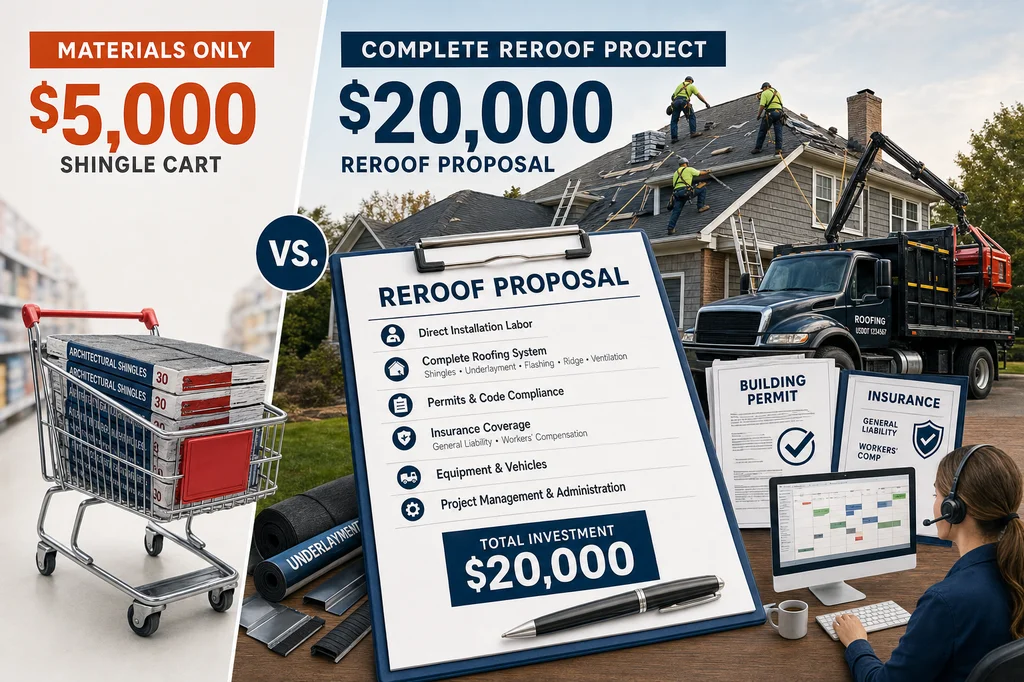
A $20,000 reroof bid can be far higher than a $3,000-to-$5,000 Home Depot shingle cart because shingles are only one part of the work. Compare the complete scope: installation labor, insurance, permits, office support, equipment, and the contractor’s ability to finish the job.
What a reroof estimate covers beyond retail shingles
A retail shingle price is a materials snapshot, not the price of replacing a roof. A roofing company has to price the people and systems required to schedule, install, supervise, and support your project.
For a company doing steady volume, that can include office staff to answer calls, handle accounting, file permits, and manage projects. It can also include office rent, vehicles, equipment, employee training, general liability insurance, and workers’ compensation insurance. Those costs are not necessarily listed as separate line items on your proposal, but they can be built into the total price of each job.
That distinction matters when you compare a retail cart with a proposal. The cart may show shingles and perhaps some accessories. It does not show the labor crew, the administrative work around a permit, the business insurance, or the cost of having a company available if a project issue needs attention.
How labor, materials, and overhead can appear in a bid
There is no universal percentage split for roofing estimates, but a rough model puts about a third toward materials, about a third toward the installation crew, and the remaining portion toward overhead and gross profit. That is a business example, not a required pricing formula for every roof.
The key homeowner point is that gross profit is not the same as take-home profit. A contractor may use the amount left after direct materials and labor to pay indirect business costs before there is any net profit. A high-looking gap between the cost of shingles and the contract total does not, by itself, show that a bid is inflated.
Your roof can also have job-specific costs that a retail price cannot capture. Permitting, project coordination, access conditions, the amount of labor needed, and the accessories included with the shingle system may change one proposal substantially. Read the scope to see what each company is actually pricing rather than trying to reverse-engineer the whole job from the shingle bundle price.
Why the lowest roofing bid can carry a different risk
A much lower proposal may reflect a leaner operation, but it can also signal that a company is not collecting enough to meet its obligations. The concern is not simply that a lower bidder earns less; it is whether the company can pay crews, suppliers, insurance costs, and operating expenses while your roof is underway.
In one South Carolina example, a competitor repeatedly underbid work despite another contractor’s concern that his own margins were already tight. That competitor later went out of business amid reported debts to suppliers, crews, and sales staff. It is one reported case, not proof that every low bid will fail. Still, it illustrates why price alone is a weak measure of contractor reliability.
A contractor that stops responding, cannot obtain materials, or closes during a project can turn apparent savings into a serious disruption. Do not assume a larger-looking company or a low price means the business is financially sound. Check the company’s reputation and verify that the proposal names the business that will contract with you and perform the work.
Directorii lists verified contractors.
What to compare when bids are thousands apart
Compare like-for-like scopes before deciding that one roofer is overpriced. A useful comparison makes visible what each company includes, excludes, and is prepared to manage.
- Materials and accessories: Identify the shingles and every listed accessory. A proposal with only a shingle name may not match one that spells out the complete materials package.
- Labor scope: Confirm what installation work the crew is responsible for and whether the estimate clearly describes the work rather than relying on a vague total.
- Permits and project administration: If permits are needed locally, find out whether the proposal addresses permit handling and related coordination. Local requirements should be confirmed with a licensed professional.
- Insurance: Ask for current proof of general liability and workers’ compensation coverage. Coverage and requirements can vary, so verify the documents rather than relying on a verbal assurance.
- Company stability: Research the contractor before signing. A price that is low because the business is not meeting supplier or crew obligations may create problems that are not visible in the estimate.
Should rising costs change your timing?
Material, labor, truck, and equipment costs were described as rising inputs that contractors may need to pass through in their prices. That does not mean every proposal will rise in the same way or that you should rush into a contract.
Instead, use current bids to establish a local market picture. If several detailed estimates fall in a similar range, that range may tell you more about the going cost of your project than a retail shingle total does. If one bid is far below the others, investigate the scope and the company before treating it as a bargain. If you need help evaluating permit requirements, policy-related questions, or structural concerns, use the appropriate licensed professional rather than relying on a roofing estimate alone.
Source: Why Roofs Cost So Much? Roofer’s Perspective
FAQ
Why is my roof estimate so much higher than shingles at Home Depot?
A reroof estimate can include much more than the retail cost of shingles. It may account for installation labor, office staff, permit handling, insurance, vehicles, equipment, training, and project management. Compare the written scope and included materials before using a retail shingle total as a benchmark for the entire project.
How much of a roofing bid is profit?
There is no single profit percentage that applies to every roofing company or project. One rough model splits costs among materials, crew labor, and overhead plus gross profit, while recognizing that gross profit still has to cover indirect business expenses. Review scope and contractor reliability, not just an assumed profit margin.
Should I choose the cheapest bid for a new roof?
Not without checking why it is cheaper. A lower bid may reflect a different scope, fewer included materials, or a company that is not charging enough to support its crews, suppliers, and operations. Compare written proposals, insurance documentation, and the contractor’s reputation before deciding whether the savings are real.
What should I verify when roofing estimates are far apart?
Verify the listed shingles and accessories, labor scope, permit responsibilities where applicable, and current insurance documentation. Also research the company that will sign the contract and perform the work. Large price differences are easier to assess when each bidder has described the same work in writing.
Can a roofing company go out of business during or after my project?
It can happen, particularly if a company is struggling to pay suppliers, crews, or other operating expenses. A reported South Carolina example involved a low-bidding competitor that later folded amid debts. That case does not predict every contractor’s future, but it supports checking the company carefully rather than selecting only by price.