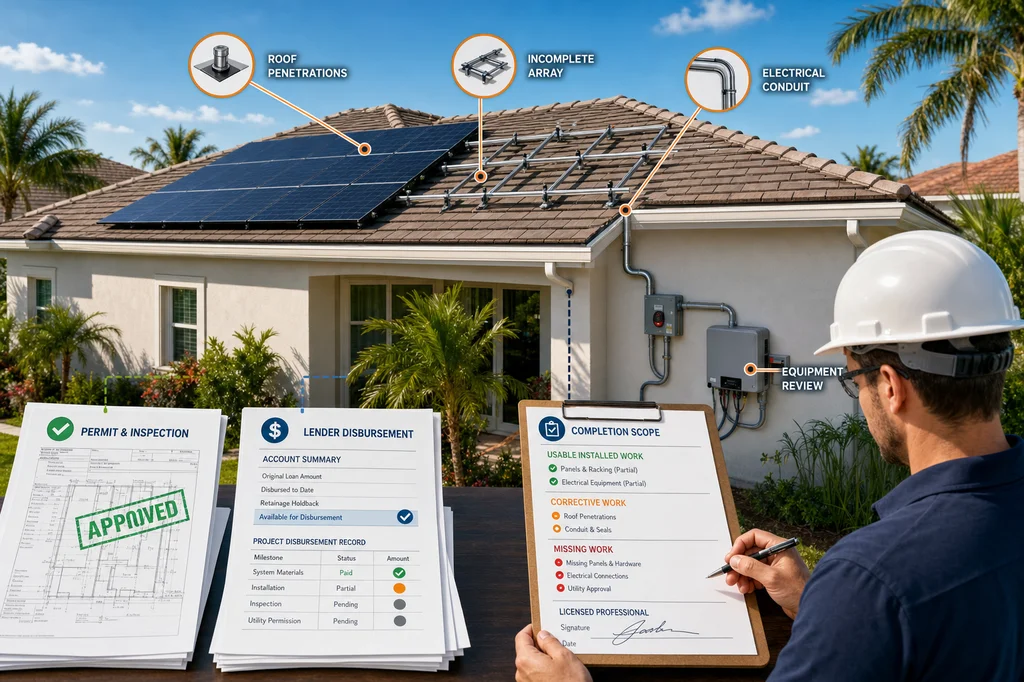
For Florida homeowners facing a Modern Concepts Solar project left unfinished, do not treat completion work as a simple new solar purchase. First establish what was installed, what was paid for, and what your financing agreement requires. Then have a qualified professional identify the permit, roofing, electrical, and production issues that still need resolution.
Start with a record of the unfinished solar project
Your first job is to preserve the project’s condition, not to make assumptions about what remains. An incomplete system can involve roof penetrations, mounted equipment, electrical connections, permit work, or equipment that was delivered but never installed.
Create one project file before contacting a completion company or authorizing more work. Keep copies rather than relying on a salesperson’s verbal summary.
- Signed contract and change orders: These show the promised system size, equipment, payment terms, and who was responsible for permits and installation.
- Financing documents and account statements: Save the lender name, loan agreement, payment history, disbursement notices, and every message about the incomplete work.
- Photos from the ground: Photograph panels, racking, conduit, electrical equipment, roof areas beneath installed equipment where visible, and any materials left on site. Date the files if possible.
- Permitting records: Collect permit numbers, inspection notices, plans, engineering documents, and correspondence from the local building department or utility.
- Communications: Preserve emails, texts, voicemails, cancellation notices, and any promise to return, repair, or complete the installation.
- Invoices and receipts: Match each payment or lender disbursement to the work actually completed.
This record gives you a factual starting point. It also helps a replacement installer separate installed components that can be evaluated from missing work that must be newly scoped.
Why the lender relationship needs careful review
The financing arrangement may be central to an unfinished Modern Concepts Solar project, but the outcome depends on your own agreement. Do not assume that a lender will automatically fund completion work, pause payments, or accept another contractor’s estimate without documentation.
A Solar Bear representative said that Modern Concepts Solar left about $45 million in projects unfinished and that one lender arranged completion work for 500 of roughly 1,200 affected customers. That example is useful because it shows why homeowners should contact their lender directly. It is not proof that every borrower has the same terms or remedy.
Tell the lender, in writing, that the installation is incomplete. Ask for the status of the account, a record of funds released for the project, and the process it uses for an unfinished contractor project. Keep the request focused on documents and next steps rather than on a verbal promise.
Questions to put to the lender
- What work or milestone was the last disbursement tied to?
- Has the lender classified this account as involving an incomplete installation?
- Are there funds not yet released, and what conditions apply to them?
- Will the lender review an independent completion scope and estimate?
- What documents does it need before considering a replacement installer?
- Who is the assigned contact, and how should you submit records?
Read the financing agreement before signing a new completion contract. If you are unsure how the contract, loan, or a proposed release affects you, speak with a qualified attorney. Contract and financing obligations can vary.
Have the existing work evaluated before paying for completion
Completion work should begin with an assessment of what is usable, defective, unpermitted, or incomplete. A new company should not simply build on top of unknown work without checking whether the existing installation matches approved plans and applicable requirements.
The Modern Concepts Solar example included work performed without permits. Permit status, roof penetrations, electrical connections, and the installed equipment can affect whether components can remain in place or need correction before the system can be completed.
Hire a properly licensed solar and electrical professional to inspect accessible system components, paperwork, and permit status. Do not climb onto the roof or attempt to test electrical equipment yourself. Ask for a written scope that distinguishes:
- work that appears complete and can be retained;
- work that needs correction or replacement;
- missing permit, engineering, inspection, or utility steps;
- equipment brands and model details that can be identified; and
- the work needed to reach a functioning, approved system.
A vague proposal can hide a major gap. For completion work, insist that the written scope identify the equipment being installed or replaced. That makes it easier to compare proposals and understand available manufacturer support.
Permits and roof details can change the completion price
An unfinished array may cost more to complete than a clean installation because the replacement company has to diagnose another installer’s work. The scope can expand if permits were not pulled, plans do not match the installation, wiring needs correction, or roof penetrations require repair.
Ask the completion company to explain whether it will take responsibility for permits, inspections, utility coordination, and any corrective work needed to get approval. The answer should appear in the contract, along with clear exclusions. Local permitting and utility requirements vary, so confirm requirements with the building department and licensed professionals rather than relying on a general promise that the system will be “finished.”
Also ask how roof issues will be handled. Solar mounting can involve roof penetrations, and an installer that missed required installation steps may create leakage risk. A solar professional and a qualified roofing professional may both be needed when there is concern about roof condition or water entry.
Directorii lists verified contractors.
Do not authorize a second contract until the handoff is clear
The replacement installer needs a defined role. You should know whether it is completing the original design, redesigning the system, removing defective work, or starting over with different equipment.
Before you sign, make sure the agreement states who will obtain permits, what existing equipment is included, what roof and electrical corrections are included, and how final inspection and utility activation will be handled. If the lender is involved, make the contractor’s scope consistent with the lender’s written process before approving payment.
Be cautious of anyone who offers a fast completion price without reviewing the installed work and records. A low number may exclude permit corrections, roof repairs, electrical troubleshooting, or equipment that cannot be reused. A written, itemized scope is more useful than a broad promise to “finish the system.”
When to escalate the unfinished-installation problem
Escalate promptly if you cannot obtain project records, believe funds were collected for work that was not completed, see possible roof leakage, or have electrical safety concerns. Keep all communications in writing and avoid altering the existing installation while the project is being evaluated.
For suspected consumer fraud or contractor misconduct, contact the appropriate Florida consumer-protection or licensing authority and seek legal advice for your specific contract. A licensed professional should address any roof, electrical, engineering, or permit issue.
Source: Solar Energy: The Truth You Need To Know
FAQ
What should I document if my Modern Concepts Solar installation is unfinished?
Document the contract, financing papers, lender statements, invoices, permit records, communications, and dated photos of visible work and materials. Your file should show what was promised, what was paid, and what was actually installed. This information helps a lender and a replacement installer evaluate the project without relying on incomplete verbal accounts.
Should I keep paying my lender after a Modern Concepts Solar project was not completed?
Review your financing agreement and contact the lender in writing before making assumptions about payment obligations. Ask for the account status, disbursement history, and its process for incomplete contractor work. Loan terms and available options can vary, so seek qualified legal advice if you need help interpreting your agreement.
Can another company finish an incomplete solar installation?
Another qualified company may be able to complete it, but it should first evaluate the existing equipment, wiring, roof penetrations, permits, plans, and inspection status. Some installed work may be usable, while other components may need correction or replacement. Get a written scope that identifies both retained work and missing work.
What should a solar completion contract include?
The contract should identify existing equipment, new equipment, corrective work, permit and inspection responsibilities, utility coordination, roof-related work, and exclusions. It should also make clear whether the company is completing the original design or redesigning the system. Avoid broad promises to finish the project without an itemized scope.