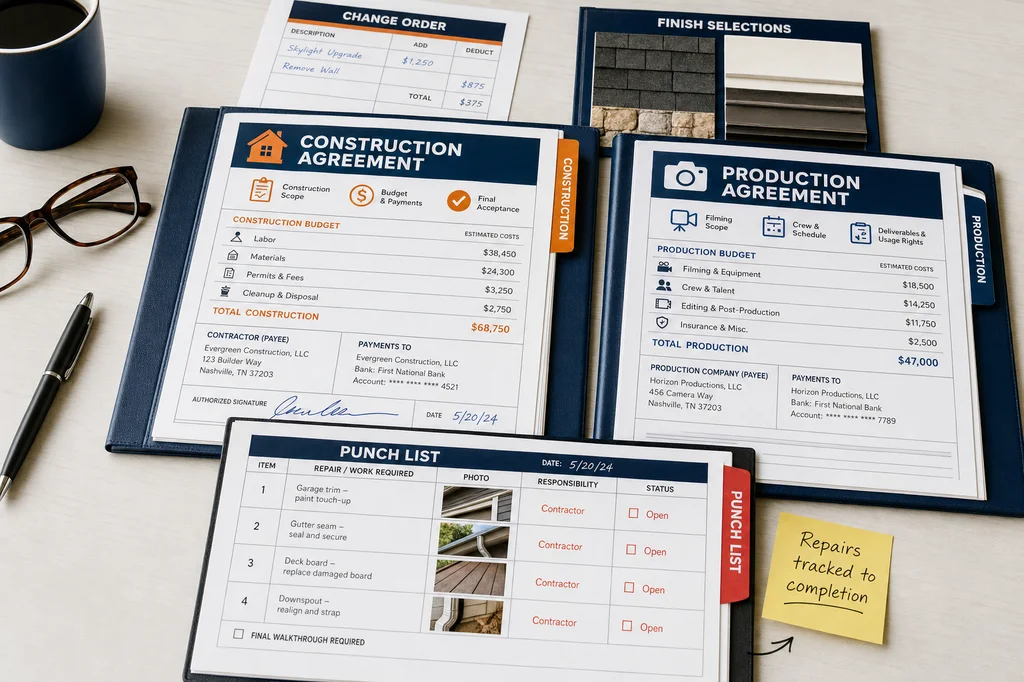
Love It or List It can make a renovation look seamless, but the agreement behind an HGTV-style project should separate construction spending from production costs, identify who answers for defective work, and set a written punch-list process. Those details matter before you authorize any payment or filming.
Start by separating the renovation budget from the TV budget
A homeowner should be able to see exactly what each dollar buys. A television production can involve filming, editing, crew, scheduling, and other media work that is distinct from labor and materials installed in your home.
In the dispute involving homeowners Dina Murphy and Tim Sullivan, the couple alleged that they paid $140,000 for renovations connected with their 2016 appearance. They said the money was sent to production company Big Code TV, which hired Aaron Fitz Construction. The homeowners alleged that about $85,000 went to the contractor and about $55,000 went to the production company.
Those allegations are not proof that every television renovation uses the same arrangement. They do show why a single all-in number is not enough. If production expenses are part of your payment, you need to know that before signing—not after construction is underway.
- Construction scope: List the rooms, demolition, repairs, materials, finishes, permits, labor, and cleanup covered by the construction budget.
- Production scope: Identify any filming, editing, travel, crew, publicity, or production charges that you are funding.
- Payment recipient: State whether you pay a contractor, a production company, or more than one party, and which party controls each portion of the funds.
- Allowances and substitutions: Require written approval before a selected finish or material is replaced with a lower-cost option.
- Unused funds: Explain what happens if work is reduced, a product is unavailable, or a planned portion of the renovation is not completed.
Make the construction contract stand on its own
Your construction agreement should remain understandable even if filming stops or the program never airs. A production release may govern your image and the show’s footage, but it should not blur who is responsible for the physical work in your home.
Keep the contractor’s agreement separate from any media or appearance release when possible. At a minimum, the documents should clearly identify the contractor performing the work, the party supervising it, and the party responsible for correcting incomplete or defective work. Do not rely on a casting conversation, a design reveal, or an on-camera promise as the scope of your project.
Ask for the contractor’s legal business name and the name of the entity receiving your payment. The agreement should also state who has authority to approve changes. A homeowner can otherwise be caught between a producer, designer, and contractor, with each party pointing to someone else when a decision or repair is needed.
Put defect responsibility and punch-list repairs in writing
A polished reveal does not replace a final acceptance process. The contract should describe how you document problems, who evaluates them, and how corrections are tracked to completion.
Murphy and Sullivan alleged damaged or unstained floorboards, open holes, low-grade carpeting placed over chipped concrete, and windows painted shut. They also alleged that the finished work was a scaled-down version of what had been promised. Big Code TV denied wrongdoing and said it had completed more than 250 renovations without issues. The lawsuit ended in 2017; related libel claims were later dismissed.
For a homeowner, the practical point is simple: defects and disagreements need a process before the cameras arrive. Your paperwork should identify the standard for completion based on the written scope, not on whether a room photographs well.
- Document the final walk-through. Create a dated list of incomplete, damaged, or nonworking items, with photos where useful.
- Assign each item. The list should name the party responsible for each correction: contractor, subcontractor, supplier, or another identified party.
- Set the repair path. State how repair requests are submitted, who responds, and how completion is confirmed.
- Address access and filming. If repairs require return visits, establish whether production personnel will be present and who coordinates access to the home.
- Keep approvals written. Preserve signed change orders, finish selections, messages approving substitutions, and the final punch list.
If a renovation depends on a contractor selected through a production arrangement, independently review that contractor before work begins. Directorii lists verified contractors.
Check whether the promised design matches the written scope
Design images and reveal-day staging can create expectations that the contract never actually promises. Make the written scope specific enough that you can compare the finished work with the agreed materials and details.
This is particularly important where a project may use budget-conscious finishes. Lower-cost materials are not automatically a problem if they were clearly selected and properly installed. The problem is a mismatch between what you approved and what was installed, or a finished surface that does not function as intended.
Before work starts, attach or identify the approved flooring, carpet, windows, cabinets, fixtures, paint, and other visible finishes. If exact products are not yet selected, require a written process for documenting the final choice. Include what happens if a product is changed for availability, cost, or production reasons.
Questions to settle before you agree to be filmed
Get answers in a signed agreement rather than treating participation as a favor exchanged for publicity. A TV appearance may have value, but it does not tell you how construction funds, quality control, and repairs will be handled.
- What amount is for construction, and what amount is for production?
- Which company hires and pays the contractor and subcontractors?
- Who is my direct contact for a construction problem after filming ends?
- What written scope, drawings, and finish selections are incorporated into the agreement?
- Who approves substitutions, and can work proceed before I approve them in writing?
- How will the final punch list be created, assigned, and closed out?
- What happens if the show changes its schedule, reduces the project, or does not air?
- Which document controls if the production agreement and construction agreement conflict?
A lawyer licensed in your state can review production releases and contract terms before you sign, especially if the documents limit remedies, assign responsibility among several companies, or require confidentiality. Confirm local permitting and construction requirements with the appropriate licensed professional.
Source: Morning Brew Show
FAQ
What should a Love It or List It renovation contract say about my payment?
It should separate the amount for construction from any amount for production or filming. It should also identify who receives each payment, who hires the contractor, what work and materials are included, and what happens if the scope changes. A single total does not show how your money is being allocated.
Should I sign a production release and construction contract together?
You can sign both only after you understand the different obligations in each document. The construction agreement should clearly cover scope, payment, materials, defects, and completion. A production release may address filming and publicity, but it should not leave uncertainty about who is responsible for work in your home.
How should punch-list repairs be handled in a TV renovation?
The agreement should provide a written process for recording incomplete, damaged, or nonworking items and assigning each correction to a responsible party. Keep dated photos, approved selections, change orders, and the final list. The key is to establish how repairs are requested and confirmed after filming has ended.
Can a TV renovation use cheaper materials than the design I expected?
It can if those materials are what you approved in the written scope, but a substitution should not be a surprise. Attach finish selections or a clear selection process to the agreement. Require written approval before a chosen item is replaced because of cost, availability, or production scheduling.
Who should fix defective work if a production company hired the contractor?
Your documents should identify that party before work begins. The homeowner allegations involving Big Code TV and Aaron Fitz Construction show why it is risky to assume a producer, designer, and contractor have the same responsibilities. Name the direct contact and the party responsible for evaluating and correcting each defect.