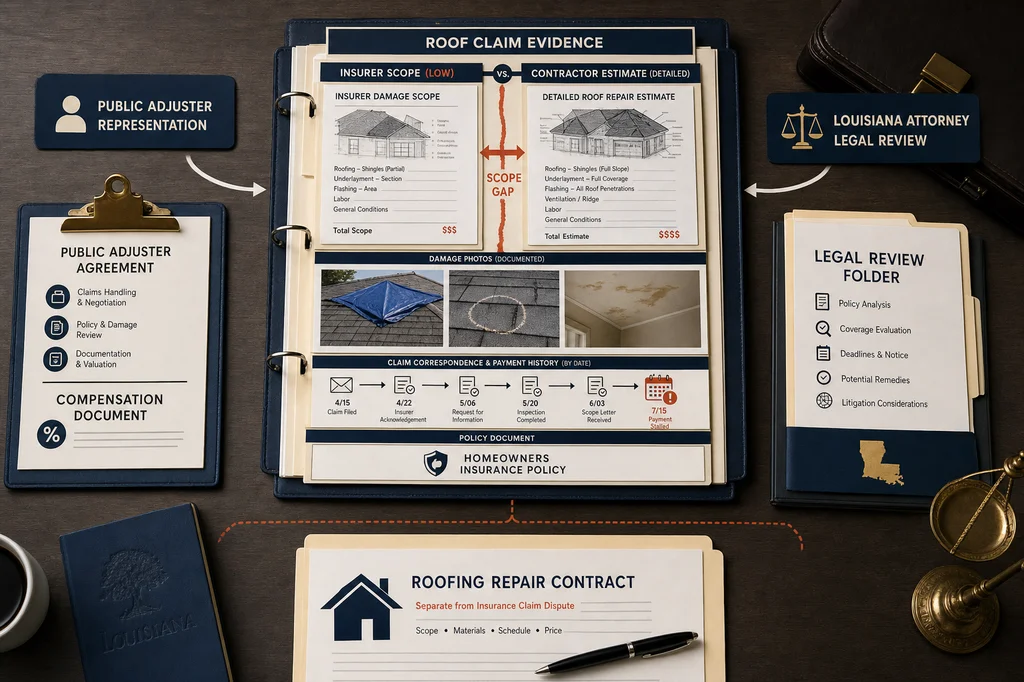
Louisiana roof-claim disputes can force a difficult choice when an insurer issues a low damage scope, delays payment, or maintains a denial. Start by building a clear claim record, then seek legal advice if direct advocacy has stopped producing progress or time limits may be approaching.
Build the claim file before escalating a roof dispute
A disagreement with an insurer is easier to evaluate when the damage, insurer communications, and repair needs are organized in one place. This does not guarantee a payment or change the coverage decision, but it gives you and any professional you hire a factual starting point.
The attorney interviewed in Lake Charles described a common breakdown: an insurer’s adjuster may prepare a scope far below what the homeowner believes the storm damage requires. In the example given, a home with alleged damage near $200,000 received a scope for roughly $30,000 to $40,000. A low scope is not, by itself, proof of improper handling. It is a reason to compare the insurer’s written scope with documented damage and a detailed repair estimate.
- Keep the insurer’s estimate and scope. It shows what was included, excluded, and priced.
- Save every claim letter, email, and payment record. Dates and written explanations can matter if the claim remains unresolved.
- Obtain a detailed contractor estimate. It should identify the roof work and related repairs needed, rather than provide only a lump-sum total.
- Document temporary conditions from the ground or inside the home. Photos of tarps, ceilings, walls, and stored belongings can help show the ongoing condition without putting you on the roof.
- Read the policy alongside the dispute. Separate dwelling, contents, and additional living expense issues may be handled differently under your policy.
The practical goal is to identify the exact gap: missing work, inadequate quantities, a coverage disagreement, delayed handling, or an unpaid portion of the loss. That is more useful than simply telling a new professional that the insurer’s offer feels too low.
When self-advocacy has reached its limit
Keep working directly with the carrier while you are still receiving meaningful responses and corrections. Consider a Louisiana attorney when the insurer’s position has become fixed, payments have stalled, or you need advice about preserving a potential legal claim.
The Lake Charles attorney’s view was that homeowners should push a claim as far as they reasonably can before retaining counsel, because litigation can take time. His stated objective was not quick payment but pursuing the largest justified recovery. That tradeoff matters if you need repairs completed and are deciding whether the likely delay of a legal dispute is worthwhile.
Do not rely on an old hurricane timeline or someone else’s claim deadline. Claim and lawsuit deadlines can depend on the policy, the date and type of loss, and current Louisiana law. If you are worried about a deadline, contact a Louisiana-licensed attorney promptly and verify the information with qualified counsel.
Why a Louisiana lawyer may be a different choice from a public adjuster
A public adjuster and a lawyer can both become involved in a property claim, but they do not necessarily offer the same tools. The attorney interviewed took a strong Louisiana-specific position: he generally would not recommend hiring a public adjuster first in Louisiana, while saying he would usually recommend one before a lawyer in Texas.
His reasoning was that Louisiana law may provide remedies involving late claim payments, penalties, and attorney fees under certain circumstances, while public adjusters do not pursue those remedies in the same way. He also stated that the key issue in a payment-delay dispute can be whether the insurer received satisfactory proof of loss. Those are legal questions, not rules to apply on your own. A Louisiana attorney can evaluate the current law, your policy, the insurer’s claim record, and whether the facts support further action.
The attorney also challenged arrangements in which a public adjuster charges an hourly rate but caps the fee at an amount resembling a percentage of the claim. That was his interpretation of Louisiana requirements, not a universal conclusion about every public-adjuster agreement. Before signing, read the fee terms closely and confirm licensing and compensation rules with an appropriate Louisiana regulator or an attorney.
Questions to resolve before hiring claim help
The right next step depends on what remains disputed and what the professional will actually do. Get clear answers before you sign a representation or fee agreement.
- What specific parts of the roof claim do you believe are missing or undervalued?
- Will you review my policy, insurer scope, correspondence, and contractor estimate before recommending a path?
- What will I owe under the written fee agreement, and how is that amount calculated?
- Could hiring you affect the pace of settlement or repairs?
- Do I need to take action soon to preserve any rights under my policy or Louisiana law?
Be wary of anyone who treats a large claim as automatic proof that more money is available. A professional should be able to explain the disputed line items and the next action, not just promise a larger result.
Keep the repair contract separate from the claim dispute
Insurance frustration can make a homeowner vulnerable to the wrong roofing contractor. Treat the repair agreement as its own decision, even if the contractor helped you identify damage or prepare an estimate.
After Hurricane Laura, the attorney reported that some clients had paid contractors $25,000 to $30,000 and never saw them again. He also described a later problem: reputable local contractors could be booked six months, seven months, or longer after a major storm. Long wait times do not justify signing an unclear contract or paying without understanding the work, payment schedule, and company identity.
Review the contractor’s written scope against the insurer’s scope, confirm licensing requirements with a qualified local professional, and make sure the agreement identifies who is responsible for each repair. Directorii lists verified contractors.
What a delayed payment may mean for your next move
A delayed payment may be a documentation problem, a coverage dispute, or a dispute over the amount owed. It is not possible to tell which from the payment delay alone.
The attorney described one case involving a $440,000 dwelling limit where the insurer eventually paid that full dwelling amount, but disputes remained over additional living expenses and contents. He said the matter later resolved for an additional $550,000. That outcome is one attorney-reported case, not a prediction for another homeowner. Its useful lesson is to review each coverage category rather than assuming a payment under one part of the policy resolves the entire claim.
Source: Louisiana: Public Adjusters vs Lawyers - Who's right for YOUR claim?
FAQ
Should I hire a public adjuster or a lawyer first for a Louisiana roof claim?
It depends on the specific dispute, but the Louisiana attorney interviewed recommended exhausting direct efforts with the insurer and then consulting a lawyer if progress stops. He viewed the Louisiana legal framework differently from Texas. Because your policy and facts control, have a Louisiana-licensed attorney assess the current rules before signing any agreement.
What should I do if my insurer's roof damage scope is much lower than my contractor's estimate?
Start by comparing the written scope and estimate line by line to identify missing work, quantities, or disputed repairs. Keep the insurer’s correspondence, payment records, policy, photos, and contractor documentation together. If the insurer will not explain or reconsider a material gap, legal advice may help you evaluate the next step.
Can a delayed roof-claim payment mean I need a lawyer?
A delayed payment can justify getting legal advice when your direct follow-up has stopped producing progress, especially if you are concerned about a deadline. It can also result from incomplete documentation or a coverage dispute. An attorney can review whether the insurer had sufficient information and what options may apply to your policy.
What records should I save before disputing a Louisiana insurance claim?
Save the policy, insurer scope, claim letters, emails, payment records, photos, and detailed contractor estimates. Organize them by date and coverage category where possible, including dwelling, contents, and additional living expenses. These records help identify the actual disagreement and give an attorney or other qualified professional a clearer file to review.
Should I sign a public adjuster agreement with an hourly fee capped at a percentage?
Do not sign until you understand exactly how the fee is calculated and whether the arrangement complies with current Louisiana requirements. The attorney interviewed questioned hourly agreements capped at an amount resembling a percentage-based fee. Verify the adjuster’s license and fee terms with an appropriate regulator or seek advice from a Louisiana attorney.
How can I avoid contractor problems while my roof claim is unresolved?
Keep the repair contract separate from the insurance dispute and insist on a detailed written scope, company information, and clear payment terms. The attorney reported cases in which homeowners paid large sums to contractors who did not return after Hurricane Laura. Verify qualifications and do not let a delayed claim force a rushed hiring decision.