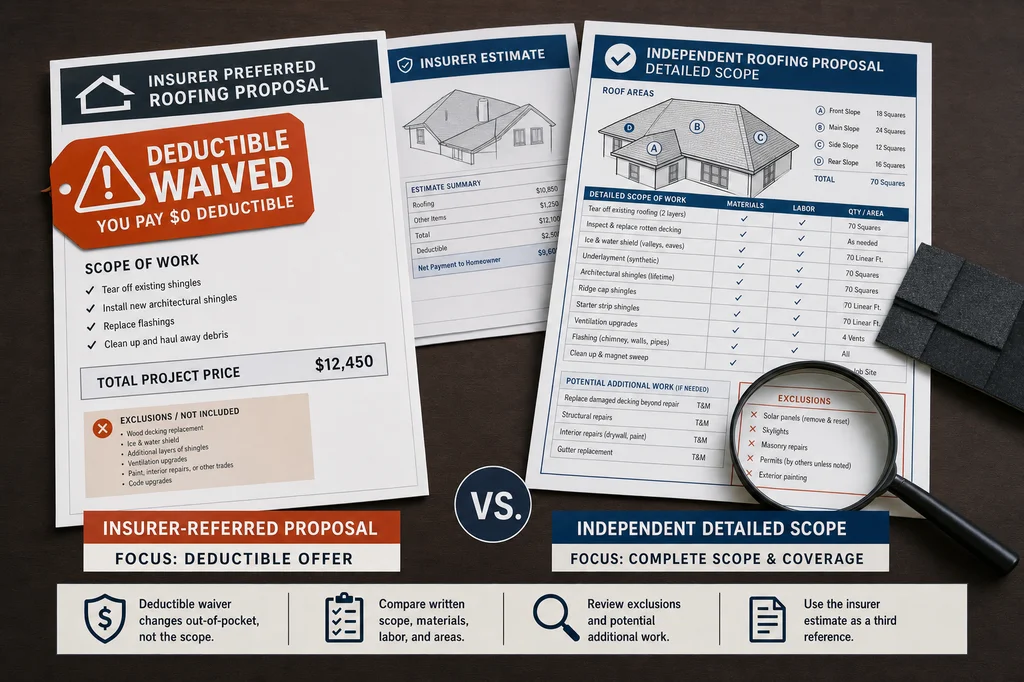
Trojan Horse Deductibles describe a troubling choice: an insurer offers a preferred roofer who can waive the deductible, while your chosen roofer cannot. The lower out-of-pocket offer may be appealing, but compare the written scope, materials, and the contractor’s independence before agreeing.
Why a waived deductible can change the contractor choice
A waived deductible can shift the decision away from roof quality and toward the immediate cost to you. The concern behind the “Trojan Horse” label is that an offer that appears to help the homeowner may also give the insurer’s chosen contractor a built-in advantage.
Deductible rules and referral arrangements can vary by location, policy, and contract. Do not assume that every referral or deductible offer works the same way, or that a deductible-related offer settles the question of what work the roof needs.
The practical issue is not simply whether one roofer charges less. A contractor referred directly to a job may have lower selling costs and more certainty about payment than a contractor that invested time estimating the work and working with you through the claim process. Those differences can affect the price a contractor is willing to accept.
How an insurer’s preferred roofer may affect roof scope
An insurer-referred roofer is not automatically a poor choice, but the referral can create a conflict when the roof scope is disputed. The contractor’s future referrals may depend on maintaining a relationship with the party directing work and paying for it.
The concern is that a contractor who depends on insurer referrals may be less likely to press for additional work, labor, or materials when the insurer’s estimate is incomplete. In insurance restoration, the most consequential disagreement may not be the total price. It may be whether the scope includes all work needed to complete the roof correctly.
That does not prove that a preferred contractor will do inferior work or refuse legitimate supplements. It means you should evaluate the proposal itself rather than treating a referral as proof that the scope is complete. A lower bid can reflect lower overhead, but it can also reflect fewer included items.
- Compare line items, not just totals. Check whether both scopes describe the same roof areas, labor, materials, and included work.
- Separate a deductible offer from the roof proposal. A waived deductible may change your immediate payment, but it does not tell you what work is included.
- Read exclusions closely. An exclusion may leave a needed item outside the contractor’s responsibility or subject to a later approval decision.
- Keep the insurer estimate and each contractor scope. You need documents that can be compared side by side if the scopes differ.
What to say before accepting the preferred-roofer offer
You do not need to accuse anyone of wrongdoing to get useful answers. Ask for the proposed work in writing and have the contractor explain where its scope differs from the insurer estimate or an independent bid.
Use direct, homeowner-focused questions such as:
- “Please show me exactly what is included in your price and what is excluded.”
- “Were you referred through an insurer program or another referral arrangement?”
- “If additional damage or necessary work is found, how will you document it and request approval?”
- “If the insurer does not approve additional work, what happens to that item under our contract?”
- “Does the deductible offer change any part of the work, materials, or payment terms?”
A clear answer should connect the promise to a written scope. Be cautious if the main selling point is that the roof is effectively free, while the contractor will not provide a detailed proposal or will not explain how scope disagreements are handled.
Get an independent scope before making the deductible decision
An independent written bid gives you a meaningful comparison point. It is especially useful when the insurer’s referral is presented as the fastest or least expensive path.
Choose a roofing contractor that can provide a written scope and explain any differences without promising a claim result. Review the insurer’s estimate, policy terms, and contract before authorizing work.
If the proposals differ, focus on the reason for each difference. Some differences may be legitimate judgment calls. Others may show that one scope does not address the same work. For coverage questions, confirm the policy interpretation with your insurer and consider guidance from a qualified insurance or legal professional when the dispute is significant.
Directorii lists verified contractors.
Do not let a deductible pitch replace a contract review
A deductible-related offer should be documented before you sign, not handled as a verbal assurance. Deductible arrangements may have consequences depending on the policy, contract, and location.
Review the contract for the full price, the scope of work, payment terms, change procedures, and any language about insurance proceeds or denied supplements. If the contractor says the insurer has already approved everything, compare that statement against the written estimate you received. If the proposed arrangement is unclear, pause and get clarification from your insurer, state insurance department, or qualified counsel.
Source: Trojan Horse Deductibles lesson from Roofing-school.com
FAQ
Should I accept an insurer-recommended roofer who says my deductible is waived?
Compare the contractor’s written scope with an independent proposal and review the contract before deciding. A waived deductible may reduce your immediate cost, but it does not establish that the scope, materials, or repair quality are equivalent. Deductible arrangements can vary by policy, contract, and location.
What does Trojan Horse Deductibles mean for a roofing claim?
It describes the concern that a deductible-related offer can appear beneficial while steering you toward an insurer-preferred contractor. The key homeowner risk is accepting a contractor without checking whether its written scope covers the same work as another qualified roofer’s proposal.
Can an insurer’s preferred roofer handle supplements after roof damage is found?
Ask the contractor how it documents and requests additional work before signing. A concern with referral-dependent contractors is that they may have less incentive to challenge an insurer’s scope. Get the contractor’s process and contract terms in writing.
What should I compare between an insurance estimate and a roofer’s bid?
Compare the actual included work, exclusions, materials, labor, and procedures for additional damage. Total price alone is not enough. A lower proposal may reflect lower selling costs, fewer included items, or both, so request clear explanations for meaningful differences.