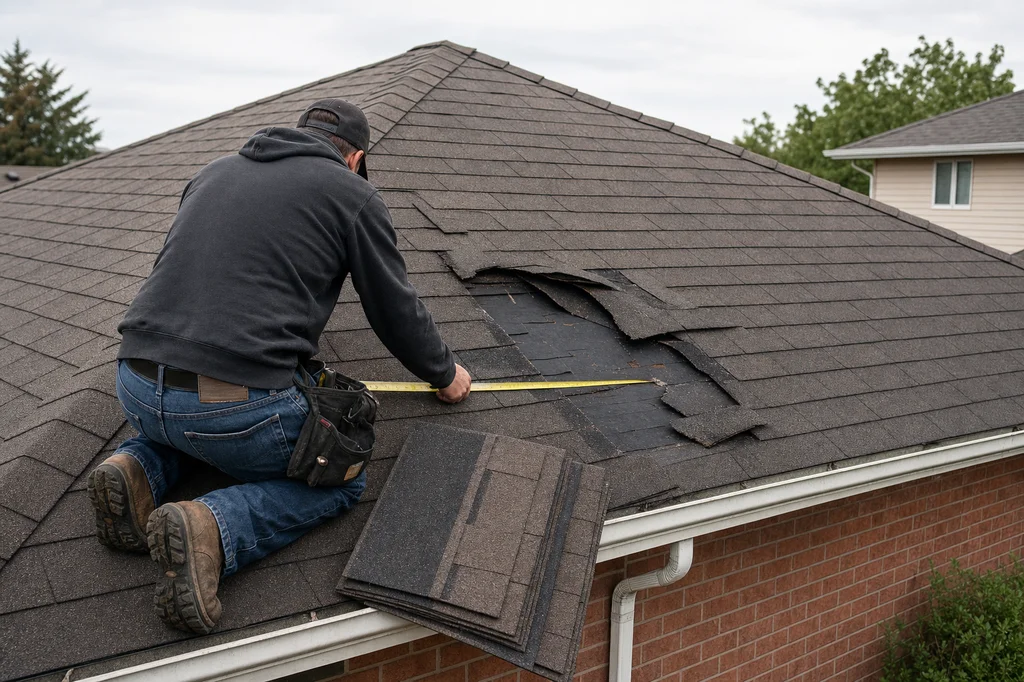
A roof insurance claim bid may cost more than a cash bid without either number being automatically wrong. The difference can come from the kind of job: a nearby homeowner paying directly is not the same business situation as a storm-related claim involving inspections, delayed payment, and uncertainty about what will be paid.
The key decision is not whether an insurance estimate is higher than a cash price. It is whether the lower price pays for the same quality work—and whether the contract and final invoice accurately reflect the work actually performed.
Checklist: why claim work can carry a higher price
- Direct payment versus payment risk: On a local cash job, the contractor may deal directly with the decision-maker and expect payment promptly. Claim work can carry a risk of delayed payment, lower payment, or no payment.
- Repeated inspections and documentation: A claim job may require multiple inspections and proof of particular damage. That takes time and can add cost.
- Storm travel and remote staging: After a catastrophe, a contractor working away from its home area may have travel, hotel, staging, and return-trip costs.
- Different scope or quality: A low cash bid may be lower because it includes less work or a lower-quality job. A total alone does not establish that two proposals are comparable.
That is why a contractor may have different pricing for a local direct-pay project and a catastrophe or insurance-related project. The important question is what each written proposal commits the contractor to do.
Do not use one price for the job and another for the invoice
If you agree to a lower-priced job, the invoice should not be increased afterward simply to obtain a larger insurance payment. A larger invoice than the agreed work can create an insurance-fraud concern.
Keep one accurate paper trail: the contract, documented changes, payment records, and final invoice should match the work performed. If you have questions about claim payment or policy requirements, confirm them with your insurer and, when needed, counsel or a licensed professional.
Give the insurer a clear estimate early
An early contractor estimate can give the insurer a clearer picture of the expected cost. In the claim practice described here, an adjuster may set a reserve when first evaluating a potential roof replacement. If the initial reserve is too low, later pricing may be harder to accommodate.
This is a possible claim-processing consideration, not a universal insurer rule. An insurer can still evaluate the damage, cause of loss, scope, and policy terms independently. An early estimate does not guarantee approval, payment, timing, or acceptance of a contractor's price.
Still, withholding a legitimate estimate because it might appear high can leave the initial cost picture incomplete. Ask for a proposal that states the work the contractor is prepared to perform, then provide consistent documentation during the claim process.
Make the cash-versus-claim decision specific
Before choosing a lower cash price, ask one focused question: does the lower price reflect less work or quality, or does it reflect the lower burden of a local direct-pay job? Require one accurate contract and a final invoice for the work actually performed. That comparison is more useful than trying to make a contractor's invoice match an insurance number.
Directorii lists verified contractors.
Source: Why Roofing contractors charge more for insurance claims than cash jobs?
FAQ
Why can a roof insurance claim bid be higher than a cash bid?
Claim work may involve payment-delay risk, uncertainty about payment, repeated inspections, damage documentation, and, after a storm, travel, remote staging, hotel, and return-trip costs. The higher bid may also cover more work or a different quality level.
Can I take a lower cash roofing price after receiving an insurance estimate?
A lower price is not automatically a problem, but compare what the contractor will actually do. The lower number may reflect a reduced scope or quality, or it may reflect the lower burden of a direct-pay local job. Keep the contract and final invoice accurate to the work performed.
Why should I not ask for a higher invoice than my contract price?
An invoice that is higher than the agreed job price in order to obtain more insurance money can create an insurance-fraud concern. Use a contract, documented changes, and final invoice that consistently describe the actual work and charges.
Should a roofing estimate be provided early in a claim?
An early estimate may give the insurer a more complete expected cost picture. In some claim processes, an initial reserve may be set during early evaluation, and a low initial figure can make later pricing harder to accommodate. This does not require claim approval or acceptance of the contractor's price.