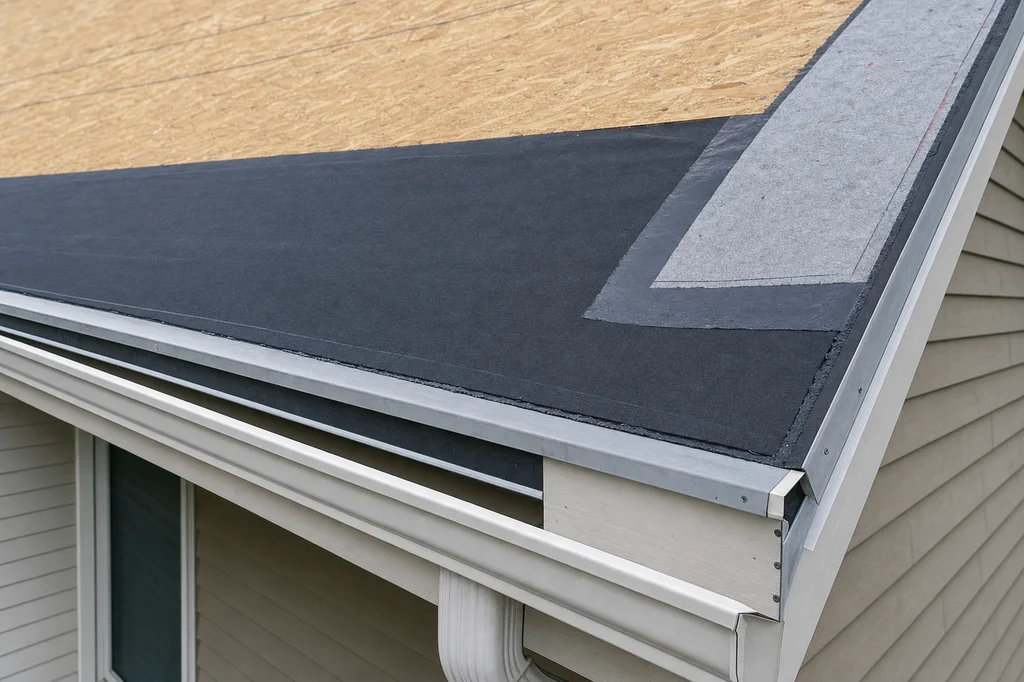
Drip edge or ice-and-water shield first? The answer depends on where it is installed and on the roof system your contractor is using. The eave and rake-edge sequence should account for local code, ice-dam conditions, drainage, and the selected manufacturer’s written instructions—not a one-size-fits-all habit.
Why eaves and rake edges may use different sequences
Drip edge and ice-and-water barrier do different jobs, so their order affects how water is directed at the roof perimeter. Drip edge helps move water away from the roof edge, fascia, soffit, and gutter area; the self-adhering barrier sticks to the deck and provides backup protection where water can back up.
Asphalt shingles shed water but are not intended to function as a submerged waterproof layer. Wind-driven water, heavy rain, or ice backing up at an eave can reach beneath shingles. That is why the details below the shingle layer matter as much as the visible roofing surface.
The sequence may also change by roof edge. One approach places drip edge first and the ice-and-water barrier over it at eaves, while using underlayment first and drip edge second at rake edges. The point for a homeowner is not to demand one sequence everywhere. It is to make sure the proposed edge detail has a clear reason and matches the applicable requirements.
Ice dams are the key failure mode at the eave
In snowy climates, ice can form in gutters and cause water to back up toward the roof. One eave detail places the self-adhering barrier first, extending it toward or over the fascia, then installs gutter apron or drip edge over it. The reasoning is that water getting behind the metal would still land on the barrier rather than directly on the roof deck.
Another system-specific approach uses an additional strip of ice-and-water barrier at the edge and brings Titanium underlayment down over the drip edge as added drainage protection. This shows why a bid should identify every layer at the eave instead of merely saying “new drip edge” or “ice and water.”
Local requirements can call for a different sequence than a contractor’s preferred method. Confirm the requirement with the local building department or a roofing professional rather than relying on a verbal claim about code.
What manufacturer instructions can change
The roofing product instructions can be as important as climate. Manufacturers do not always present the same edge-detail options, particularly when the roof uses a specific branded barrier, underlayment, starter, or shingle system.
CertainTeed instructions state that higher pieces of drip edge should overlap lower pieces at the rake. They also allow drip edge to be installed under or over WinterGuard at the rake; when the drip edge is installed over WinterGuard, the WinterGuard must cover the top of the rake board. That is a useful example of why “always under” and “always over” are incomplete answers.
Some contractors use a layered, or “sandwich,” detail: a membrane or tape below the metal and another strip above it. This approach uses more material and must still fit the manufacturer’s system instructions and local rules. Do not approve an added layer simply because it sounds more protective. Have the contractor identify the exact products and show that the layers are compatible.
Checklist for reviewing the roof-edge plan
You should be able to see the perimeter sequence on the written scope or in a simple detail drawing before shingles cover it. A contractor who understands the assembly can explain it plainly and consistently.
- Separate the eave from the rake. These edges may have different drainage and code details.
- Name the membrane. Confirm whether the scope calls for an ice-and-water barrier, where it begins and ends, and whether any additional strip is planned.
- Name the metal. The estimate should distinguish drip edge or gutter apron from other edge-metal components.
- Check the fascia and gutter relationship. Improper fastening or a flattened gutter apron can create a bulge that may direct water behind the fascia or gutter.
- Match the detail to the climate. If your area sees snow, ice dams, or strong wind-driven rain, the contractor should explain how the edge design addresses that exposure.
- Match the detail to the system instructions. Request the installation instructions for the selected roofing products, not a generic statement about what “manufacturers” prefer.
- Confirm local approval needs. If a permit or inspection applies, verify the accepted detail before installation starts.
What a clear roofer answer sounds like
A useful answer identifies the edge, the materials, and the reason for the sequence. “We always do it this way” is not enough when local conditions and product instructions can point to different assemblies.
Ask for a brief written answer to these project-specific points:
- At the eaves, which layer will be against the roof deck, and where will the drip edge sit?
- At the rake edges, will the sequence differ from the eaves?
- Which local code requirement or inspection detail applies to this address?
- Which manufacturer instructions govern the selected barrier, underlayment, and shingles?
- How will the gutter apron, fascia, and gutter installation avoid water getting behind the edge metal?
If a contractor cannot describe the planned layers or provides an answer that conflicts with the written scope, pause before signing. The roof edge is hard to evaluate after installation, and correcting concealed perimeter details can become expensive. Directorii lists verified contractors.
Get the edge detail settled before installation day
The best choice is the documented assembly that fits your roof edge, climate, local requirements, and product instructions. A contractor may have a strong preference based on local repair work, but preferences should not replace an approved and compatible roofing-system detail.
Keep the final scope, product names, and any approved edge detail with your project records. If conditions change after tear-off—such as damaged fascia or a gutter issue—get the revised approach documented before the roof is covered.
Source: The Big Roofing Debate: Drip edge or Underlayment first?
FAQ
Should ice-and-water shield go under drip edge at the eaves?
It may, especially where a contractor is designing for ice backing up at the gutter, but it is not a universal sequence. Local code, the selected roofing system’s instructions, and the roof’s snow and drainage conditions can require or support a different detail. Get the proposed eave assembly in writing before work begins.
Can drip edge go over ice-and-water shield?
Yes, some roof-edge details place drip edge over the self-adhering barrier. CertainTeed instructions allow either placement at rake edges for WinterGuard, with a specific condition when drip edge goes over it. Your contractor should follow the instructions for the actual products selected for your roof.
Why would eaves and rake edges have different roofing details?
Eaves and rake edges handle water differently, so the same sequence may not be used on both. The eave connects to the gutter and can face ice backup, while rake-edge details also need to manage overlapping metal and wind-driven water. A written perimeter plan should distinguish the two locations.
What should I ask a roofer about drip edge and gutter apron?
Ask which edge metal will be installed, where it sits relative to the ice-and-water barrier, and how it will connect with the fascia and gutters. Also ask how it will be fastened. A flattened gutter apron and fastening into a void near the fascia can create drainage problems.
Should I choose a contractor who uses a layered membrane-and-drip-edge detail?
Choose it only if the contractor can show why that detail suits your climate, roof edge, local requirements, and selected products. Some roofers use a membrane below and above the metal for added protection against ice dams or wind-driven rain. More material alone does not prove the assembly is appropriate or compatible.