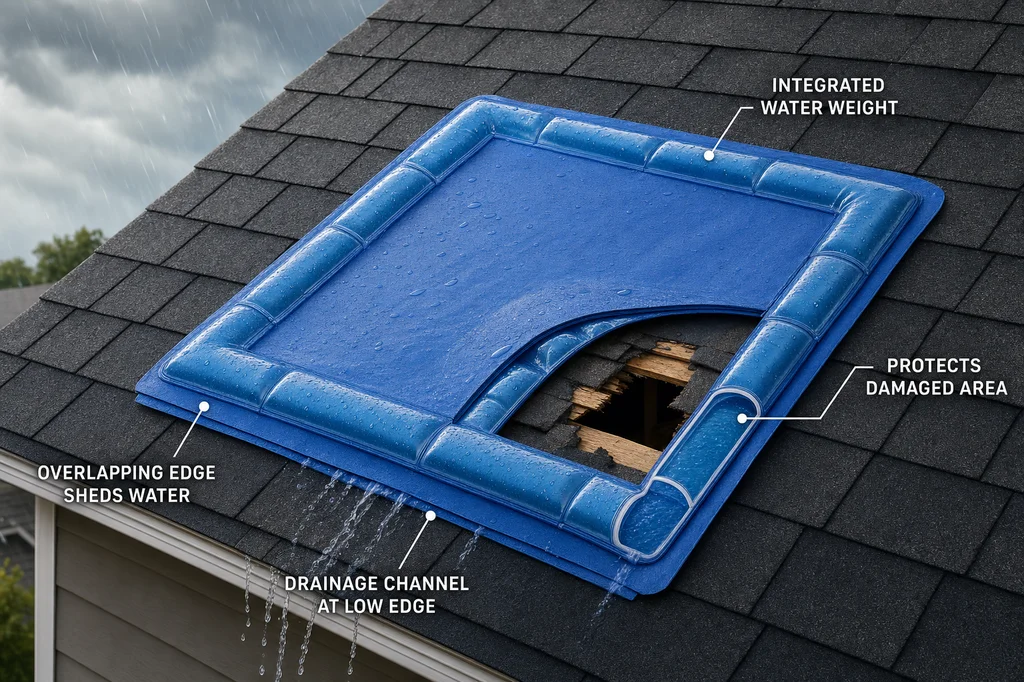
Hurri Tarp is a water-weighted temporary roof cover designed for damaged areas after wind, debris, or rain events. Its self-contained ballast may reduce the need for bricks or sandbags, but homeowners should treat it as an emerging prototype product and confirm whether it fits the actual damage, weather, and mitigation plan.
What makes Hurri Tarp different from a standard emergency tarp?
Hurri Tarp is intended to hold water in integrated chambers that weigh the cover down rather than relying primarily on loose ballast. The stated goal is to cover a damaged roof area while limiting extra materials and repeated movement across the roof.
The inventor described the concept as useful after shingles or tiles blow off, wind-driven rain enters a roof system, or debris such as a fallen tree creates an opening. The product was also presented as a possible pre-storm protective measure. That does not mean it can prevent every type of storm damage or replace repairs after a loss. A temporary cover addresses water intrusion; it does not restore damaged shingles, decking, flashing, or structural components.
For a homeowner, the practical appeal is straightforward: a mitigation contractor may be able to place a weighted cover over a localized opening without hauling separate blocks, bricks, or sandbags onto the roof. Fewer materials can mean a simpler temporary setup, especially where fragile tile or steep roof surfaces make unnecessary foot traffic a concern.
Hurri Tarp remains a prototype, not a proven insurance standard
The key limitation is that Hurri Tarp was still being tested and developed, with no sales system or broad field rollout described. The inventor had reached a sixth prototype and had not yet sold units through Whitney Roofing.
One unit was reportedly left on a personal roof through spring and summer storms in Illinois for about five to six months without moving. That is a field observation from the inventor, not a manufacturer warranty, independent test result, or guarantee that the cover will perform the same way on your roof.
The product was described as a 10-by-10 unit with a possible target cost of roughly $80 to $90 per unit at that stage. Larger 20-by-20 versions and overlapping smaller units were also discussed. Those figures and configurations were part of a developing product plan, so do not assume current availability, pricing, sizes, or performance without written confirmation from the supplier or mitigation company.
Its patent was described as pending, and the name as trademarked. Those details do not establish that an insurer will accept the product or reimburse its use on a particular claim.
What water weighting may solve—and what it does not
Water ballast may help hold a temporary cover in place without puncturing the roof in some applications. That can be useful where a contractor is trying to keep the temporary work focused on a small damaged section rather than wrapping an entire house.
However, a water-weighted cover is not automatically the right response for every loss. The inventor estimated a filled unit at around 200 pounds. That weight, the roof slope, the roof material, the size and location of the opening, drainage paths, and the condition of the underlying structure all matter. A roofing or mitigation contractor should determine whether a temporary cover can be safely supported and positioned.
- Localized openings: A cover may be suited to a defined damaged area rather than widespread roof failure.
- Roof condition: Missing materials are one issue; soft, broken, or structurally compromised decking can require a different response.
- Weather exposure: The need for immediate water control can be urgent, but the temporary method still has to suit expected wind, rain, and temperature.
- Access and safety: A product that reduces extra trips may be helpful, but roof access remains hazardous and should be handled by a contractor.
Cold-weather performance needs specific confirmation
Earlier Hurri Tarp prototypes reportedly became brittle in cold conditions, and freeze-thaw conditions cracked welds. The inventor said a different PVC material with better cold-temperature tolerance was being considered or used to address that issue.
That is a meaningful development note for homeowners in cold climates. It is not proof that every available unit is suitable for freezing weather. If storm damage occurs during cold conditions, ask the mitigation company which version it plans to use, whether the material is intended for the forecast temperatures, and what backup plan it has if the cover cannot remain watertight.
Also confirm how the contractor will monitor the temporary protection after installation. A tarp that shifts, tears, pools water incorrectly, or allows water under an edge can worsen interior damage. You should receive a clear plan for documenting the original damage, the temporary work, and the next step toward permanent repair.
What to confirm before approving a Hurri Tarp installation
Do not approve a novel temporary cover based only on the promise of fewer fasteners or less labor. Get a written explanation of the damage being addressed and the limits of the temporary work.
- What exact opening will it cover? The contractor should identify the damaged area and explain why this size of cover is appropriate.
- Will any fastening be used? Hurri Tarp was presented as self-weighted in some placements, but a mid-roof application was also described as potentially requiring placement beneath shingles and nailing. Have the contractor state where any fasteners would go and how that work will be repaired later.
- How will water drain? The cover was described as having a channel intended to let water escape if water gets underneath. Ask how drainage will work on your roof layout.
- Is this a temporary mitigation measure only? Confirm the planned date or trigger for inspection and permanent repair. A temporary cover should not become an undefined substitute for roof restoration.
- Will the work be documented for the claim? Ask for photos of the damage before covering it, photos after installation, and an itemized invoice. Coverage and reimbursement can depend on your policy and the insurer’s evaluation.
A mitigation contractor should be able to explain why a localized cover is sufficient or why broader protection is necessary. If the scope seems larger than the visible damage, seek another professional assessment. Directorii lists verified contractors.
Do not assume insurers will treat every temporary cover the same
Hurri Tarp was presented as a way insurers might eventually standardize some temporary mitigation work and avoid broader shrink-wrap systems for small damaged areas. That is a proposed use case, not an established claims rule.
Your insurer may want to inspect or photograph the damage. The inventor suggested that a water-weighted cover could be slid aside and repositioned for that purpose, but whether that is feasible depends on the roof, damage, and installation. Do not move, remove, or reinstall a roof cover yourself. Coordinate access with the mitigation contractor and insurer, and keep records of all communications and emergency work.
Source: Hurri Tarp emergency roof cover presentation
FAQ
What is a Hurri Tarp used for after storm damage?
Hurri Tarp is intended as a temporary cover for roof openings caused by wind, blown-off shingles or tiles, falling debris, and rain exposure. Its water-filled chambers are meant to provide ballast. It is not a permanent repair and does not fix damaged decking, flashing, shingles, or structural issues.
Can a Hurri Tarp be used before a hurricane or windstorm?
It was presented as a product that could potentially be installed before a storm, but that does not establish that it will prevent damage or suit every roof. A roofing contractor should evaluate the roof material, slope, existing condition, expected weather, and whether temporary protection is appropriate.
Is Hurri Tarp a proven replacement for a regular tarp?
No, it should not be treated as a proven universal replacement. The product was described as a prototype under development, with limited reported field use and no broad sales rollout at that time. Confirm the current product version, instructions, availability, and suitability for your specific roof before authorizing installation.
How heavy is a water-weighted Hurri Tarp?
A filled unit was estimated at around 200 pounds. That weight may help resist movement, but it also makes roof condition and placement critical. A contractor should assess whether the damaged area and supporting roof components can safely accommodate a temporary weighted cover.
Should I use Hurri Tarp in freezing weather?
Use caution and get product-specific confirmation before using it in freezing weather. Earlier prototypes reportedly became brittle and developed cracked welds after freeze-thaw exposure. A revised PVC material was discussed, but homeowners should verify the actual material, temperature limitations, and contingency plan with the mitigation contractor.
Will my insurance company pay for a Hurri Tarp?
Coverage is not automatic and can depend on your policy, the storm damage, the insurer’s inspection, and the documented need for temporary mitigation. Ask the contractor for an itemized scope and photos, notify your insurer promptly, and confirm how the insurer wants the damage and emergency work documented.